


Featured Summary:
- Starlink Africa is changing the telecom debate as major operators move from resistance toward partnership.
- Internet providers are learning that satellite connectivity can fill coverage gaps where towers and fibre remain too expensive.
- SpaceX Starlink is not replacing telecom infrastructure overnight, but it is changing where operators must invest and collaborate.
- LEO satellites are becoming essential for rural connectivity because Africa’s usage gap remains too large for terrestrial networks alone.
Africa’s telecom operators are learning that fighting Starlink is not a strategy.
The stronger move is to decide where satellite internet fits inside the network they already control.
For years, traditional internet providers could treat satellite broadband as a side threat: useful for remote users, but too expensive or too limited to change the industry’s centre of gravity.
That view is breaking down.
Airtel Africa’s SpaceX partnership, Vodacom’s Starlink collaboration, and successful Starlink Mobile testing in Kenya show a market moving from opposition to integration.
Starlink Africa is no longer just a licensing fight or a consumer broadband story.
It is becoming a test of whether Africa’s telcos can use satellite reach to solve the coverage problem their towers and fibre have not solved alone.
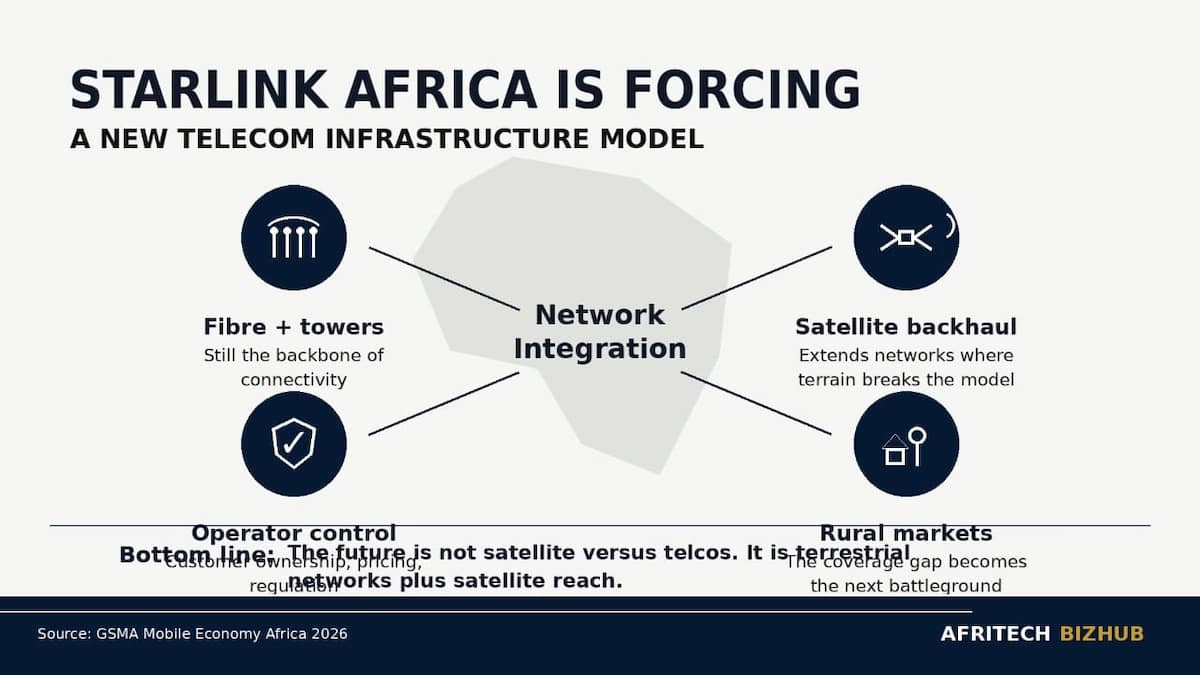
Why Is Starlink Africa Winning Over Major Telecom Operators?
Starlink Africa is winning over major telecom operators because the old coverage model has reached its limits in too many places.
Towers, fibre, microwave links and base stations remain the backbone of connectivity, but they do not reach every village, road, school, clinic, farm, mine or border community at a cost operators can justify.
The hardest markets are usually the ones that need connectivity most: low-density, remote, difficult to power and expensive to maintain. That is where the business logic has shifted.
Airtel Africa and SpaceX are working on Starlink Direct-to-Cell connectivity across Airtel’s 14 markets, while Vodacom has also moved into a Starlink collaboration.
These are not small signals. They show that the argument is no longer only whether Starlink competes with operators.
The sharper question is how operators use Starlink Africa to extend coverage without carrying the full cost of terrestrial expansion alone.
Can SpaceX Starlink Replace Traditional Internet Providers?
SpaceX Starlink can challenge traditional internet providers, but it is not replacing them across Africa in one sweep.
Telecom operators still own customer relationships, spectrum licences, mobile money ecosystems, towers, fibre routes, retail distribution, local regulatory experience and billing systems.
Those advantages matter. Most users still connect through mobile networks, not satellite terminals.
The real threat is more subtle. SpaceX Starlink changes customer expectations in places where traditional providers have underdelivered.
If a remote school, business, farm, lodge or community can access high-speed satellite internet before fibre arrives, the market stops waiting patiently for the old model.
That pressure forces internet providers to rethink coverage, pricing, enterprise services, rural backhaul and customer experience.
Starlink does not need to replace every operator to change the competitive rules.
It only needs to prove that dead zones are no longer inevitable.
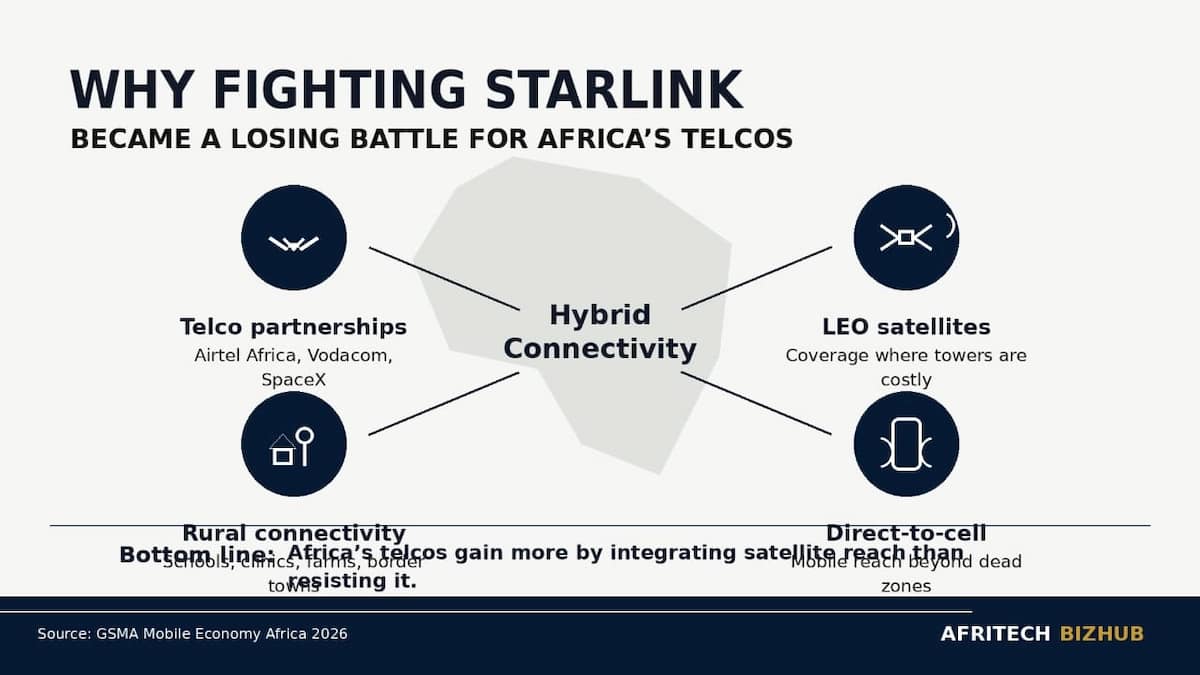
How Are Telecom Infrastructure Investments Changing After Starlink?
Telecom infrastructure investments are moving toward hybrid networks.
Operators still need fibre, towers, data centres, power systems, spectrum and 4G or 5G upgrades, but they are also adding satellite partnerships to cover the edges of their networks.
Airtel’s 2025 agreement with SpaceX included high-speed Starlink connectivity for customers, enterprise users, schools, health centres and rural communities, as well as exploration of cellular backhauling.
That points to a new investment logic: satellites do not replace the network; they extend where the network can go.
The change is already visible in how operators talk about infrastructure.
Airtel Africa and Vodacom signed a separate infrastructure-sharing agreement in 2025 focused on fibre and tower assets in key markets such as Mozambique, Tanzania and the DRC.
That matters because Africa’s connectivity problem will not be solved by one technology.
The next phase is fibre where demand is dense, towers where mobile economics work, satellite where geography breaks the model, and partnerships where cost makes solo expansion too slow.
Starlink Africa is forcing operators to build around reality, not around old boundaries.
Why Are LEO Satellites Becoming Essential for Rural Connectivity?
GSMA’s latest Africa connectivity data gives this shift its institutional weight.
The association’s 2026 Africa report says almost 1 billion people on the continent still do not use mobile internet, representing 63% of the population.
That number changes the argument. The issue is not whether mobile operators have built large networks; they have.
The issue is whether the remaining gaps can be closed quickly enough using only the same infrastructure model.
GSMA’s direct-to-device satellite guidance also points to the next layer of connectivity.
It says D2D satellite services can connect mobile handsets directly to satellites, supplement terrestrial mobile networks, and improve network resilience if regulation protects terrestrial networks from harmful interference.
That is why LEO satellites matter for rural connectivity.
They can reach places where towers are uneconomic, fibre is delayed, or terrain makes rollout difficult. The opportunity is not satellite replacing mobile networks.
It is satellite becoming part of the coverage layer that keeps users connected when terrestrial infrastructure stops.
Will Internet Providers Benefit More From Partnering With Starlink?
Internet providers gain more leverage by turning Starlink into network capacity than by pretending satellite broadband will stay outside the market.
The operators that partner early can use satellite capacity to extend coverage, improve rural service, support enterprise customers, strengthen disaster resilience and offer connectivity in places where their terrestrial networks are weak.
That gives them a way to defend relevance instead of watching satellite providers build direct relationships with underserved users.
The risk is that partnerships could also shift power toward SpaceX.
If Starlink becomes the default solution for hard-to-reach markets, operators may depend on an external satellite network for part of their coverage story.
That is why the strongest telcos will not simply hand over the rural connectivity problem.
They will integrate SpaceX Starlink into a broader telecom infrastructure strategy that still protects local networks, customer ownership, pricing power and regulatory control.
The lesson is clear without needing to overstate it: Africa’s telcos are not losing because Starlink exists. They are losing only if they refuse to adapt.


Recent Comments