


Featured Summary:
- Capital Allocation is shifting toward government finance as business finance continues to lag across much of Africa
- Financial infrastructure is making sovereign finance more efficient, while many productive businesses still struggle to access capital at the same pace
- African institutions are promoting domestic capital mobilisation even as new financial links expand international access to African government securities
- Africa’s next financial breakthrough will depend not only on raising capital, but on moving more of it into the businesses that drive production, exports, and job creation
Africa’s financial institutions have spent the past year making a stronger case for financing the continent from within.
The African Development Bank has called for greater mobilisation of Africa’s pension funds, insurance assets, and domestic savings, while institutions such as Afreximbank continue raising billions to strengthen trade, infrastructure, and industrial development.
At the same time, new financial infrastructure is making it easier for international investors to access African government securities, expanding another route through which governments can raise capital.
These developments point to a larger question. Africa is becoming more connected to global capital markets while working to mobilise more of its own capital at home.
Yet the businesses expected to manufacture, export, innovate, and create jobs continue describing finance as one of their biggest constraints.
The debate is no longer only about whether Africa can raise capital. It is increasingly about whether Capital Allocation is moving with the same urgency toward productive businesses as it is toward government finance.
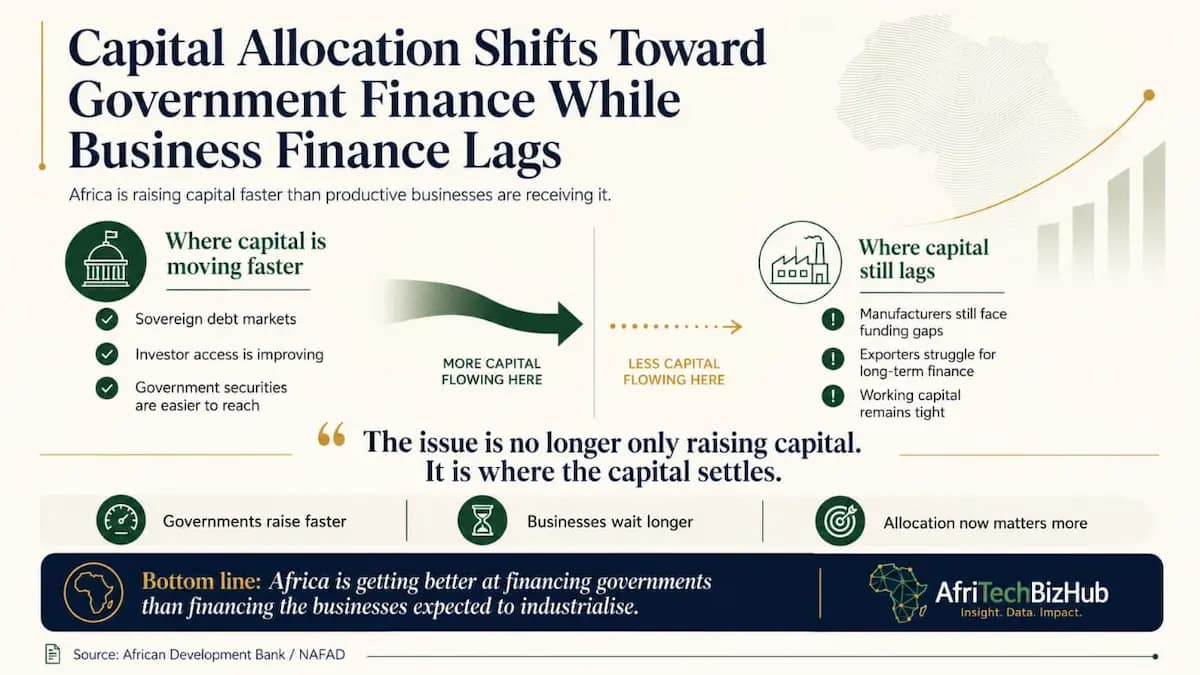
Government Finance Is Becoming Easier Than Business Finance
Africa’s financial system is removing barriers where governments raise money faster than where businesses do.
New settlement links, broader investor access, and stronger sovereign debt-market infrastructure are making government securities easier to reach for institutional investors.
Clearstream’s decision to connect international investors more directly to Kenya’s government securities reflects that wider shift.
The continent is becoming more efficient at moving capital into government finance than into the productive economy.
The same momentum is harder to find where businesses raise capital.
African entrepreneurs, manufacturers, exporters, technology firms, and growing businesses continue identifying access to finance as one of their biggest constraints to expansion.
Venture funding remains selective, commercial lending is often difficult to secure, and working-capital shortages continue limiting growth long after businesses have proven demand for their products and services.
The imbalance is becoming harder to ignore. Africa is accelerating the movement of capital into government finance while the businesses expected to industrialise the continent still spend far more time searching for capital than deploying it.
Capital Is Expanding. Allocation Is Becoming the Bigger Challenge.
Africa is attracting more capital than it did a decade ago.
Development finance institutions are raising larger facilities, sovereign debt markets are drawing broader investor participation, and global capital continues finding new routes into African finance.
The shortage is becoming less about money entering the continent and more about where that money ultimately settles.
Capital Allocation is beginning to separate financial activity from economic transformation.
Capital flowing into governments can strengthen public finance, but factories expand only when manufacturers invest, exports grow only when producers scale, and employment rises only when businesses have the confidence to deploy long-term capital.
Africa’s productive economy cannot industrialise at the speed policymakers expect if the movement of capital remains faster than its movement into production.
The continent’s next competitive advantage may depend less on attracting another billion dollars than on ensuring more of the capital already available reaches the businesses that turn investment into output.
Africa’s Productive Economy Still Struggles to Attract Capital
The sectors expected to transform African economies are not necessarily the sectors attracting the fastest flow of capital.
Manufacturing remains underfinanced despite repeated industrialisation agendas.
Agribusinesses continue searching for long-term investment to expand processing capacity.
Technology firms compete for a limited pool of growth capital, while exporters and logistics businesses often rely on expensive short-term financing to support expansion.
These industries sit at the centre of Africa’s economic ambitions, yet access to patient capital remains uneven.
That imbalance extends beyond individual businesses. Every factory that delays expansion slows local production.
Every processor unable to finance new equipment exports fewer value-added goods. Every logistics company constrained by working capital moves fewer products across borders.
Africa’s productive economy cannot industrialise through policy alone.
It also requires a financial system that moves capital into the sectors expected to build the continent’s next stage of growth.
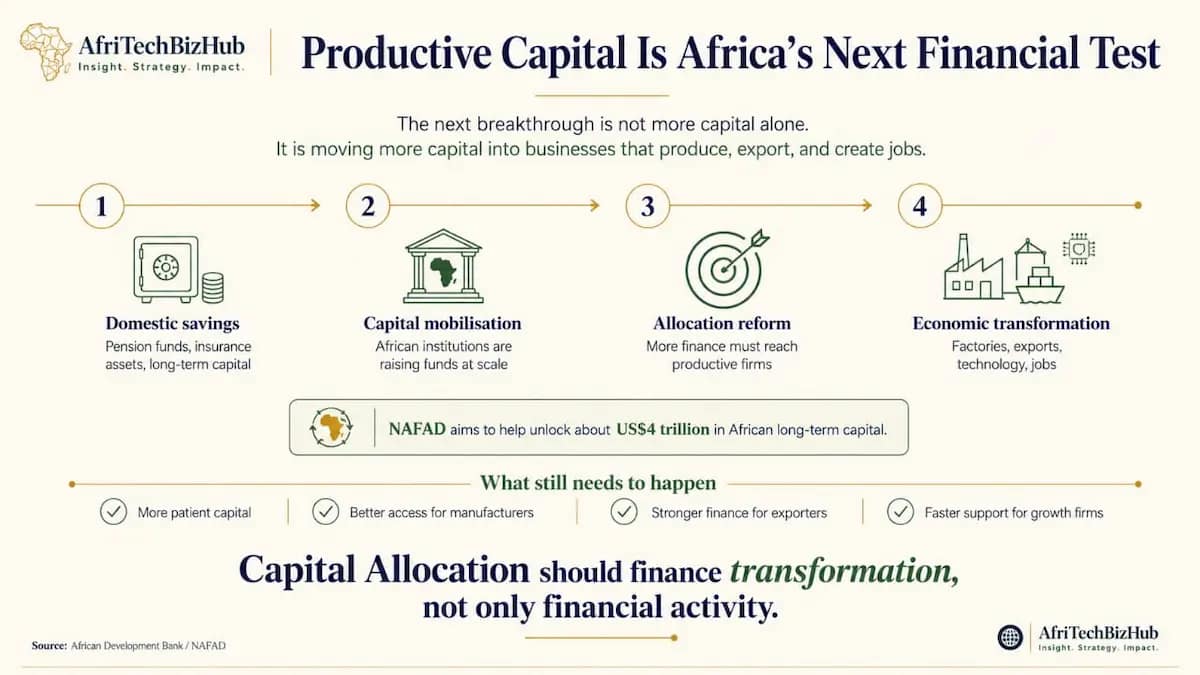
Africa Wants to Finance Itself From Within. Capital Is Still Taking a Different Route.
At its May 2026 Annual Meetings, the African Development Bank placed domestic capital mobilisation at the centre of Africa’s development strategy.
Through the New African Financial Architecture for Development (NAFAD), the Bank is working to unlock an estimated US$4 trillion held in African pension funds, insurance assets, sovereign wealth funds, and other long-term savings.
Afreximbank and the Africa Finance Corporation are pursuing the same objective by expanding African-led financing for trade, infrastructure, and industrial development.
Together, these initiatives reflect a broader shift in Capital Allocation: financing Africa with African capital rather than relying predominantly on external funding.
Recent market developments tell another part of the story.
International investors are gaining easier access to African government securities through stronger sovereign market infrastructure, while productive businesses continue describing long-term finance as one of their biggest obstacles to expansion.
The ambition to mobilise African capital is becoming increasingly visible.
The next milestone is ensuring that the same Capital Allocation reaches manufacturers, exporters, processors, technology companies, and other productive sectors with comparable scale and efficiency.
Capital Allocation Is Africa’s Next Financial Reform
Africa is unlikely to solve its development challenge by raising capital alone.
The continent is already building stronger financial institutions, attracting broader investor participation, and expanding access to global capital markets.
The harder task is directing more of that capital into the businesses that produce goods, process raw materials, develop technology, strengthen exports, and create employment.
That is where long-term economic strength is built.
The next chapter of African finance will be defined less by larger funding announcements and more by stronger productive businesses.
Governments will continue raising capital. Financial institutions will continue expanding markets.
The bigger signal will be whether manufacturers build more factories, processors add more value before export, technology companies scale beyond local markets, and private enterprises compete for investment instead of competing for survival.
Capital Allocation will ultimately determine whether Africa finances economic activity or economic transformation.


Recent Comments