

Featured Summary:
- African markets are attracting Russian geological interest as oil, gas, uranium, and energy-linked minerals become more strategic.
- Zarubezhgeologia’s influence sits before the mine: in mapping, geological data, resource assessment, and project preparation.
- Russia Africa cooperation now reaches into mining intelligence, energy planning, technical training, and the early knowledge behind resource investment.
- Africa’s mineral future will depend on how firmly governments control data, licensing, processing, local value chains, and strategic resource policy.
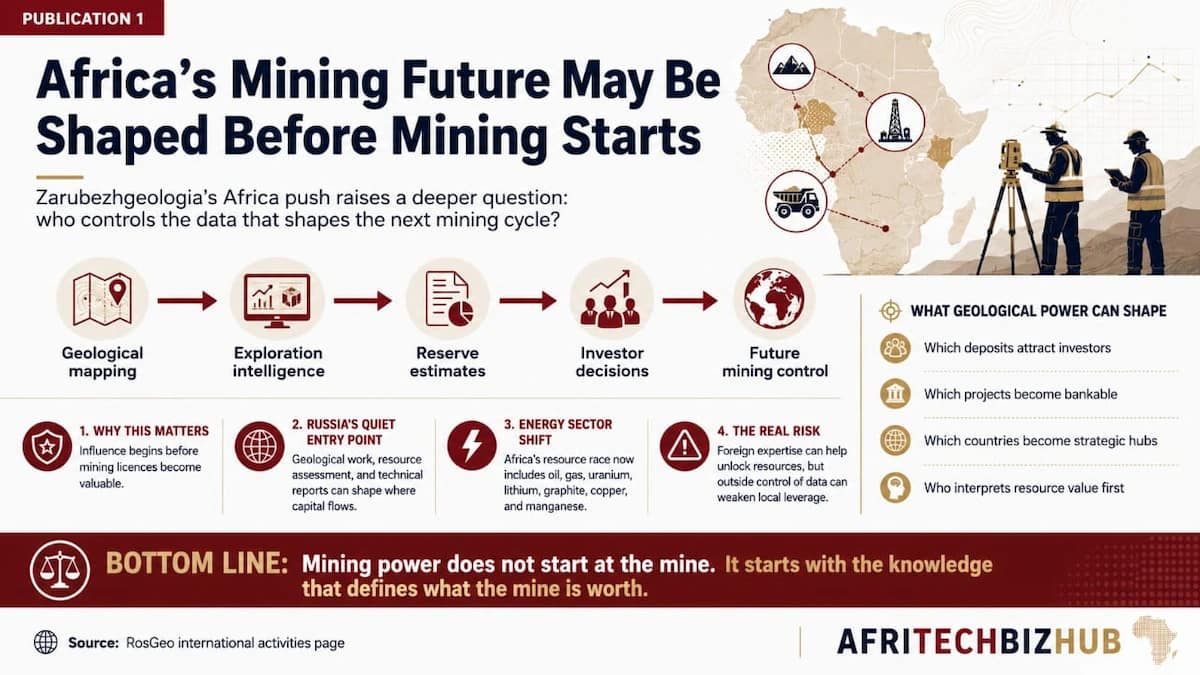
Mining power rarely begins at the mine.
It begins in maps, surveys, seismic data, mineral databases, reserve estimates, and technical models that decide which deposits become bankable long before extraction starts.
Zarubezhgeologia’s Africa focus belongs in that earlier, quieter stage of the resource race. The company does not need to hold every mining licence to matter.
A geological company that helps identify deposits, interpret mineral potential, and prepare projects for investors can influence where capital moves next.
For African markets, the choice is no longer only about who extracts the resources.
It is also about who reads the ground first.
How Is Russia Transforming the Energy Sector in Africa?
Russia’s energy-sector influence in Africa is moving through the work most people only notice after major deals are announced.
Before an oil block becomes attractive, before a gas basin becomes bankable, before uranium or energy minerals enter investor presentations, geological work has already shaped the field.
Companies such as Zarubezhgeologia sit close to that starting point, where technical knowledge becomes commercial direction.
Africa’s energy sector is also wider than crude oil.
Gas, uranium, lithium, graphite, copper, manganese, rare earths, and other strategic minerals now sit inside electricity systems, batteries, grids, nuclear energy, industrial planning, and energy security.
A company that helps define the quality, scale, and commercial promise of those resources enters the conversation early.
Influence does not always arrive through a giant mine or a public concession.
Sometimes it begins with a survey, a model, a reserve estimate, and a technical file that investors later treat as the foundation.
Will a Russian Geological Company Dominate Mining in Africa?
Dominance is the wrong signal to watch first.
The more important movement happens before domination becomes visible.
A geological company can shape mining outcomes without operating the final mine, because early exploration determines which deposits look viable, which sites attract bidders, and which governments gain leverage in negotiations.
Zarubezhgeologia’s role fits that quieter space.
Geological mapping, reserve classification, resource assessment, and technical reporting can decide which countries enter the next phase of global mineral competition.
The final licence may carry another company’s name, but the earlier intelligence can still guide the market.
For African governments, foreign geological support can be useful.
The pressure comes when the interpretation of African mineral resources sits too far outside African institutions.
What Drives the Expanding African Markets Shift?
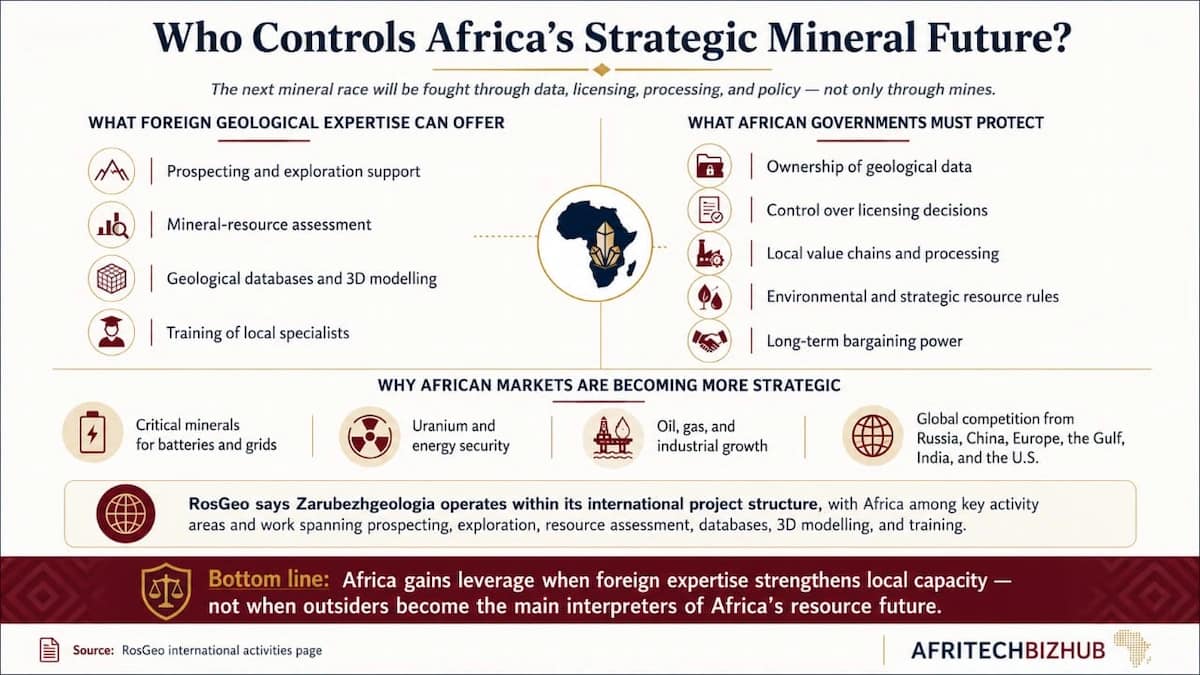
African markets are becoming more valuable because the global economy is searching for the minerals behind the next industrial cycle.
Lithium, cobalt, copper, manganese, graphite, uranium, gold, rare earths, iron ore, and gas are no longer treated only as raw materials.
They now sit inside electric vehicles, battery storage, defence industries, electricity grids, fertiliser, construction, digital infrastructure, and energy security.
Africa’s resource base has moved from extractive interest to strategic competition.
That competition is drawing Russia, China, Europe, the Gulf, India, and the United States deeper into African markets.
The continent has bargaining power, but bargaining power weakens when resource intelligence, processing capacity, export routes, and financing structures are controlled elsewhere.
The countries that gain most will not simply be those with the richest deposits.
They will be the countries that use foreign interest to strengthen geological institutions, train local experts, retain data ownership, and build value chains beyond raw exports.
Why Does Russia Africa Economic Cooperation Matter?
Russia Africa economic cooperation now reaches into sectors that define long-term national power: mining, oil, gas, nuclear energy, agriculture, infrastructure, security, and technology.
In the resource sector, the earliest technical work can matter as much as the final extraction agreement.
Geological surveys, reserve audits, data systems, and project preparation shape which deposits become visible to investors and which governments negotiate from strength.
Zarubezhgeologia’s official website identifies the company as the single operator of foreign projects for RosGeo, with more than 50 years of international experience.
That institutional footprint places the company inside the technical layer of Russia’s external resource engagement. Its work is not only about field activity.
It is about exploration, resource assessment, geological interpretation, project preparation, and specialist knowledge that can influence future investment decisions.
For African markets, Russia Africa cooperation is therefore not just a diplomatic or mining story.
It is a story about who helps define the value of the resources before the market arrives.
Who Controls Strategic Global Mineral Resources Next?
Control over strategic global mineral resources will belong to countries that manage the full chain, not only those that sit above the deposits.
Africa has many of the minerals the world wants, including cobalt, lithium, copper, manganese, graphite, uranium, rare earths, gold, and iron ore.
But deposits alone do not create power.
Data, exploration finance, processing capacity, export routes, pricing systems, and technical knowledge decide how much value stays inside the country.
Zarubezhgeologia’s Africa push points to the hidden stage where that power begins.
Maps, surveys, drilling results, models, databases, and reserve estimates can shape future mining power long before production starts.
African markets can benefit from Russian geological expertise when governments keep firm rules on data ownership, licensing, environmental standards, local training, and value addition.
They lose leverage when foreign partners become the main interpreters of their resource future.
The next mineral race will not only move through mines.
It will move through information, processing, finance, and the ability of African states to set the terms of their own resource development.


Recent Comments