

Featured Summary:
- African currencies ranking often highlights unexpected winners because currency strength is not the same as total economic size.
- Strongest currencies in Africa are usually supported by monetary control, export earnings, foreign exchange management, reserves, or market confidence.
- African markets can benefit from stronger currencies through lower import pressure, better price stability, and stronger investor confidence.
- Currency strength matters for African countries, but it must be judged alongside inflation, productivity, exports, debt, and economic resilience.
Africa’s strongest currency rankings often surprise readers because the winners are not always the countries people expect.
A large economy can have a weaker currency, while a smaller economy can hold a stronger exchange value against the dollar.
That difference creates confusion because many people treat currency strength as proof of national wealth, even though the reality is more complex.
African currencies tell a story about exchange rates, policy choices, reserves, inflation, controls, exports, and investor confidence.
They do not tell the whole story of an economy.
That is why the ranking matters, but also why it must be handled carefully.
Currency strength affects import costs, inflation, investor confidence, business planning, foreign debt pressure, and consumer purchasing power.
But a strong currency can reflect sound policy and market trust, or it can reflect strict controls, limited convertibility, and managed exchange-rate systems.
Africa’s currency story is therefore not only about who ranks first.
It is about what those rankings reveal about the structure, risks, and competitiveness of African economies.
Which African Currencies Dominate the Strongest Currencies Ranking?
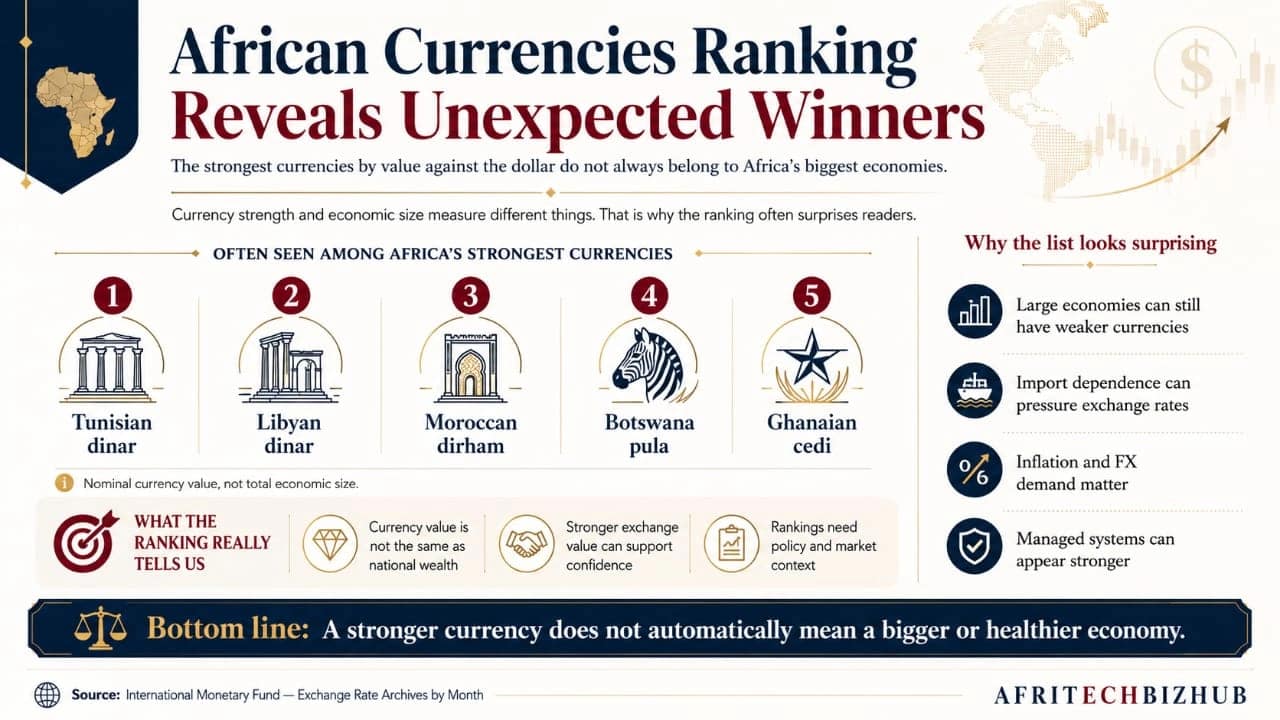
African currencies with the highest nominal value against the US dollar are often not from the continent’s largest economies.
Rankings frequently place currencies such as the Tunisian dinar, Libyan dinar, Moroccan dirham, Ghanaian cedi, Botswana pula, Seychellois rupee, and Eritrean nakfa among the stronger units by exchange value.
That can surprise readers who expect Nigeria, South Africa, Egypt, or Kenya to dominate every economic ranking.
The surprise comes from mixing up two different measures: currency unit value and total economic size.
A high currency value does not automatically mean a stronger economy.
Nigeria may have one of Africa’s largest markets, but the naira can still face pressure from dollar demand, import dependence, inflation, and oil-revenue volatility.
South Africa has deep financial markets, but the rand moves with global risk appetite, commodity cycles, and domestic policy confidence.
Meanwhile, countries with managed exchange regimes, stronger reserves, smaller import pressure, or specific export advantages can appear stronger in nominal currency rankings.
African currencies must therefore be read as signals, not verdicts.
Why are Strongest Currencies Boosting African Markets Today?
Stronger currencies can support African markets by reducing the cost pressure that comes from imported fuel, food, machinery, medicine, and industrial inputs.
When a currency holds its value better, businesses face less pressure from sudden import-cost increases.
That can help stabilise consumer prices, protect purchasing power, and give companies more room to plan.
In economies where imports shape inflation, exchange-rate stability can become a market advantage.
Investor confidence also improves when a currency appears stable and predictable.
Sharp currency swings can scare investors, raise the cost of doing business, and make long-term contracts harder to price.
Strongest currencies can therefore help African markets by improving trust in pricing, payments, and capital planning.
But the benefit is strongest when currency value is supported by real economic strength.
A strong exchange rate built only on strict controls can hide pressure rather than remove it.
How are African Markets Benefiting From Currency Strength?
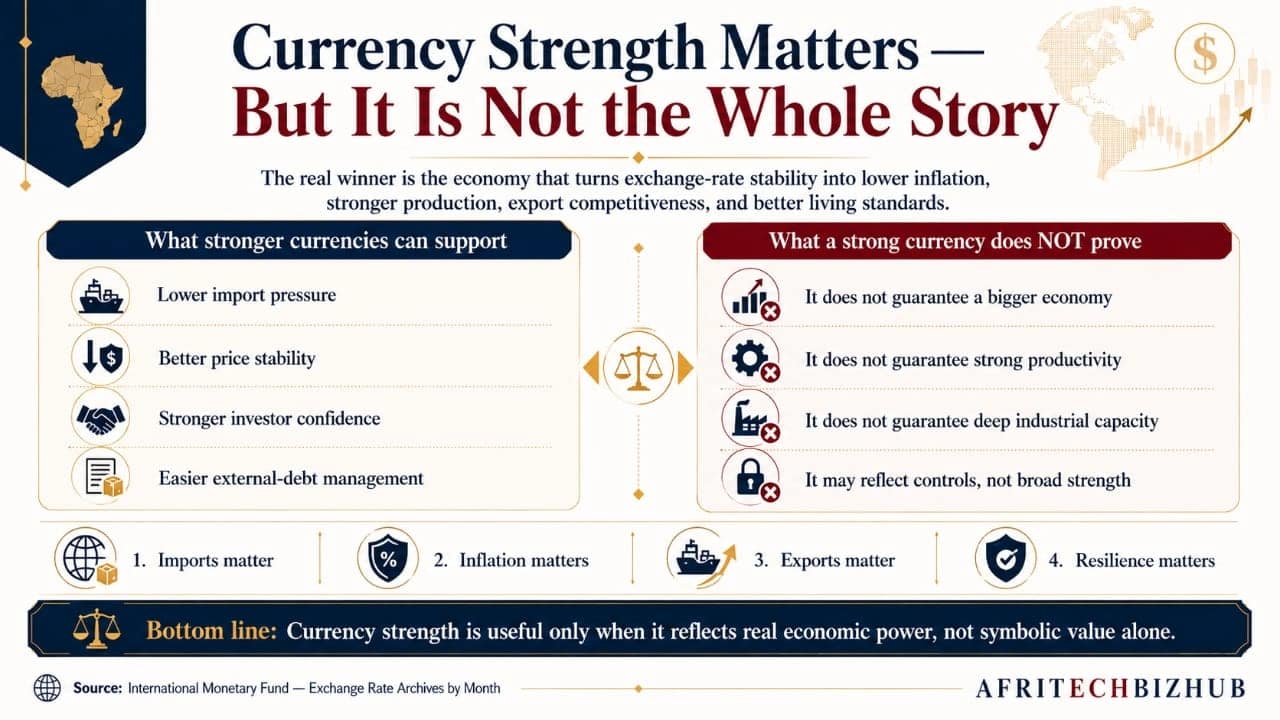
African markets benefit from currency strength when businesses can import essential goods without facing constant exchange-rate shocks.
Manufacturers need machinery, spare parts, raw materials, packaging, and energy inputs. Retailers need predictable import costs.
Banks need clearer foreign exchange conditions. Consumers also benefit when stronger currencies help reduce inflation pressure on imported products.
The gain can spread across the economy when currency strength supports trade, investment, and financial planning.
A stable currency can make foreign investors more comfortable entering bonds, equities, real estate, infrastructure, or private-sector projects.
It can also help governments manage external debt more easily because foreign-currency repayments become less painful when the local currency is not collapsing.
Still, currency strength is not a full economic solution.
African markets benefit most when stronger exchange rates are matched by productivity, exports, investment, and sound fiscal policy.
Which Africa Economy Gains Most from Stronger Currencies?
The economies that gain most from stronger currencies are usually those that depend heavily on imported inputs but also have enough export strength, reserves, or policy discipline to defend currency stability.
For these countries, stronger currency value can reduce inflation pressure, lower business costs, and support investor confidence.
The advantage becomes especially important in economies where manufacturers, retailers, banks, and consumers are sensitive to exchange-rate movements.
The IMF exchange rate data tool provides a formal institutional basis for comparing currency values across countries, but the ranking itself should be read carefully.
A country may rank high by nominal exchange rate and still face unemployment, weak growth, low productivity, or limited industrial depth.
Another country may have a weaker currency but a larger economy, deeper capital market, and stronger export base.
That is why the real winner is not always the country with the highest currency value.
The real winner is the Africa economy that turns currency strength into lower inflation, stronger production, export competitiveness, and better living standards.
Why Does Currency Strength Matter for African Countries?
Currency strength matters for African countries because exchange rates affect almost every part of economic life.
They influence the price of imports, the cost of foreign debt, the value of wages, the confidence of investors, and the ability of businesses to plan beyond the next few months.
When a currency weakens sharply, the pressure can move quickly into fuel prices, food costs, transport, medicine, and industrial production.
The deeper lesson from Africa’s currency rankings is that strength must be judged with caution.
A strong currency is useful when it reflects productivity, exports, reserves, policy credibility, and investor trust.
It is less useful when it hides weak growth behind strict controls or limited convertibility.
African countries need currencies that are stable enough to support markets, but flexible enough to reflect real economic conditions.
That balance is what separates symbolic currency strength from real economic power.


Recent Comments