


Featured Summary:
- African market growth depends partly on faster business payments because companies need better control over supplier payments, travel spend, and operating costs.
- South Africa Payments are becoming a testing ground for corporate payment tools that can improve reconciliation, visibility, and financial control.
- Visa Commercial Pay supports B2B Payments by using virtual payment solutions, automated data matching, and more structured spend management.
- Digital Payments can help African businesses reduce manual processes, improve cash-flow planning, and make corporate spending easier to track.
Africa’s payment story has been dominated by the consumer. Cards, mobile money, QR codes, instant transfers and cashless habits have carried most of the attention.
The business side has moved more quietly, even though companies still lose time and control inside supplier payments, travel expenses, procurement, invoices and reconciliation.
That is where the next payment battle is forming.
Visa Commercial Pay’s South Africa launch matters because it turns attention to the corporate layer of Digital Payments, where growth is not only about faster transactions.
It is about whether finance teams can see, approve, control and reconcile spending before it leaks into cost overruns.
If South Africa becomes the proving ground, the wider African market may not be watching another payment product.
It may be watching the back office become part of the digital economy.
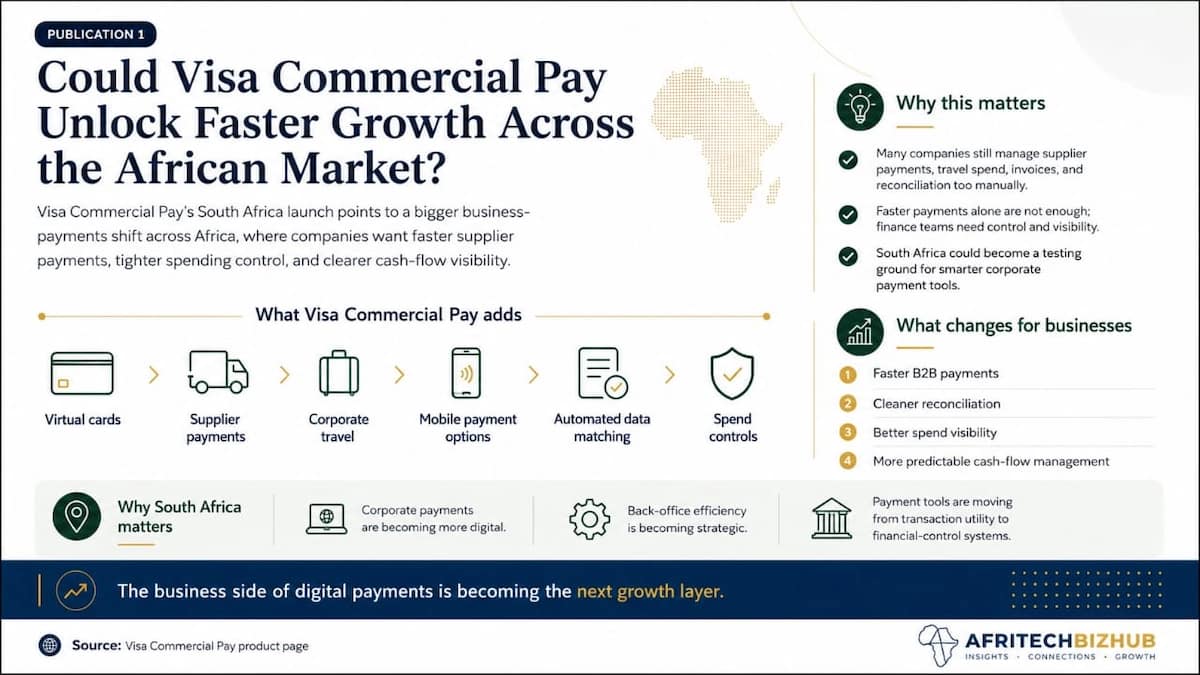
How Does Visa Commercial Pay Transform South Africa Payments?
South Africa Payments are moving into a stage where corporate finance teams need the same speed and discipline that consumers already expect from digital channels.
Visa Commercial Pay supports that shift through tools for supplier payments, corporate travel, mobile payment options, virtual cards and automated reconciliation.
These features matter because companies do not only need to pay quickly.
They need to know who paid, why they paid, how the payment was approved and how it fits into internal records.
The transformation sits in the back office, not at the checkout counter.
A virtual card can be created for a supplier, purchase, department or travel purpose, reducing the risks linked to shared card details and uncontrolled spending.
Automated data matching can cut the time finance teams spend connecting invoices, approvals and payments.
For South African companies, the payment system is no longer just a transaction tool.
It becomes part of procurement discipline, fraud control, cash-flow planning and working-capital management.
Why Are B2B Payments Becoming Essential for African Businesses?
African businesses are paying more attention to B2B Payments because supplier relationships now depend on speed, trust and cash-flow discipline.
A company that pays suppliers late can damage its supply chain, lose negotiating power and slow its own operations.
A company that cannot track corporate spending clearly can also face leakage, fraud risk, weak budgeting and poor financial planning.
The problem is not only payment delay. It is the lack of visibility around how business money moves.
That pressure grows as companies operate across more branches, vendors, employees, countries and digital channels.
Manual processes may survive in small operations, but they become dangerous when a business scales.
B2B payment tools can help firms approve payments faster, track spending in real time and separate business expenses from informal or cash-heavy systems.
For the African market, this is more than a technology upgrade.
It is part of building companies that can grow without losing control of their own cash flow.
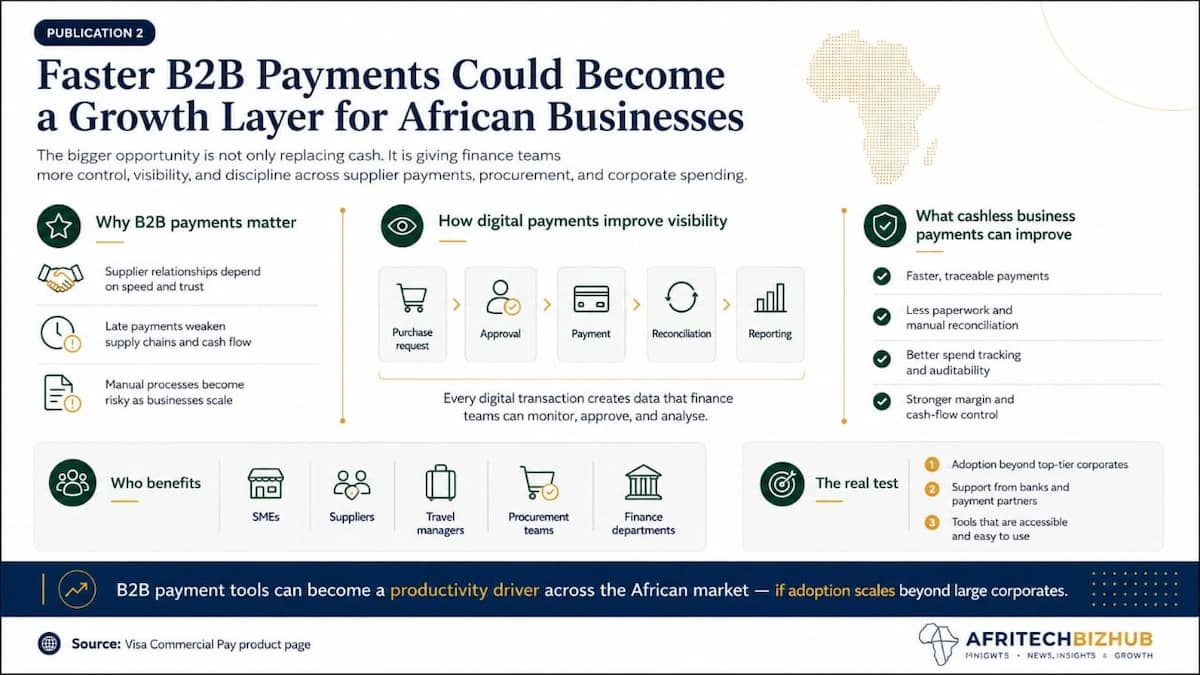
Can Digital Payments Improve Corporate Spending and Visibility?
Digital Payments improve corporate visibility when every transaction leaves usable data.
Traditional payment methods often create gaps between a purchase request, an approval, an invoice and the final accounting record.
Those gaps make it harder for businesses to control costs or understand where money is going.
In a tight-margin economy, that weakness becomes expensive.
Visa Commercial Pay addresses that gap by connecting payments with spend controls and reporting tools.
Businesses can set limits, assign payment rights, manage virtual cards and track spending by supplier, employee, project or department.
This gives management a clearer view of cash movement and reduces the risk of hidden expenses.
The strongest value is not the card itself. It is the discipline around the card.
In the African market, where many companies are trying to scale while protecting margins, visibility is no longer a finance-team preference. It is a survival tool.
How Will Cashless Payments Reshape Business Operations in Africa?
Cashless Payments can reshape African business operations by replacing slow manual processes with systems that are faster, traceable and easier to audit.
Cash and paper-heavy payment methods can create security risks, reconciliation delays and weak visibility over who spent what.
Digital and virtual payment tools make it easier to connect spending decisions to business records.
That is where corporate payments become operational infrastructure.
Visa’s official South Africa product page describes Visa Commercial Pay as a suite of virtual B2B payment solutions for supplier payments, corporate travel and mobile payment options.
It also highlights automated data matching, payment data visibility, virtual card management, cash-flow support and digitisation of purchasing and financial management processes.
That matters because business payments are not only about moving money.
They are about creating a cleaner operating system for procurement, travel, supplier management, compliance and finance-team decision-making.
Why Is the African Market Embracing Faster Business Payment Solutions?
The African market is embracing faster business payment solutions because companies are under pressure to operate with more speed, control and financial clarity.
Growth creates complexity. More suppliers, employees, branches, travel needs, procurement requests and cross-border transactions can quickly overwhelm manual systems.
Faster payments matter, but faster payments without control can simply move mistakes more quickly.
Visa Commercial Pay’s South Africa rollout shows how corporate payment infrastructure could become a new growth layer for African businesses.
The opportunity is not limited to large companies.
SMEs, suppliers, travel managers, procurement teams and finance departments can all benefit when payments become more digital, controlled and easier to reconcile.
The bigger test is adoption.
If banks, businesses and payment partners make these tools accessible beyond top-tier corporates, Cashless Payments and B2B Payments could become a stronger driver of productivity across the African market.


Recent Comments