

Featured Summary:
- Diesel fuel is becoming one of Africa’s most painful business costs because trucks, generators, farms, ports, mines, and factories still depend heavily on it.
- Diesel cost triggers fuel inflation when transport fares, food distribution, backup power, and production expenses rise together.
- Energy access becomes harder when homes, clinics, small businesses, and manufacturers must rely on expensive diesel generators during grid shortages.
- GlobalPetrolPrices data places Malawi, Central African Republic, Sierra Leone, Rwanda, Zimbabwe, and South Africa among the African nations paying some of the highest diesel prices.
Africa’s diesel shock is not only happening at filling stations.
It is moving through trucks that carry food, generators that keep shops open, machines that power factories, cold rooms that preserve goods, farms that move produce, and ports that handle imports and exports.
When diesel fuel becomes expensive, the pressure spreads through the economy before many consumers even know where the extra cost began.
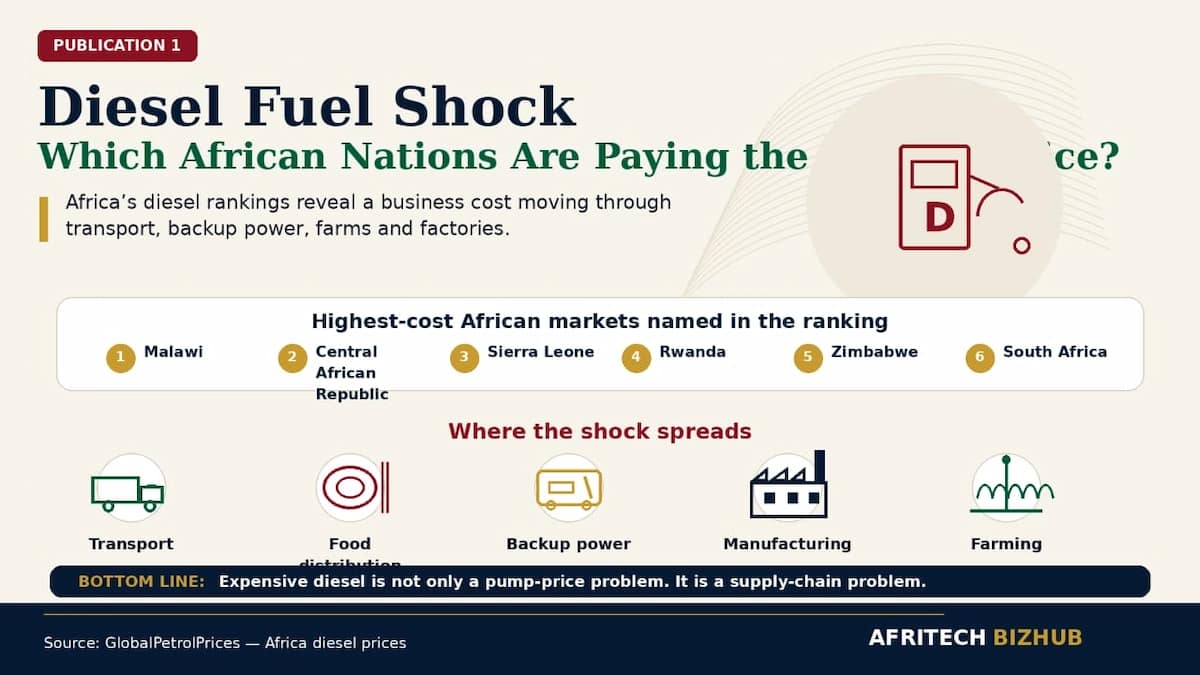
That is why the latest diesel rankings matter. GlobalPetrolPrices places Malawi, Central African Republic, Sierra Leone, Rwanda, Zimbabwe, and South Africa among the African markets paying some of the highest diesel prices.
The ranking exposes a deeper problem for countries where diesel supports both transport and backup electricity.
Expensive diesel does not only raise pump prices.
It raises the cost of supply chains, weakens manufacturing competitiveness, worsens fuel inflation, and makes energy access harder for businesses and households already dealing with unreliable power.
Why Is Diesel Fuel Cost Rising Across African Supply Chains?
Africa’s supply chains absorb diesel shocks quickly because road transport remains central to how goods move across the continent.
Trucks carry farm produce to cities, containers from ports to warehouses, fuel to inland markets, and raw materials to factories.
When diesel fuel rises, the cost of every trip rises with it. That cost rarely stays with transporters.
It moves to wholesalers, retailers, manufacturers, farmers, and households.
The pressure is heavier in countries that import refined fuel, depend on long transport corridors, or face weak currency conditions.
Landlocked economies often pay more because fuel must move through ports, borders, and inland routes before reaching local markets.
Import-dependent countries also face global price swings, freight charges, taxes, and distribution costs.
That is why diesel cost becomes a supply chain problem, not just a transport problem.
Once freight, storage, farming, port handling, and generator-backed services become more expensive, the wider economy begins to carry the shock.
How Does Diesel Cost Trigger Fuel Inflation Across African Economies?
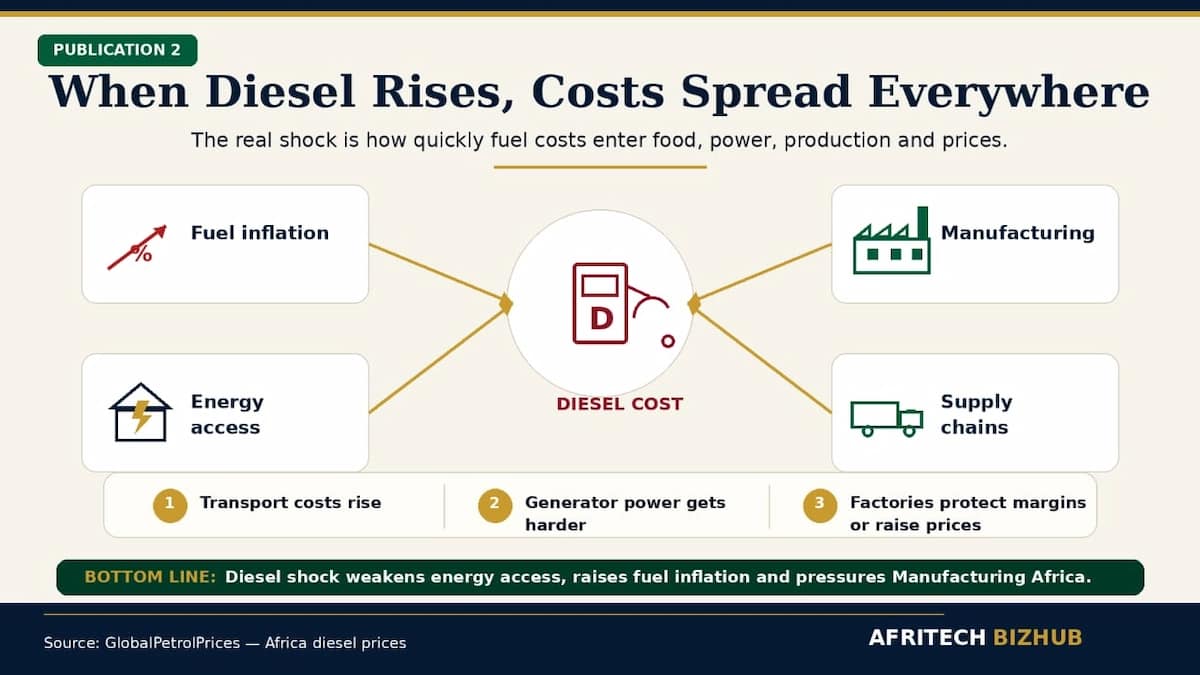
Diesel cost becomes fuel inflation when higher energy expenses enter the price of food, transport, goods, and services.
A farmer may pay more to run equipment. A distributor may pay more to move produce.
A manufacturer may pay more to power machines during outages.
A retailer may pay more to keep goods cold or lights on.
Each cost can return later as a higher price for ordinary households.
The inflation effect becomes stronger because diesel sits inside several parts of the same product chain.
A bag of rice, a carton of beverages, a cement block, or a frozen food item can carry diesel costs from farming, transport, storage, processing, and final delivery.
This makes diesel fuel one of the fastest ways energy pressure reaches daily living costs. When diesel rises, inflation does not stay in the fuel market.
It spreads into food, housing materials, transport fares, business services, and industrial goods.
Why Is Energy Access Becoming Harder With Expensive Diesel Fuel?
Energy access becomes harder when diesel generators remain a backup for weak electricity systems.
In many African economies, diesel is not only used by vehicles.
It powers shops, hospitals, telecom towers, schools, cold rooms, hotels, farms, factories, and small businesses whenever grid electricity fails.
That makes diesel a hidden part of electricity access.
The problem is that diesel-backed power is expensive and unequal.
Larger companies may keep generators running despite higher costs, but smaller businesses may reduce operating hours, lose refrigerated goods, delay production, or pass costs to customers.
Households may also cut generator use when fuel becomes unaffordable, leaving them with fewer hours of usable power.
Expensive diesel therefore widens the gap between those who can afford backup electricity and those who cannot.
It turns unreliable grid supply into a deeper economic burden.
What Do GlobalPetrolPrices Reveal About Africa’s Diesel Fuel Rankings?
GlobalPetrolPrices’ Africa diesel ranking shows that the highest-cost countries face more than a pump-price problem.
Its 22 June 2026 data lists Malawi at the top of the African diesel price table, followed by Central African Republic, Sierra Leone, Rwanda, Zimbabwe, and South Africa among the most expensive markets in the ranking.
These countries matter because high diesel prices affect logistics, food distribution, mining, farming, retail, manufacturing, and backup power at the same time.
Several factors can push diesel prices higher across African markets.
Landlocked geography can raise transport costs. Import dependence can expose countries to global fuel-price swings.
Currency weakness can make imported fuel more expensive.
Taxes, subsidy changes, distribution costs, storage limits, and supply disruptions can also raise the final price paid by consumers and businesses.
That is why diesel fuel rankings should be read as an economic warning.
When diesel becomes too expensive, supply chains become weaker, energy access becomes harder, fuel inflation becomes more painful, and Manufacturing Africa faces another barrier to growth.
How Are Manufacturing Africa Industries Coping With Higher Diesel Cost?
Manufacturing Africa industries are responding to higher diesel cost by raising prices, cutting waste, changing production schedules, investing in solar hybrids, and improving energy monitoring.
Food processors, cement producers, textile factories, beverage companies, packaging firms, cold-storage operators, miners, and plastics manufacturers often use diesel to protect production when electricity supply fails.
That means fuel price increases can quickly become a factory-floor problem.
The bigger manufacturers are trying to reduce exposure by using solar systems, batteries, gas where available, and more efficient machinery.
Some companies now run energy-heavy processes during cheaper or more reliable power periods, while others renegotiate transport contracts or reduce generator idle time.
Smaller manufacturers have fewer options. Many do not have the capital to install alternative power systems, which leaves them more exposed to diesel shocks.
If diesel remains expensive, the gap between large industrial firms and smaller producers could widen further.
Africa’s diesel shock is therefore not only a fuel story. It is a competitiveness test for factories, supply chains, and the businesses trying to produce locally in high-cost energy markets.


Recent Comments