


Featured Summary:
- African fintech companies secured 17 places in CNBC and Statista’s 2026 global list as payments, investment technology and enterprise platforms gained institutional relevance.
- Nigeria produced seven of the recognised companies because its interoperable payment rails created a market where financial technology could scale across banks, merchants and consumers.
- The mobile payment market now supports commerce, savings, credit and financial inclusion rather than functioning as a transfer channel alone.
- Long-term leadership will depend on which fintech companies become indispensable to financial institutions and the wider economy.
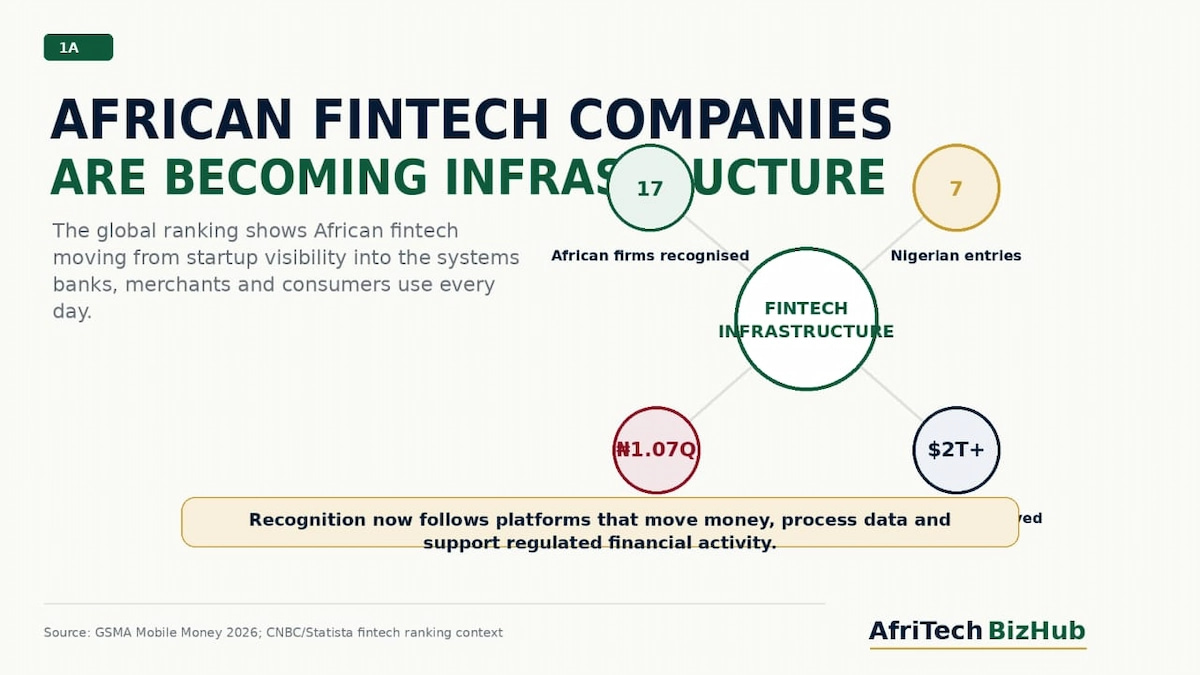
Seventeen African-founded, Africa-headquartered or Africa-focused businesses appeared in CNBC and Statista’s 2026 World’s Top Fintech Companies list, up from 10 African firms recognised in the previous year’s smaller global selection.
Nigeria accounted for seven entries, while companies connected to South Africa, Egypt, Kenya and other African markets also appeared across payments, wealth technology, alternative finance and enterprise fintech.
The recognition signals wider international confidence, but the number of companies on the list is not the most important development.
The stronger message is that African fintech has moved beyond solving isolated payment problems and now operates within the systems that banks, merchants, investors and consumers use every day.
That transition creates a sharper test for the sector.
Africa’s early fintech growth was built on large populations underserved by conventional banking, fragmented payment networks and widespread demand for faster financial services.
Those gaps attracted capital and produced rapid customer growth, but they did not guarantee durable businesses.
Global recognition is now following companies that have converted those gaps into payment rails, merchant networks, digital investment platforms and enterprise systems capable of supporting regulated financial activity.
The ranking therefore records a change in economic function: African fintech companies are no longer valued only for the markets they may capture, but for the financial infrastructure they already operate.
Why Did African Fintech Companies Dominate CNBC’s World’s Top 500?
African fintech companies secured a stronger presence in the 2026 list because payments remain one of the continent’s largest unresolved infrastructure challenges and one of its most developed technology markets.
The 17 recognised companies included businesses operating in consumer payments, payment processing, mobile money, digital savings, asset financing and enterprise data services.
Most were connected to payments, reflecting the scale of demand created by cash-heavy commerce, fragmented banking systems, costly transfers and limited card acceptance.
The ranking was not a league table based only on valuation; CNBC and Statista assessed companies using general business indicators and measures relevant to each fintech category, giving greater weight to operating performance and market position than startup publicity alone.
The recognition matters because African fintech firms were assessed within the same global framework as businesses operating in more mature financial markets.
Their inclusion shows that local payment problems have produced platforms with wider industrial relevance.
A company that connects banks, merchants, mobile wallets and consumers does more than offer a digital product; it reduces the cost of moving money across the economy.
African fintech companies reached the list because many now perform that function at scale.
Their presence reflects not dominance over the entire global industry, but a clear concentration of African capability in the part of financial technology where the continent’s structural needs have created the strongest businesses.
How Did Nigeria’s Payment Infrastructure Lead African Fintech Companies?
Nigeria produced seven of the recognised African companies because its payment infrastructure allowed fintech businesses to scale without building every part of the financial system themselves.
The NIBSS Instant Payment platform provides real-time transfers between participating banks and financial institutions, while the Bank Verification Number supports customer identification across the banking system.
Licensing frameworks introduced by the Central Bank of Nigeria created formal roles for switching companies, mobile money operators, payment service providers and other specialised businesses.
These shared rails allowed fintech companies to focus on merchant acquisition, consumer interfaces, agency banking, digital wallets and business services while relying on national infrastructure for settlement and interoperability.
The scale of activity on those rails created a market large enough to support several business models at once.
NIBSS reported that transaction volumes processed through Nigeria’s digital payment infrastructure rose from about 9.7 billion in 2023 to 11.2 billion in 2024, while the value of electronic payments reached roughly ₦1.07 quadrillion.
Nearly 11 billion transactions passed through the NIBSS Instant Payment platform in 2024, more than double the 2022 volume.
That growth created continuous demand for fraud controls, merchant software, consumer payments, identity systems and financial data services.
Nigeria’s fintech leadership was therefore not produced by population size alone.
It emerged from the combination of mass demand and interoperable infrastructure capable of converting that demand into repeatable financial activity.
Why Are African Fintech Companies Gaining Global Recognition?
African fintech companies are gaining global recognition because their business models are moving closer to the centre of regulated finance.
Early-stage fintech firms could attract attention through customer acquisition and transaction growth, but institutional confidence requires more.
Companies must prove that they can process money reliably, manage fraud, protect customer data, comply with regulation and generate revenue from services used repeatedly by consumers, merchants or financial institutions.
Recognition is therefore following firms that have built operating systems around Africa’s financial constraints rather than applications that depend on temporary subsidies or promotional growth.
The range of companies recognised also shows that the market is broadening beyond consumer payments.
Digital investment platforms are organising household savings into regulated products, enterprise software providers are helping banks and businesses use data more efficiently, and asset-financing platforms are combining technology with credit distribution.
These models deepen the financial system by improving access to capital, risk information and investment products.
Global investors and institutions now have stronger evidence that African fintech can produce durable infrastructure businesses, but the standard has also risen.
Market size may attract attention; profitability, resilience and regulatory trust will determine which platforms remain globally relevant.
How Is the Mobile Payment Market Expanding Africa’s Financial Infrastructure?
The mobile payment market is expanding Africa’s financial infrastructure by connecting people and businesses that conventional banking networks have not served efficiently.
Mobile wallets and agent networks allow users to receive income, transfer funds, pay bills, store value and complete merchant transactions without depending on a bank branch.
Once these accounts connect to merchants, banks and other digital platforms, they become part of a broader financial network rather than a simple person-to-person transfer service.
The GSMA reported that more than $2 trillion moved through mobile money accounts worldwide in 2025, while merchant payments rose by almost half to $155 billion.
Sub-Saharan Africa remained the central market, confirming that mobile money now supports significant volumes of everyday economic activity.
The infrastructure value comes from what those payment networks make possible after the first transaction.
A merchant with a digital payment history can receive faster settlement, access working capital and build a record that supports formal financial services.
Consumers can move from transfers into savings, insurance and credit, while governments and businesses can distribute payments more efficiently.
The market remains vulnerable to high charges, fraud, outages and weak dispute resolution, all of which can push users back towards cash.
Mobile payments will strengthen Africa’s financial systems only where interoperability, affordability and consumer trust develop together.
The scale of transactions proves demand; the quality of the supporting institutions will determine whether that demand produces deeper financial participation.
How Will African Fintech Companies Reshape Financial Market Infrastructure?
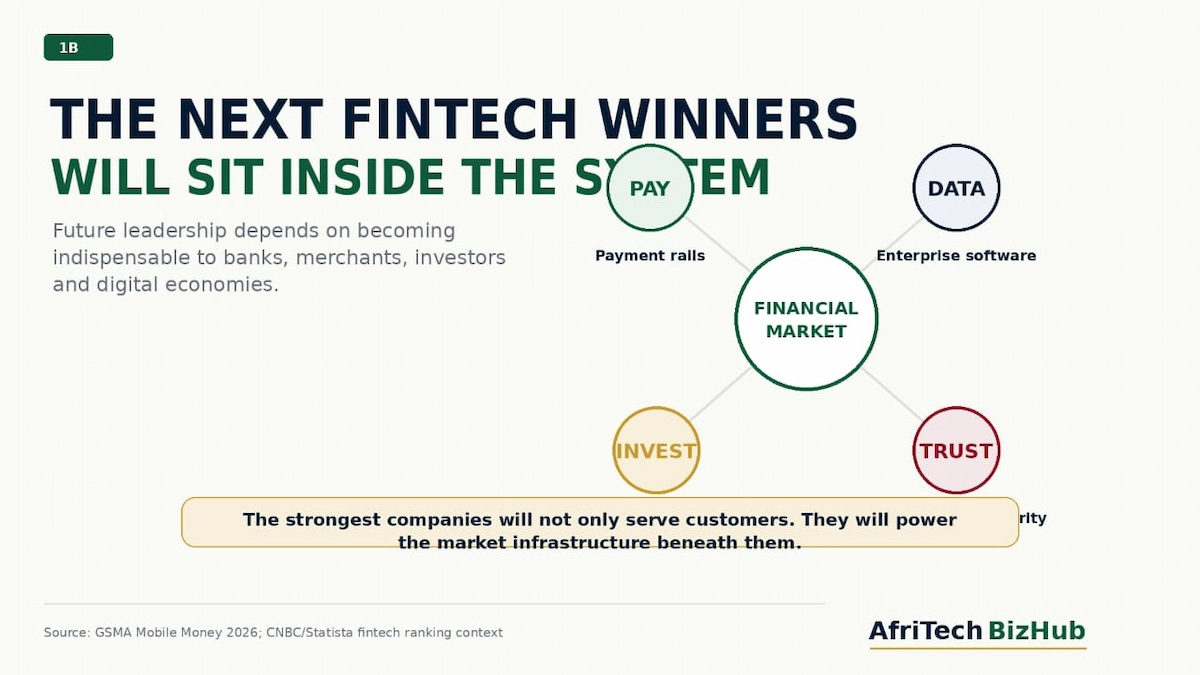
African fintech companies will reshape financial market infrastructure by moving deeper into the systems that financial institutions use to operate.
Fintech enterprise software can support identity verification, fraud detection, compliance, treasury management, credit assessment and payment reconciliation.
Digital investment platforms can connect retail savers to regulated funds and capital-market products, while embedded finance can place payments, insurance and working-capital credit inside commerce, logistics and business software.
Artificial intelligence may improve risk analysis and customer service, but it will also increase the importance of data governance, explainability and cybersecurity.
The companies that control these functions will influence how financial activity is organised even when consumers never interact directly with their brands.
CNBC’s recognition followed African fintech companies because they solved transaction and access problems at scale, but future leadership will require more than processing higher volumes.
Payment platforms must become more reliable, enterprise systems must integrate more deeply with regulated institutions, and investment products must earn trust through strong custody and consumer protection.
The sector conquered the global list by proving that African financial technology could build platforms large enough to matter.
Its next stage will be decided by which companies become too important for banks, merchants and digital economies to operate efficiently without them.


Recent Comments