


Featured Summary:
- The U.S. Africa strategy is placing critical minerals at the centre of trade, investment and national-security engagement with the continent.
- Critical minerals investment is shifting the relationship from aid-led programmes towards commercially structured infrastructure and supply-chain partnerships.
- Africa will capture limited value if investment concentrates on extraction and transport without building refining, technical skills and industrial capacity.
- Mineral processing and manufacturing will determine whether African economies remain raw-material suppliers or secure a larger role in global production networks.
Critical minerals now sit at the intersection of industrial policy, advanced technology and national security.
Cobalt, copper, graphite, lithium, manganese, platinum-group metals and rare earths support products ranging from batteries and semiconductors to data centres, aerospace systems and defence equipment.
The Trump administration has responded by accelerating domestic production, creating a strategic minerals reserve, pursuing supply agreements with partner countries and directing U.S. agencies to reduce exposure to concentrated foreign processing networks.
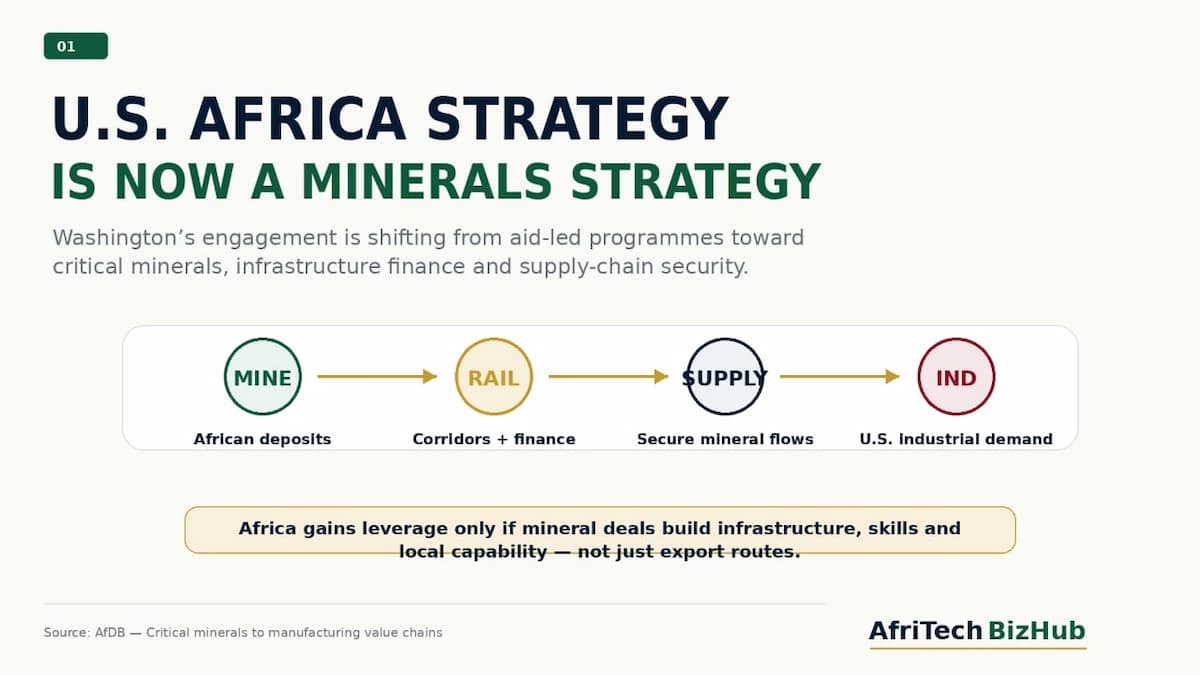
In March 2026, the State Department described its objective in Africa directly: to ensure that more of the continent’s critical minerals flow towards the United States through infrastructure and commercial partnerships.
The evolving U.S. Africa strategy goes beyond buying mineral output.
Washington and the African Union launched a Strategic Investment Working Group in January 2026 to combine African institutional priorities with U.S. capital and financing tools for critical minerals, infrastructure and other strategic sectors.
The Development Finance Corporation has also increased support for projects linked to mineral transport, production and supply-chain security, including the Lobito Corridor connecting the Democratic Republic of Congo and Zambia to Angola’s Atlantic coast.
Africa is therefore moving from the margins of development policy towards the centre of American industrial strategy, but the economic outcome for the continent will depend on whether these partnerships build local capability or simply redirect raw materials to Western markets.
Why is the U.S.-Africa Strategy Targeting Critical Minerals?
The U.S. Africa strategy is targeting critical minerals because American industries depend on materials whose mining and processing are concentrated outside the United States.
A January 2026 White House proclamation warned that rising demand from artificial intelligence, data centres, nuclear energy, defence and other advanced industries had exposed national-security vulnerabilities in processed mineral supply chains.
It directed U.S. officials to negotiate agreements with trading partners that could provide secure supplies, while a February ministerial brought partner governments together to accelerate financing, stockpiling and project development.
African producers are strategically important within this framework because the continent contains major reserves and production capacity across cobalt, copper, manganese, graphite, platinum-group metals and other priority materials.
The policy shift also reflects concern about processing concentration rather than geological scarcity alone.
Extracted ore generates little strategic security when refining, separation and component manufacturing remain controlled by a small number of foreign suppliers.
The United States is therefore combining domestic mining measures with overseas agreements, infrastructure financing and investment in partner-country projects.
Africa offers both resource depth and the possibility of alternative supply routes, particularly through the mineral-rich corridor linking the DRC and Zambia to Angola.
Critical minerals are redefining U.S. engagement because access to African deposits can support American industrial resilience while giving African governments greater leverage to negotiate infrastructure, financing and market access.
Why is Critical Mineral Supply Becoming a Strategic Advantage?
Critical mineral supply has become a strategic advantage because modern industrial systems cannot easily substitute many of the materials embedded in advanced products.
Cobalt and lithium support battery chemistry, graphite is used in battery anodes, rare earths are essential to permanent magnets, while manganese, chromium and platinum-group metals serve manufacturing, energy and defence applications.
A disruption affecting one processing country, shipping route or dominant supplier can therefore delay production far beyond the mining industry.
The U.S. Geological Survey defines a critical mineral partly by its importance to economic or national security and the vulnerability of its supply chain to disruption.
Reliable access changes the economics of industrial planning.
Manufacturers can invest in factories with greater confidence when long-term mineral volumes, prices and processing capacity are predictable; governments can also reduce the risk that geopolitical restrictions interrupt defence procurement or strategic infrastructure.
This explains why policy now includes public financing, offtake agreements, strategic reserves, price-support mechanisms and partnerships with allied producers.
The advantage does not belong only to countries with deposits.
It also belongs to economies that can refine minerals, certify their origin, provide dependable transport and convert them into materials used by manufacturers.
Control over secure mineral supply has therefore become a measure of industrial resilience rather than simply a source of export revenue.
Why is Critical Minerals Investment Replacing Traditional U.S. Aid?
Critical minerals investment is replacing traditional U.S. aid as the dominant framework for strategic engagement because the Trump administration has explicitly moved towards trade, private capital and commercially viable projects.
The 2025 U.S. National Security Strategy called for a transition from an aid-focused relationship with Africa towards trade- and investment-focused partnerships, identifying energy and critical-mineral development as areas offering potential returns.
State Department officials reinforced that position in 2026 by presenting U.S. engagement as a partnership built around bankable projects, American companies and supply chains capable of directing strategic resources towards Western markets.
This model uses development-finance institutions to reduce risks that private investors may not accept alone.
DFC loans, equity, guarantees and project-development support can finance railways, mines, processing facilities and energy systems that require large upfront capital and long repayment periods.
Its $553 million commitment to the Lobito Atlantic Railway forms part of roughly $1.5 billion committed across Africa since the agency’s current leadership took office, while a $600 million investment in the Orion Critical Mineral Consortium is designed to mobilise a broader $1.8 billion public-private platform.
The change does not mean that every development need will be solved commercially; it means projects are more likely to receive U.S. support when they also strengthen American supply security, create investable assets and serve identifiable industrial demand.
How Can Critical Minerals Build Africa’s Industrial Capability?
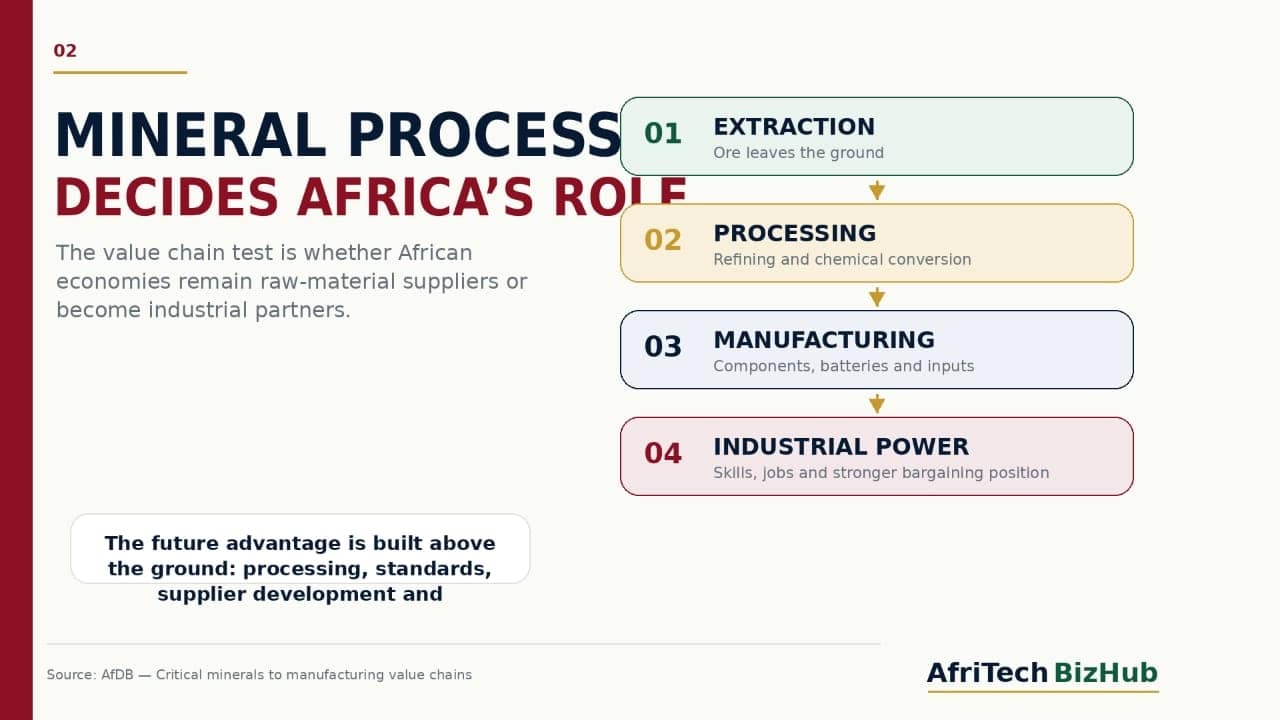
Mineral processing can reposition Africa from the beginning of global supply chains towards the industrial stages where higher margins, technical knowledge and stronger commercial linkages are created.
A country exporting unrefined ore earns from the extracted volume, but the destination economy may capture additional value through refining, chemicals, battery materials, engineered components and finished products.
Local processing also gives African producers greater influence over quality standards, traceability and long-term supply contracts.
Regional production networks could allow one country’s minerals, another’s energy capacity and a third market’s manufacturing base to support a shared value chain under the African Continental Free Trade Area.
Trump’s strategy changes the commercial environment because the United States now needs alternative mineral supply chains quickly enough to support defence, technology and energy industries.
That urgency gives African governments more bargaining power, but only if they coordinate infrastructure, regulation and value-addition requirements around commercially viable projects.
Deals built solely around extraction and export corridors may diversify American supply without changing Africa’s economic position.
Deals that connect mineral production to refining, supplier development, skills transfer and manufacturing can establish the continent as an industrial partner.
Africa’s long-term influence will therefore depend not on how many strategic minerals it controls underground, but on how much of the technology, processing and manufacturing economy it builds above them.


Recent Comments