


Featured Summary:
- Data governance is becoming a strategic priority as African institutions manage growing volumes of sensitive information.
- Data privacy is increasingly important for humanitarian organisations responsible for vulnerable population data.
- Data protection is emerging as a trust-building requirement rather than simply a regulatory obligation.
- Cybersecurity and regulatory coordination are becoming essential to responsible humanitarian data management.
As governments, humanitarian organisations, development agencies, and digital-service providers collect increasing amounts of personal and operational data, Africa faces growing pressure to strengthen data governance frameworks capable of balancing innovation, privacy, security, and public trust.
The continent’s digital transformation is expanding the scale, value, and sensitivity of information being generated across borders.
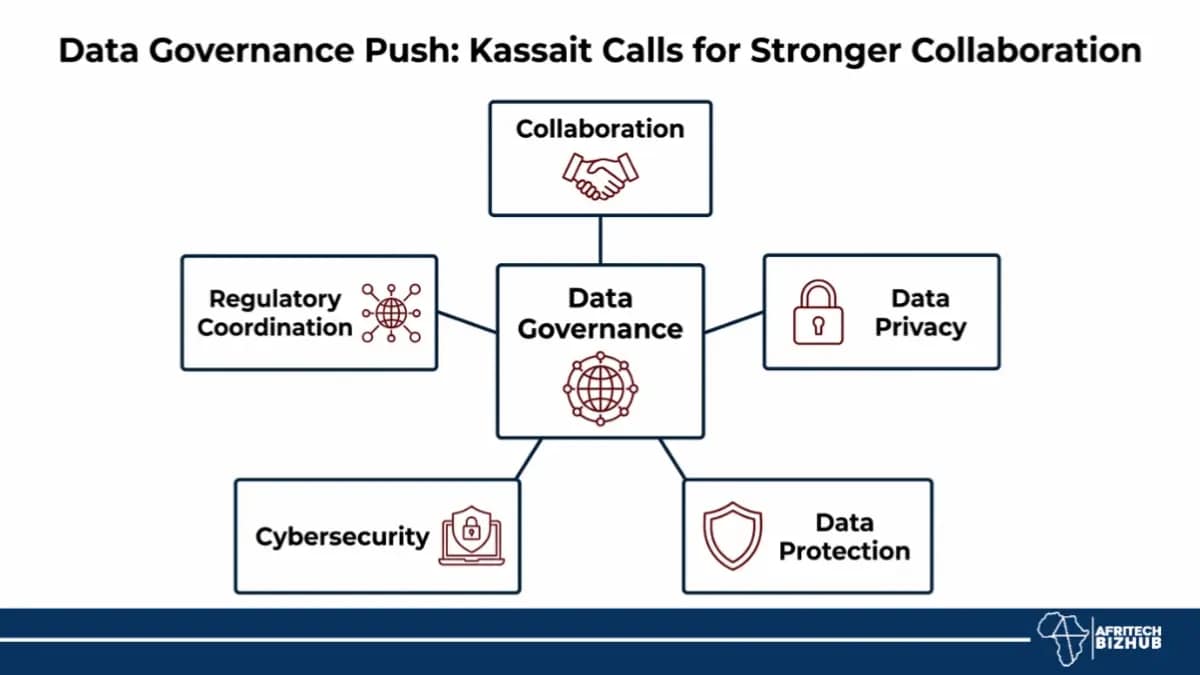
Kassait’s call for stronger collaboration reflects a challenge that extends far beyond a single institution or sector.
Data governance is no longer a technical discussion confined to compliance departments.
It increasingly influences humanitarian operations, digital services, public trust, and cross-border cooperation.
As Africa attracts greater investment into digital infrastructure, fintech, healthcare systems, and humanitarian technology, the ability to govern information responsibly is becoming a strategic requirement rather than an administrative exercise.
How Can Africa’s Data Officers Strengthen Collaboration?
Data officers are becoming increasingly important as organisations depend more heavily on information to deliver services, manage programmes, and support decision-making.
Their responsibilities now extend beyond record management into privacy, security, compliance, and institutional accountability.
Stronger collaboration among data officers can help organisations exchange expertise, align standards, reduce duplication, and improve governance practices.
The benefits become particularly important when information moves across institutions, sectors, and national borders.
Africa’s data challenge is increasingly continental while many governance systems remain fragmented.
Collaboration among data officers is becoming a practical necessity rather than a professional preference.
Institutions may collect data locally, but the risks associated with managing that information increasingly extend beyond national boundaries.
Data governance becomes stronger when knowledge and standards move as effectively as the data itself.
Why Is Data Privacy Vital For Africa’s Humanitarian Sector?
Data privacy is particularly important within the humanitarian sector because organisations frequently manage highly sensitive information relating to vulnerable populations.
Refugee records, health information, biometric data, social assistance records, and protection-related information often sit at the centre of humanitarian operations.
The consequences of poor privacy practices can be severe.
Exposure of personal information can place already vulnerable individuals at greater risk while undermining confidence in the institutions responsible for providing assistance.
Humanitarian organisations therefore, carry responsibilities that extend beyond operational effectiveness.
The most vulnerable populations often generate the most sensitive datasets.
That reality makes data privacy more than a compliance issue.
It becomes a protection issue.
Organisations that fail to safeguard information risk damaging the very trust upon which humanitarian work depends.
How Does Data Protection Build Trust Among Communities?
Data protection builds trust by demonstrating that institutions can manage information responsibly and transparently.
As governments and organisations increasingly rely on digital systems, communities are paying closer attention to how personal information is collected, stored, shared, and protected.
Trust directly influences participation.
People are more likely to engage with digital platforms, registration systems, and humanitarian programmes when they believe their information will be handled appropriately.
Confidence in the system often determines whether individuals are willing to provide the information required for services to function effectively.
Data protection is increasingly becoming a development issue rather than simply a legal requirement.
Organisations can invest heavily in technology, infrastructure, and service delivery, but trust lost through poor information management is often harder to rebuild than the systems themselves.
The institutions that earn trust increasingly gain an operational advantage.
Can Data Governance Reduce Regulatory Fragmentation Risks?
Regulatory fragmentation is becoming one of the largest hidden costs within Africa’s digital economy.
Organisations increasingly operate across borders while compliance frameworks, reporting requirements, and governance standards remain uneven across jurisdictions.
Data governance can help reduce those risks by promoting greater consistency in how information is managed, protected, and shared.
Stronger coordination can improve interoperability, reduce compliance complexity, and support more effective collaboration among governments, humanitarian organisations, and development institutions.
Technology can move information across borders instantly.
Regulation often moves far more slowly.
Effective data governance is becoming as much about coordination as compliance. Fragmentation creates costs that technology alone cannot solve.
The African Union has spent years encouraging stronger frameworks for cybersecurity and personal data protection because fragmented governance increasingly undermines cross-border cooperation and digital integration.
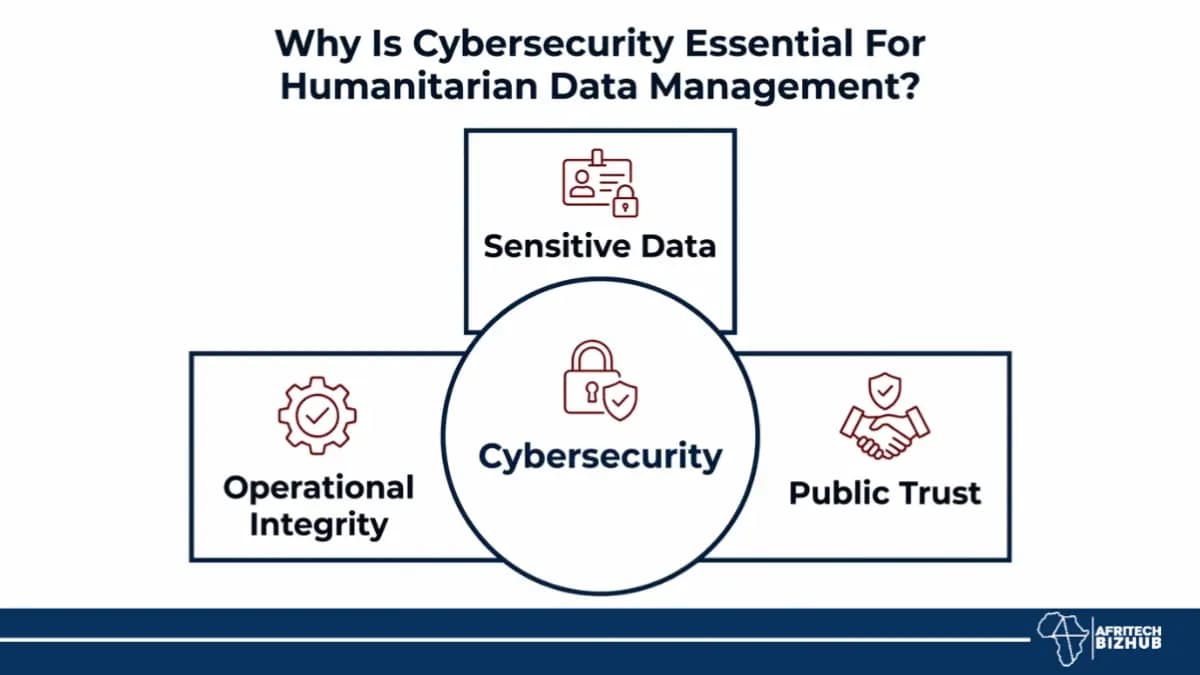
Why Is Cybersecurity Essential For Humanitarian Data Management?
Cybersecurity has become essential for humanitarian data management because the value and sensitivity of information held by humanitarian organisations continue to increase.
Databases frequently contain identity records, health information, financial assistance data, and personal details relating to vulnerable populations.
As humanitarian systems become more digital, the consequences of unauthorised access, data breaches, or cyberattacks become more significant.
Protecting information is therefore not simply a technical responsibility.
It is directly linked to operational integrity, institutional credibility, and public trust.
Cybersecurity is no longer a specialised function operating at the edge of humanitarian operations.
It increasingly sits at the centre of responsible data governance.
Organisations can build sophisticated digital systems, but those systems become liabilities if security protections fail to keep pace with the value of the information they contain.
Africa’s humanitarian sector is becoming more digital every year.
The challenge is no longer whether organisations can collect data.
The challenge is whether they can govern, protect, and secure it responsibly.
Data governance ultimately succeeds or fails on trust.
Once trust is compromised, rebuilding it becomes far more difficult than building the technology itself.


Recent Comments