


Featured Summary:
- Data protection failures often emerge through operational disruption rather than security breaches.
- Poor sequencing of privacy controls can reduce reporting quality and decision-making accuracy.
- Customer data tokenisation can create workflow challenges when governance is weak.
- Access controls alone cannot eliminate privacy risk without stronger data governance.
Data protection is often discussed as a compliance requirement or cybersecurity function. Increasingly, it is becoming a business-performance issue.
Organisations depend on accurate reporting, reliable data flows, and operational visibility to make decisions.
When privacy controls are implemented without proper governance, sequencing, or operational planning, the result is rarely stronger protection alone.
It can weaken reporting accuracy, disrupt workflows, and create new forms of organisational risk.
Many organisations discover these failures only after reporting quality begins to deteriorate.
How Can Africa Strengthen Data Governance Frameworks?
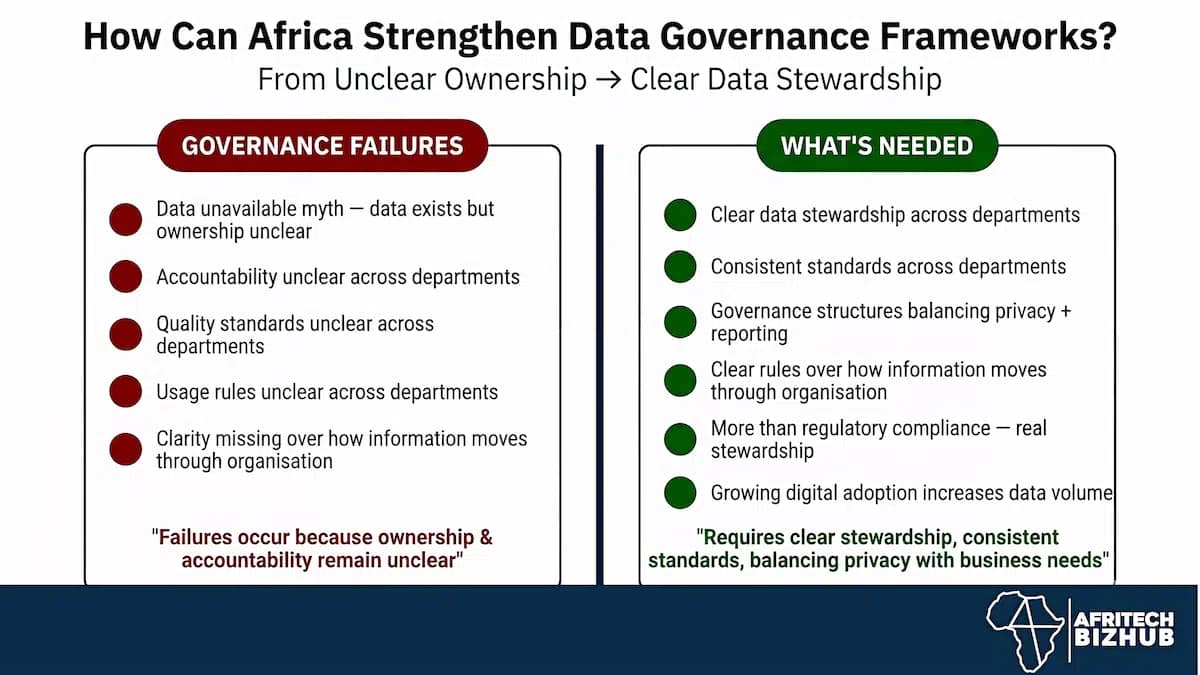
Strong data governance frameworks begin with clarity over how information moves through an organisation.
Many governance failures occur not because data is unavailable but because ownership, accountability, quality standards, and usage rules remain unclear across departments.
Across Africa, growing digital adoption is increasing the volume of customer data, financial records, and operational information managed by businesses and institutions.
Strengthening data governance requires more than regulatory compliance.
It requires clear stewardship, consistent standards, and governance structures capable of balancing privacy obligations with business reporting needs.
The organisations that manage data most effectively are rarely those with the most controls.
They are often those with the clearest accountability.
Why Does Data Privacy Fail Without Proper Sequencing?
Data privacy initiatives often fail when technical controls are introduced before organisations understand how information supports operational processes.
Restricting, masking, or restructuring data without mapping dependencies can create unintended disruptions across reporting systems, customer-management functions, and business operations.
Sequencing matters because privacy controls influence multiple parts of an organisation simultaneously.
Effective implementation typically begins with governance, process mapping, and risk assessment before technical measures are applied.
Organisations that reverse that order often discover operational challenges only after reporting quality and business workflows have already been affected.
Many privacy failures are not technology failures.
They are planning failures.
How Can Data Protection Break Reporting Accuracy?
Reporting systems depend on consistency, completeness, and traceability.
Data protection measures can weaken reporting accuracy when information is altered, anonymised, fragmented, or restricted without maintaining the relationships needed for analysis and oversight.
The risk is not data protection itself.
The risk emerges when privacy controls are implemented without considering reporting requirements.
Organisations can find themselves operating with compliant systems that generate incomplete insights, making it harder for managers, auditors, regulators, and decision-makers to understand performance accurately.
Poor reporting is often an operational risk long before it becomes a governance problem.
Once decision-makers lose visibility, the consequences usually extend far beyond compliance.
Can Customer Data Tokenisation Damage Operational Workflows?
Customer data tokenisation reduces exposure by replacing sensitive information with non-sensitive substitutes.
The approach strengthens security and privacy protection, but operational challenges can emerge when tokenised data is not properly integrated across systems that rely on customer records.
Institutions such as the National Institute of Standards and Technology (NIST) have consistently emphasised the importance of aligning privacy engineering and data protection controls with operational requirements.
Security controls deliver the greatest value when they support business functions rather than disrupt them.
Tokenisation can strengthen privacy, but its effectiveness depends on implementation quality, system design, and governance oversight.
The objective is not simply to protect customer data.
It is to protect customer data without breaking the systems that depend on it.
Why Are Access Controls Insufficient Against Privacy Risk?
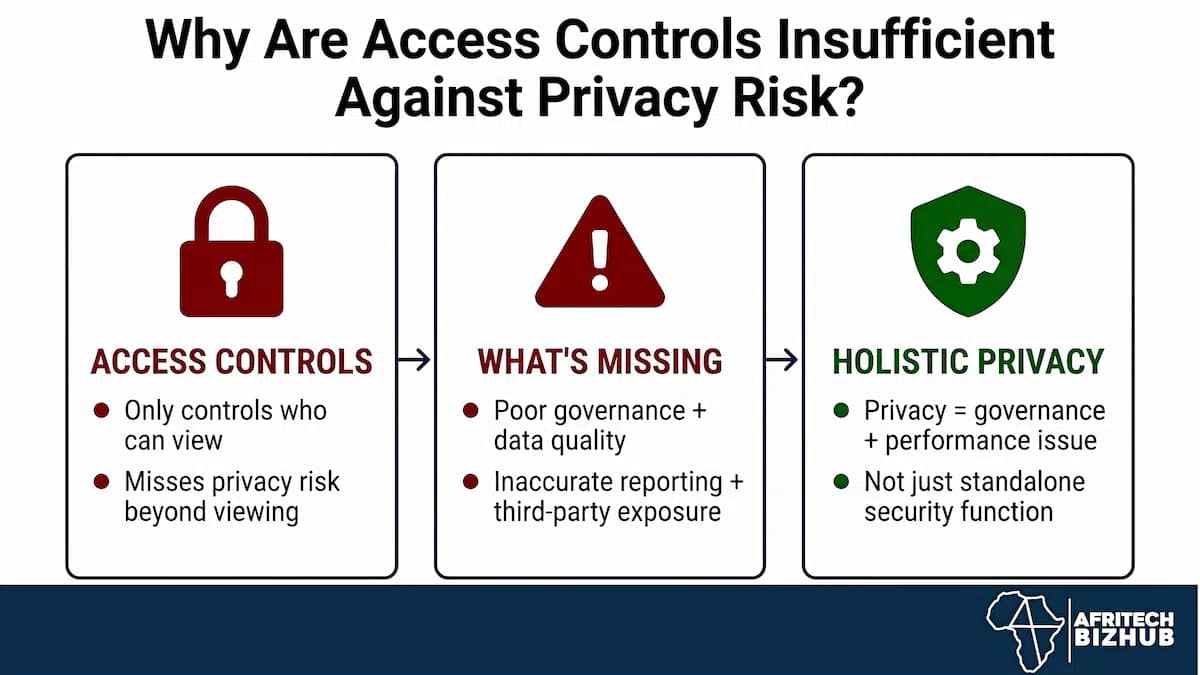
Access controls remain a foundational component of data protection, but privacy risk extends beyond who can view information.
Risks also emerge through poor governance, inaccurate reporting, weak data-quality controls, third-party exposure, inadequate oversight, and failures in how information is managed across its lifecycle.
Organisations that rely exclusively on access restrictions often address only one part of a broader governance challenge.
Strong privacy outcomes depend on data governance frameworks, operational discipline, accountability mechanisms, and continuous monitoring.
A critical question remains: how many organisations can confidently explain where sensitive data travels, how it influences reporting, and who remains accountable for its quality over time?
As regulatory expectations rise and data ecosystems become more complex, the organisations most likely to succeed will be those that treat privacy as a governance and performance issue rather than a standalone security function.
The next challenge is not simply protecting data.
It is protecting data without sacrificing the visibility, accountability, and reporting accuracy that effective decision-making depends on.


Recent Comments