


Featured Summary:
- Africa Development Finance is shifting toward domestic capital as institutions move to finance more of the continent’s own growth
- AfDB’s investment in ATIDI strengthens Africa’s ability to de-risk infrastructure and industrial projects
- Countries building stable, market-based financial systems are becoming better positioned to attract long-term capital
- With more than $4 trillion in capital pools and natural assets, African institutions are increasingly focused on mobilisation rather than scarcity
Africa may have spent decades searching for external capital when the larger challenge was building institutions capable of organising its own.
That is the signal emerging from Brazzaville.
The African Development Bank’s $125 million investment in ATIDI was presented as a capital injection. It looks more like a structural statement.
As AfDB, ATIDI, and Afreximbank increasingly align around risk, capital, and liquidity, Africa appears to be moving closer to a financing model built less around waiting for external money and more around mobilising assets already under its control.
The question is no longer whether the continent possesses wealth. The question is whether the institutions required to deploy it are finally beginning to emerge.
Why Is Africa Development Finance Moving Away From External Capital?
Africa is not turning inward because it suddenly prefers domestic capital. It is turning inward because the economics of dependence are becoming harder to sustain.
Rising borrowing costs, tighter global financial conditions, and growing geopolitical fragmentation have exposed the limits of a development model built primarily around external financing.
Brazzaville reflected that reality. The launch of the New African Financial Architecture for Development, the endorsement of President Sidi Ould Tah’s Four Cardinal Points vision, and growing attention on domestic resource mobilisation all pointed toward the same conclusion:
Africa Development Finance can no longer depend indefinitely on capital controlled elsewhere.
The shift is becoming increasingly practical. African institutions are examining how pension funds, insurance assets, sovereign capital, and other domestic resources can play a larger role in financing infrastructure, industry, and long-term development priorities.
The debate is moving beyond attracting capital. It is increasingly about organising it.
How Much Capital Does Africa Already Control?
Africa’s financing debate increasingly sits alongside a different reality.
The Africa Finance Corporation estimates that African financial systems hold more than $4 trillion across pension assets, insurance funds, banking assets, sovereign wealth vehicles, and reserves.
The continent’s resource base is larger still. The African Development Bank’s 2026 African Economic Outlook places Africa’s natural capital at roughly $6 trillion, spanning critical minerals, forests, biodiversity, carbon assets, and water systems.
For Africa Development Finance, the question emerging from Brazzaville is becoming harder to ignore.
If Africa controls both the capital and the resources, what exactly is preventing them from financing more of their own development?
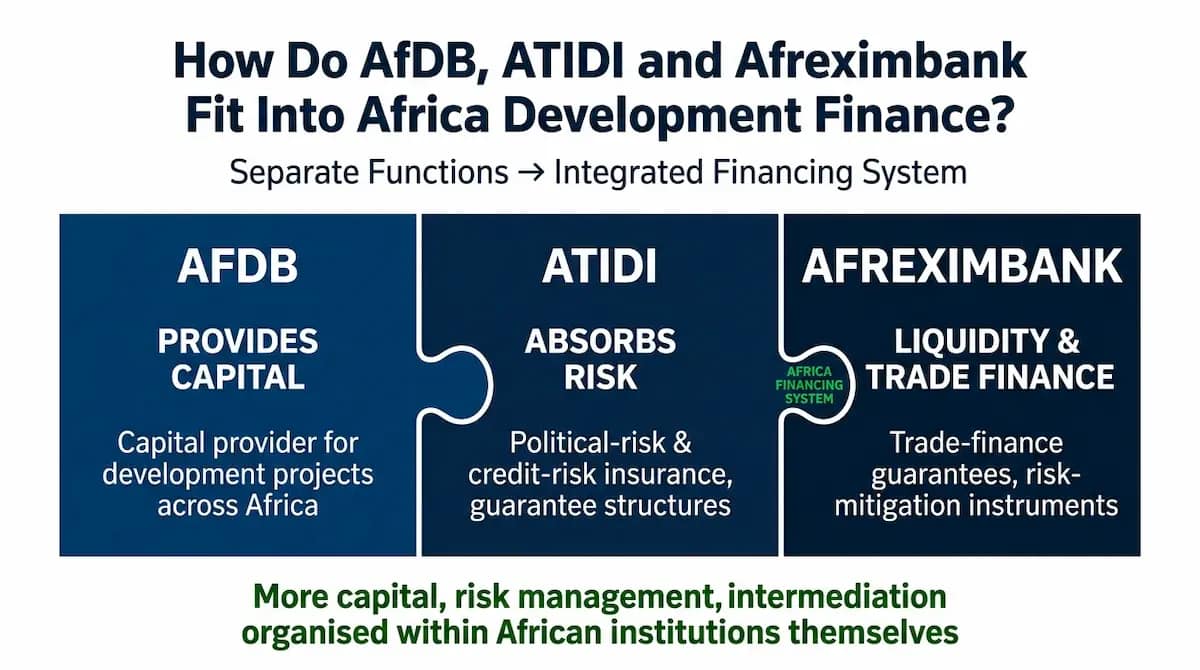
How Do AfDB, ATIDI and Afreximbank Fit Into Africa Development Finance?
Africa’s financing architecture is becoming increasingly integrated.
AfDB provides capital. ATIDI absorbs risk. Afreximbank provides liquidity and trade finance.
Individually, each institution performs a different function. Together, they are beginning to form the foundations of a financing system capable of supporting larger portions of Africa’s economic ambitions.
More of the capital, risk management, and financial intermediation required for development is increasingly being organised within African institutions themselves.
That may prove to be one of the most important shifts underway in Africa Development Finance.
Can Africa Finance Infrastructure and Industry From Within?
The question is increasingly shifting from capital availability to capital deployment.
Africa’s infrastructure ambitions, industrial projects, processing facilities, and logistics networks require long-term financing capable of supporting development over decades rather than years.
This is where Africa Development Finance is beginning to face its real test.
Capital pools, financial institutions, and risk-mitigation mechanisms are increasingly moving into place.
The next challenge is whether they can channel more financing into productive assets that expand industrial capacity, strengthen infrastructure, and capture more value from African resources.
Execution begins here.
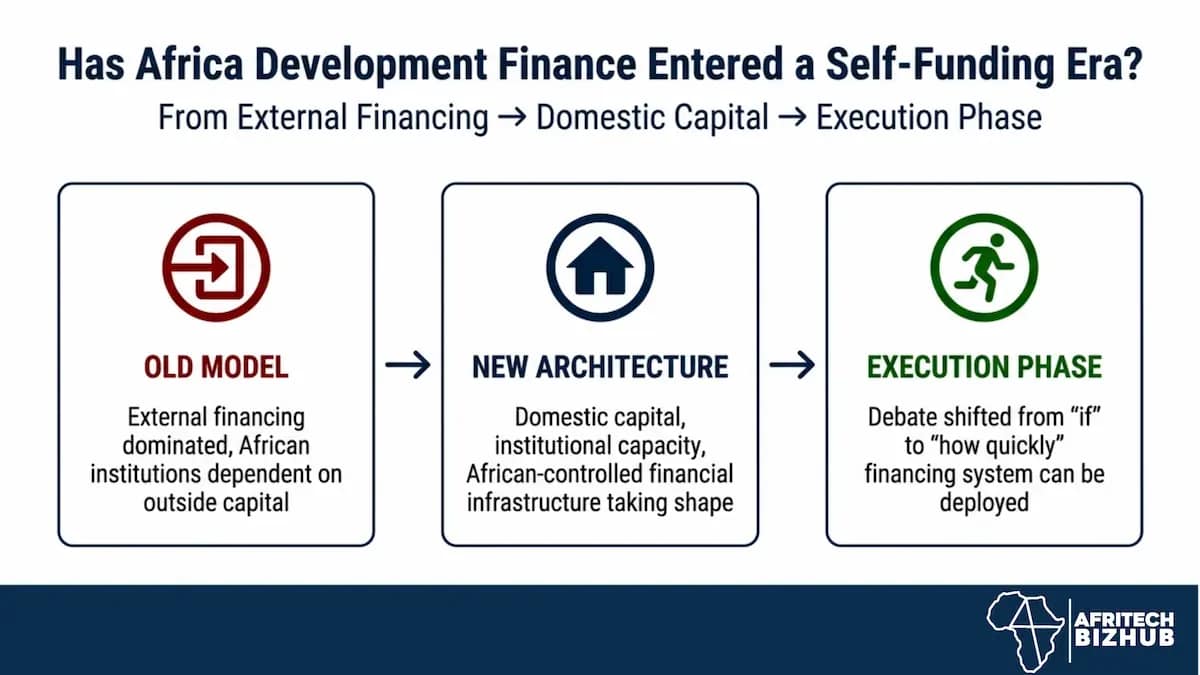
Has Africa Development Finance Entered a Self-Funding Era?
The direction appears increasingly clear. Africa Development Finance is entering a period in which domestic capital, institutional capacity, and African-controlled financial infrastructure are expected to play a larger role in financing the continent’s growth.
The significance of recent developments is not that every financing challenge has been solved.
It is that the architecture required to address them is increasingly taking shape.
The debate is shifting from whether Africa can finance more of its own development to how quickly that financing system can be deployed.
The world that shaped Africa’s previous development model is changing.
African institutions increasingly appear to be responding accordingly. The next phase will be defined by execution, but the direction of travel is becoming harder to ignore.


Recent Comments