


Last updated: June 16, 2026
Featured Summary:
- Africa is becoming a larger supplier of digital labour to global companies.
- Business Process Outsourcing is expanding beyond customer service into higher-value digital work.
- AI outsourcing is creating new demand for content moderation, data annotation, and specialised support services.
- Nigeria, Kenya, and South Africa are emerging as major destinations for global outsourcing contracts.
The global outsourcing market is entering a different phase.
Companies are no longer outsourcing only administrative functions, customer support, or back-office services.
Increasingly, they are outsourcing digital work that supports artificial intelligence systems, online platforms, data operations, and global business services.
That shift is creating opportunities for countries capable of supplying skilled labour at scale.
Across Africa, Nigeria, Kenya, and South Africa are positioning themselves inside a growing segment of the global economy that increasingly operates behind the platforms, AI systems, and digital services used worldwide.
The outsourcing opportunity is no longer about low-cost labour alone.
It is increasingly about access to skilled digital talent.
Why Is Business Process Outsourcing Growing In Africa?
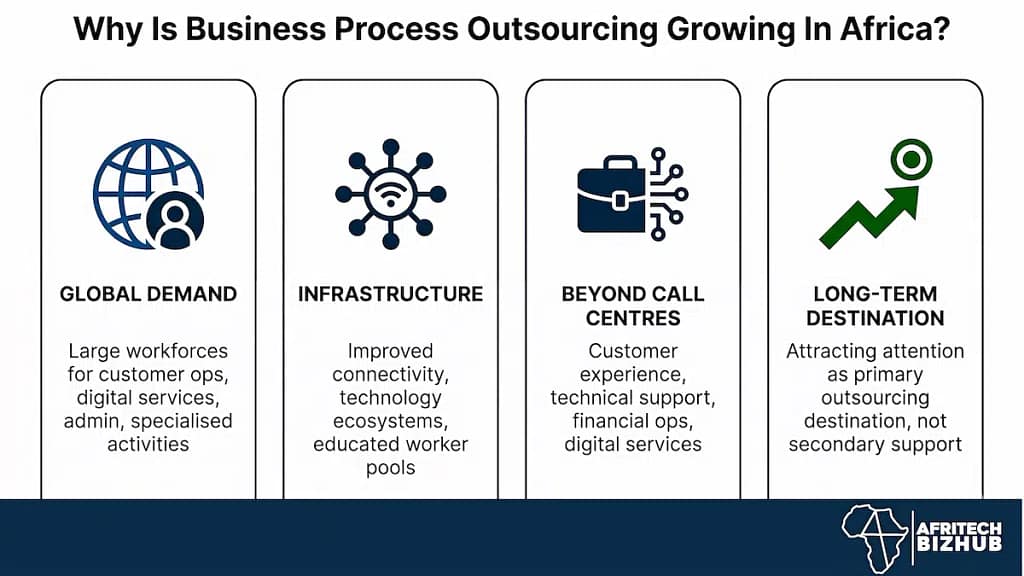
Business Process Outsourcing is expanding across Africa because global firms increasingly require large workforces capable of supporting customer operations, digital services, administrative functions, and specialised business activities.
Improvements in connectivity, growing technology ecosystems, and expanding pools of educated workers have strengthened the continent’s position within the global services economy.
The sector is also moving beyond traditional call-centre work.
Outsourcing contracts increasingly involve customer-experience management, technical support, financial operations, business processing, and digital services.
As companies search for operational efficiency while maintaining service quality, African markets are attracting greater attention as long-term outsourcing destinations rather than secondary support locations.
The misconception is that Business Process Outsourcing remains a low-value industry.
Increasingly, the sector is becoming an entry point into higher-value digital services, technology support, and knowledge-based work.
How Is The Outsourcing Market Shifting To Africa?
The outsourcing market is shifting toward Africa as global firms diversify operational footprints and seek access to new talent pools outside traditional outsourcing hubs.
Labour availability, language capabilities, workforce scale, and improving digital infrastructure continue influencing those decisions.
Nigeria, Kenya, and South Africa have emerged as particularly important markets because they combine large labour pools with established business environments and growing digital sectors.
The shift is also linked to broader changes in global services trade.
Companies increasingly compete for skilled labour rather than simply searching for the lowest operating costs.
That distinction matters.
The countries attracting the most outsourcing investment are increasingly those capable of supplying talent, reliability, and scale simultaneously.
Why Are Global Firms Expanding AI Outsourcing Operations?
Artificial intelligence has created demand for categories of outsourced work that require human involvement even as automation expands.
AI systems depend on data preparation, quality control, model evaluation, trust-and-safety operations, and continuous monitoring to maintain performance.
Global firms are expanding AI outsourcing operations because these functions often require large teams capable of delivering consistent outputs across multiple markets and languages.
The demand reflects a practical reality inside the AI industry.
Automated systems still rely heavily on human labour to improve accuracy, manage edge cases, review outputs, and support operational reliability.
One of the biggest misconceptions surrounding AI is that it eliminates human work.
In practice, the rapid expansion of AI has created new categories of digital labour operating behind the technology itself.
AI outsourcing has therefore become part of the infrastructure supporting the wider expansion of artificial intelligence.
How Is Content Moderation Creating Jobs In Africa?
Content Moderation has become a significant component of digital-platform operations.
Social-media companies, online marketplaces, and digital communities require large workforces capable of reviewing content, enforcing platform rules, and managing safety standards across millions of user interactions.
This operational demand has created employment opportunities across several African countries.
Kenya, South Africa, Ghana, and other markets have increasingly hosted teams responsible for reviewing content and supporting trust-and-safety functions for global technology platforms.
At the same time, the sector has generated wider discussions around labour protections, psychological welfare, and employment standards as digital labour becomes a more important part of the outsourcing economy.
The growth of Content Moderation reflects how platform companies increasingly rely on outsourced human infrastructure to support global digital operations.
The industry’s long-term credibility may depend as much on worker protections as job creation itself.
Why Is Data Annotation Demand Rising Across Africa?
Data Annotation sits at the foundation of many artificial intelligence systems.
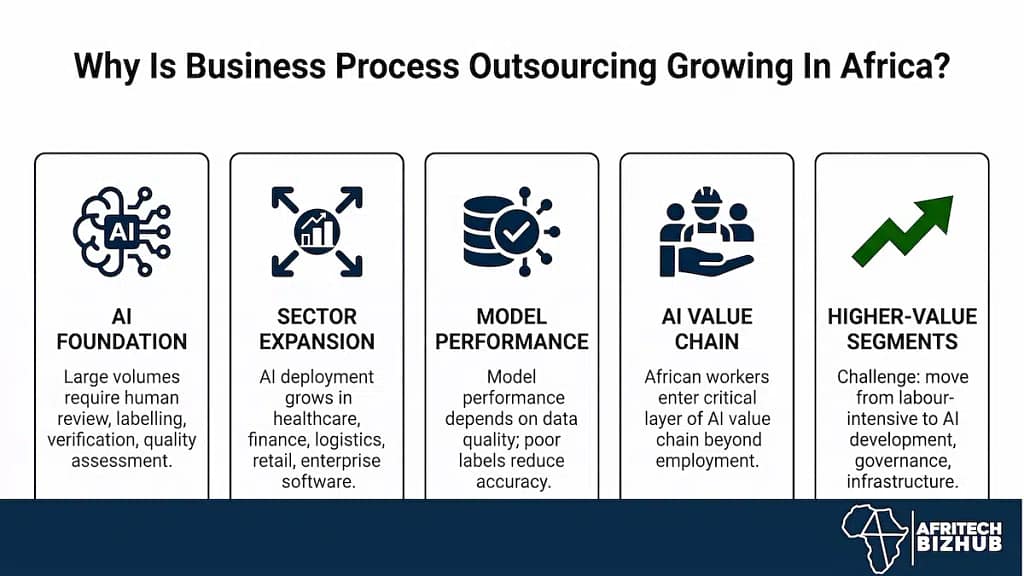
Before AI models can identify images, process language, classify information, or generate reliable outputs, large volumes of data often require human review, labelling, verification, and quality assessment.
Demand continues rising because AI deployment is expanding across sectors including healthcare, finance, logistics, retail, and enterprise software.
Companies invest in Data Annotation because model performance depends heavily on data quality.
Poorly labelled data can reduce accuracy, increase operational errors, and weaken commercial outcomes.
The opportunity for Africa extends beyond employment creation alone.
Data Annotation places African workers inside a critical layer of the AI value chain.
The bigger question is whether Africa remains a supplier of labour-intensive AI services or captures larger portions of the value chain linked to AI development, infrastructure, governance, and intellectual property.
That distinction will determine whether the outsourcing boom becomes a temporary employment story or a long-term digital-industrial opportunity.


Recent Comments