


Featured Summary:
- NDPC Nigeria and the National Broadcasting Commission have agreed to strengthen cooperation on data protection and privacy compliance.
- Consumer data is becoming increasingly important as broadcasters expand digital services, streaming platforms, and audience analytics.
- Data governance is emerging as a critical trust layer within Nigeria’s growing digital economy.
- Broadcasting regulation is increasingly extending beyond content oversight into consumer data protection.
Nigeria’s data protection regulator and broadcasting regulator are moving closer together as digital media generates larger volumes of consumer data.
The Nigeria Data Protection Commission (NDPC Nigeria) and the National Broadcasting Commission (NBC) recently agreed to deepen cooperation on data privacy, compliance, public awareness, and regulatory engagement.
The partnership arrives at a time when broadcasters are operating far beyond traditional television and radio services.
Streaming platforms, digital applications, audience analytics, targeted advertising, and online engagement now place media organisations among the country’s largest handlers of consumer data.
The agreement reflects a wider shift across Africa: digital growth is increasingly creating a data-governance challenge as much as an innovation opportunity.

How Will Nigeria Data Privacy Rules Impact Broadcasters?
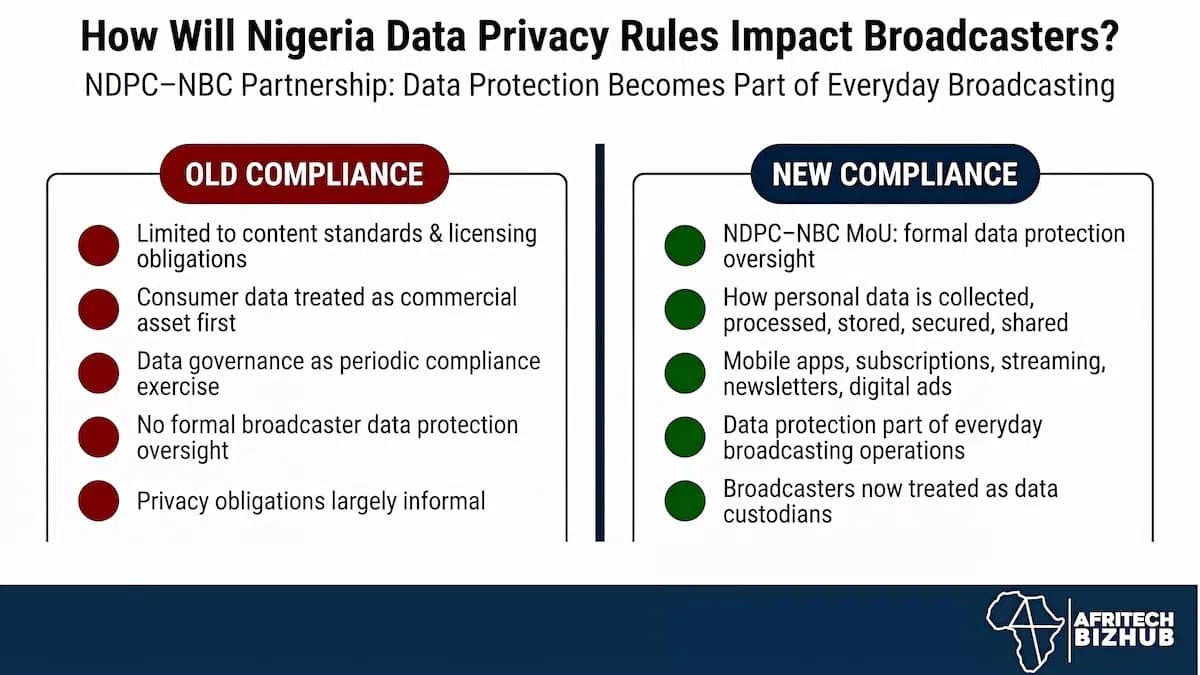
The partnership signals that broadcasters will increasingly be viewed as data custodians as well as content providers.
Media organisations now collect information through mobile applications, online subscriptions, streaming platforms, newsletters, audience surveys, digital advertising systems, and social-media engagement channels.
As those activities expand, so do responsibilities around data privacy and consumer data protection.
For broadcasters, compliance is no longer limited to content standards and licensing obligations.
It increasingly includes how personal information is collected, processed, stored, secured, and shared.
The uncomfortable reality is that many organisations still treat consumer data as a commercial asset long before they treat it as a governance responsibility.
Regulators are increasingly moving to close that gap.
The NDPC Nigeria–NBC partnership reflects a broader expectation that data protection must become part of everyday broadcasting operations rather than a periodic compliance exercise.
Why Is Data Protection Critical For Consumer Data?
Consumer data has become one of the most valuable resources in the digital economy.
Every digital interaction generates information that can be used to personalise services, support advertising, improve products, and strengthen business decision-making.
The value of that information continues growing as businesses rely more heavily on digital channels.
That value also creates risk.
Weak data protection practices expose individuals to identity theft, unauthorised data sharing, fraud, privacy breaches, and declining trust in digital systems.
Once trust erodes, participation often follows.
For Nigeria, the challenge is becoming increasingly urgent because digital adoption is accelerating across financial services, ecommerce, media, education, healthcare, and public services.
Digital economies do not lose credibility because they collect too much data.
They lose credibility when citizens stop trusting how that data is handled.
How Data Protection Shapes Africa Broadcasting Rules
Broadcasting regulation across Africa is gradually expanding beyond content supervision. As broadcasters develop digital products and rely more heavily on audience data, regulators are increasingly examining how privacy obligations intersect with media operations.
This shift is visible in multiple African markets where data-protection laws are strengthening alongside digital-economy policies.
The traditional distinction between media regulation and data governance is becoming harder to maintain.
Broadcasters now operate websites, mobile applications, digital advertising networks, and streaming platforms that generate significant volumes of consumer data.
That evolution carries continental implications.
Countries seeking stronger digital economies increasingly recognise that media trust and data trust are becoming interconnected.
Africa’s broadcasting industry is becoming a data industry as much as a content industry.
Can Data Governance Improve Nigeria’s Digital Economy Trust?
Trust is emerging as one of the most important assets in the digital economy.
Consumers are more willing to engage with digital services when they believe their information is protected.
Businesses are more willing to invest when regulatory expectations are clear.
Investors are more willing to support digital ecosystems where governance frameworks reduce uncertainty.
According to the official statement issued by the Nigeria Data Protection Commission, the engagement between NDPC Nigeria and the National Broadcasting Commission is intended to strengthen compliance, promote awareness, deepen institutional cooperation, and improve implementation of data protection obligations within Nigeria’s broadcasting ecosystem.
The significance extends beyond broadcasting regulation.
Stronger data governance supports confidence across financial services, digital commerce, telecommunications, education technology, healthcare platforms, and media services.
Nigeria’s digital economy ultimately depends not only on how much consumer data is generated, but on how effectively that data is governed.
How Will Broadcasting Regulation Enhance Data Privacy Standards?
Broadcasting regulation is entering a new phase where audience protection increasingly includes data protection.
Historically, broadcasting regulation focused on content standards, licensing frameworks, public-interest obligations, and market conduct.
Digital transformation is expanding that responsibility.
Regulators now face growing pressure to ensure that consumer rights remain protected across both content consumption and data collection activities.
The NDPC Nigeria partnership reflects that transition.
It acknowledges that consumer protection no longer ends when a programme is broadcast.
It increasingly extends to what happens before, during, and after audience data is collected.
For Nigeria, the implications reach beyond the media industry.
Stronger data privacy standards can improve confidence in digital services, encourage broader participation in online platforms, and strengthen the foundations of long-term digital growth.
Nigeria can continue expanding digital services, digital media, and digital commerce.
But if consumers stop trusting how their information is handled, growth eventually becomes a trust problem rather than a technology problem.
That is the risk data governance is trying to prevent.


Recent Comments