


Featured Summary:
- Malawi tax gains are rising as digital invoicing improves transaction visibility and strengthens domestic revenue systems.
- Digital invoicing is helping tax authorities improve tracking efficiency and reduce information gaps across economic activity.
- The Value Added Tax system is benefiting from stronger reporting and more transparent transaction records.
- Tax compliance increasingly depends on digital visibility rather than higher tax rates alone.
Across Africa, governments face growing pressure to increase domestic revenue without placing additional burdens on businesses and households.
Tax authorities are increasingly turning to technology to improve visibility into economic activity, strengthen compliance, and reduce revenue leakages that have historically limited collection performance.
Malawi tax authorities are pursuing that objective through digital invoicing systems designed to improve transaction reporting and strengthen tax administration.
The significance extends beyond Malawi itself.
As countries across Africa modernise revenue systems, the broader question is whether better information can generate stronger revenue outcomes without relying solely on new taxes or higher rates.
Malawi’s experience suggests that digital systems are becoming one of the most powerful tools available to governments seeking to improve domestic revenue performance.
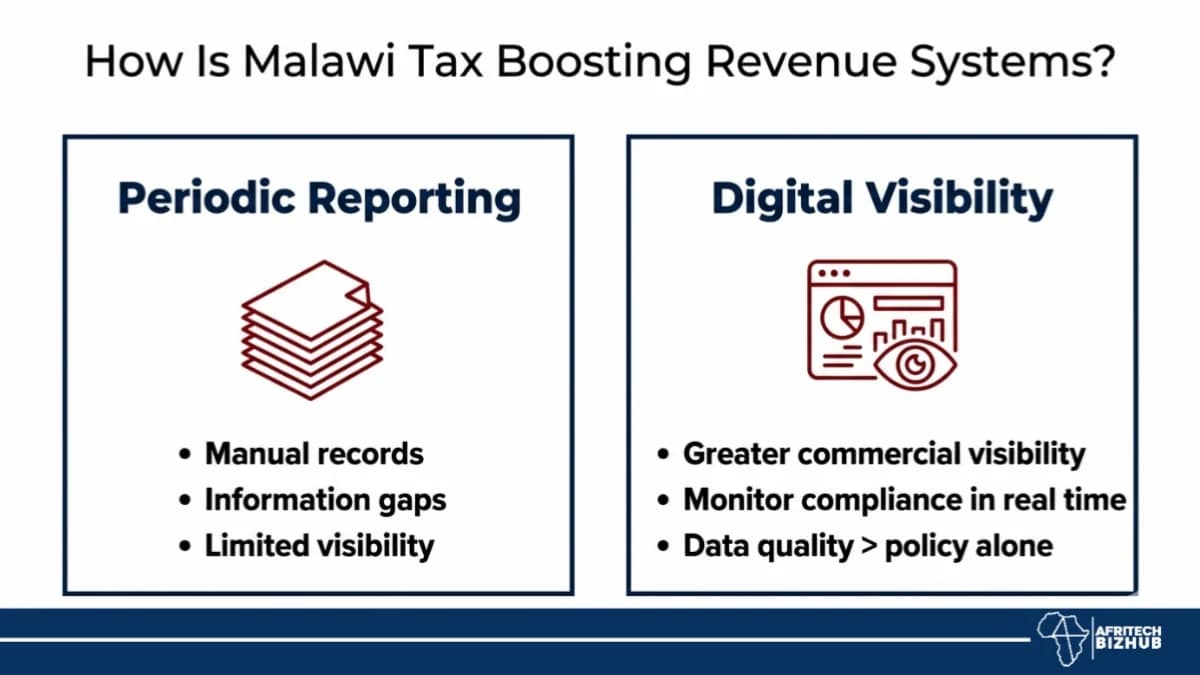
How is Malawi Tax Boosting Revenue Systems?
Malawi tax authorities are boosting revenue systems by improving the way economic transactions are recorded, reported, and monitored.
Digital tools are providing tax administrators with greater visibility into commercial activity, helping reduce information gaps that can limit effective revenue collection.
The shift reflects a broader change in tax administration.
Revenue authorities increasingly depend on data quality and transaction visibility rather than periodic reporting alone.
Digital systems make it easier to identify inconsistencies, monitor compliance, and improve the accuracy of tax records across different sectors of the economy.
The deeper significance is that Malawi tax performance is becoming increasingly linked to information management.
Governments often focus on tax policy when discussing revenue growth.
In practice, stronger visibility into economic activity can be equally important.
Revenue systems cannot collect what they cannot see.
Is Digital Invoicing Improving Tax Tracking Efficiency in Africa?
Digital invoicing is improving tax tracking efficiency in Africa by creating more transparent records of commercial transactions.
Electronic invoicing systems allow tax authorities to receive information more quickly, improve verification processes, and reduce reliance on manual documentation.
The benefits extend beyond tax administration.
Businesses gain more structured record-keeping systems, while governments improve their ability to monitor economic activity in real time.
This creates stronger foundations for compliance, auditing, and revenue forecasting.
Malawi’s experience mirrors a broader shift taking place across Africa as tax authorities increasingly treat data infrastructure as revenue infrastructure.
The countries improving transaction visibility are often improving tax administration efficiency at the same time.
That relationship explains why digital invoicing is attracting growing attention among revenue authorities across the continent.
Does Value Added Tax system Improve Compliance?
The Value Added Tax system can improve compliance when supported by accurate transaction reporting and effective monitoring systems.
VAT relies heavily on transaction records, making visibility an important factor in determining how effectively the system operates.
Digital invoicing strengthens the Value Added Tax system by creating clearer audit trails and improving the ability of tax authorities to verify reported transactions.
Better reporting reduces opportunities for underreporting while improving confidence in tax data.
The Value Added Tax system becomes significantly more effective when supported by reliable digital infrastructure.
Compliance improves not simply because regulations exist, but because authorities gain greater capacity to verify economic activity.
The combination of VAT and digital reporting is increasingly becoming a central feature of modern tax administration across African economies.
How is Tax Collection Reaching Record Levels?
Tax collection is reaching stronger levels because revenue authorities are gaining greater visibility into economic activity.
Digital systems reduce reporting gaps, improve verification, strengthen audit capabilities, and make it more difficult for taxable transactions to remain outside formal records.
According to the Malawi Revenue Authority, electronic systems play an important role in supporting tax administration, compliance monitoring, and revenue collection activities.
As more economic activity becomes digitally recorded, tax authorities gain greater visibility into the transactions that generate taxable revenue.
The important lesson is that tax collection growth does not always require new taxes.
In many cases, stronger administration and better information can improve revenue outcomes.
Africa’s revenue challenge is not always a tax-rate problem.
It is often a visibility problem.
Governments can increase rates repeatedly, but collection efficiency improves only when economic activity becomes easier to track, verify, and report.
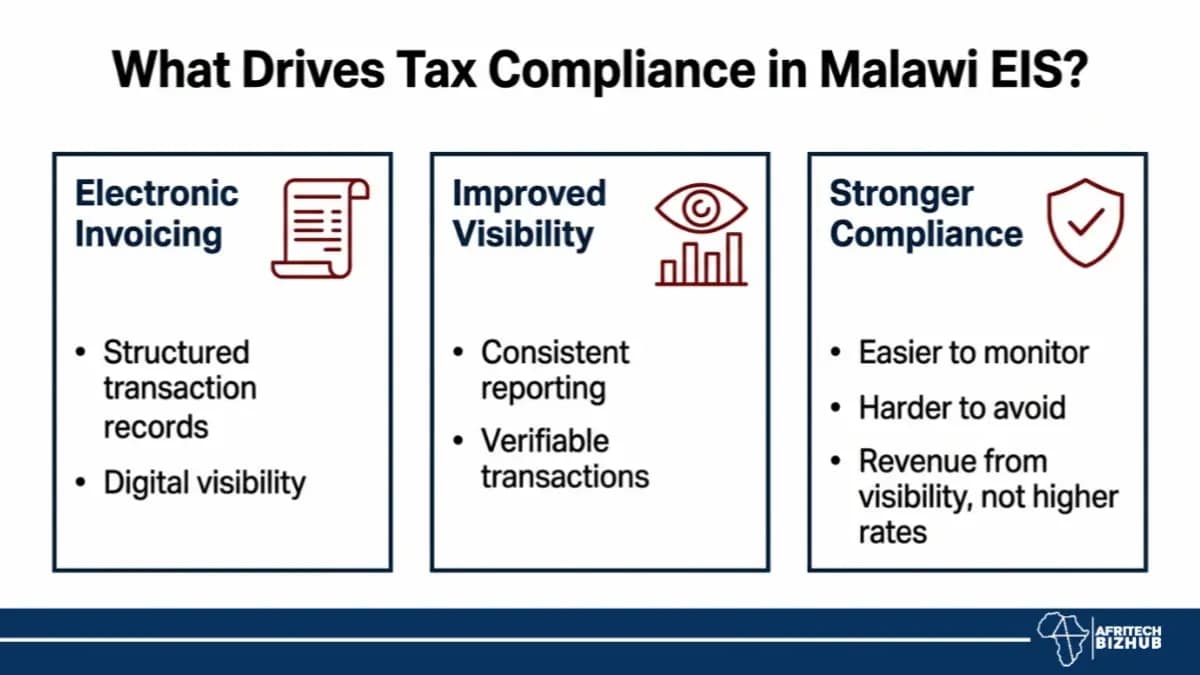
What Drives Tax Compliance in Malawi EIS?
Tax compliance in Malawi EIS is increasingly driven by transparency, reporting accuracy, and improved visibility into economic activity.
Electronic invoicing systems create structured records that make compliance easier for businesses while improving monitoring capabilities for tax authorities.
The system also changes incentives.
When transaction reporting becomes more consistent and verifiable, compliance becomes easier to monitor and more difficult to avoid.
This strengthens confidence in the overall tax framework while improving administrative efficiency.
The broader lesson from Malawi tax gains is that revenue growth increasingly depends on visibility rather than higher tax rates.
Governments often assume revenue shortages require new taxation measures.
Digital systems suggest that better information may be equally important.
As more African countries expand electronic invoicing systems, the competition may increasingly shift from tax policy to tax administration.
The countries that understand economic activity most clearly may ultimately generate the strongest domestic revenue outcomes.
Governments often search for new taxes when revenue disappoints.
Malawi’s experience suggests that seeing economic activity more clearly may be just as important as taxing it.


Recent Comments