


Featured Summary:
- Cybercrime Africa is growing alongside the continent’s expanding digital economy.
- Criminal networks increasingly exploit differences in enforcement, regulation, and coordination across countries.
- Africa cybersecurity capabilities continue improving, but readiness remains uneven.
- Strong digital governance may ultimately prove more important than technology alone in reducing cybercrime.
Africa’s digital economy is growing faster than many of the systems designed to protect it.
Mobile money transactions continue expanding.
Digital banking continues expanding.
Ecommerce continues expanding.
Governments are moving services online.
Businesses increasingly depend on cloud infrastructure and connected systems.
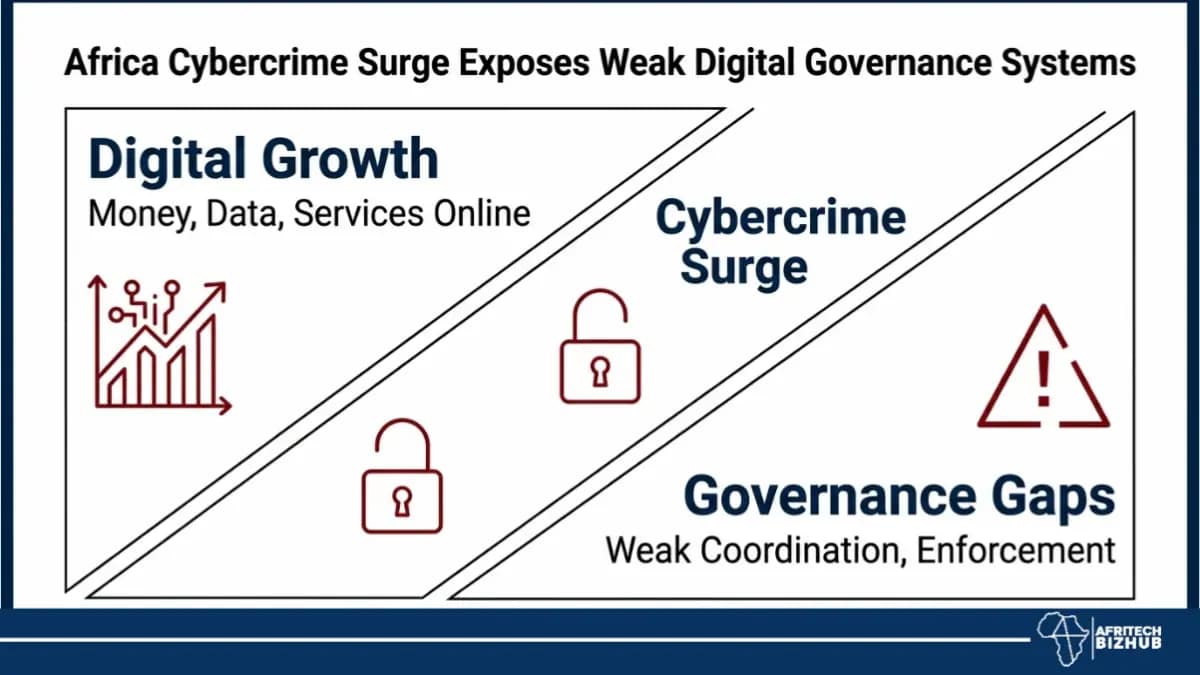
Every year, more money, data, and economic activity move through digital channels.
Cybercriminals have noticed.
The continent’s cybercrime challenge is often discussed as a technology problem.
Increasingly, it looks like a governance problem.
Criminal networks move across borders with relative ease.
Enforcement systems often do not.
Digital services scale rapidly.
Regulatory coordination frequently moves more slowly.
That gap is becoming one of the defining risks facing Africa’s digital economy.
Why Is Cybercrime Africa Rapidly Increasing?
The answer begins with scale.
More people are banking online.
More businesses rely on digital systems.
More services operate through connected platforms.
More transactions take place electronically.
The value concentrated inside digital networks continues increasing.
Cybercriminals tend to follow concentration of value.
The same infrastructure that makes payments faster, commerce easier, and services more accessible also creates new opportunities for fraud, data theft, financial crime, and cyber attacks.
Growth expands opportunity for legitimate users.
It expands opportunity for criminals as well.
That reality should not be mistaken for failure.
Digital adoption is not creating cybercrime.
It is creating larger targets.
The faster digital activity grows, the more pressure falls on the institutions responsible for protecting it.
How Is Cybercrime Exploiting African Borders Today?
The internet rarely respects national boundaries.
Criminal networks understand this better than most institutions.
A cybercriminal can target victims in multiple countries, move stolen funds through different financial systems, use infrastructure hosted elsewhere, and operate across jurisdictions without physically crossing a border.
Law-enforcement agencies often do not enjoy the same flexibility.
This creates an asymmetry that favours criminals.
Different reporting standards, legal frameworks, investigative capabilities, and enforcement procedures create gaps that organised cybercrime groups can exploit.
A crime that begins in one country may quickly become an investigation involving several others.
The result is that cybercrime increasingly behaves like a regional challenge while many response mechanisms remain largely national.
Is Africa Cybersecurity Ready For Rising Threats?
The continent is stronger than it was a decade ago.
Many countries now operate national cybersecurity strategies.
Incident-response teams are more common.
Regulatory frameworks have expanded.
Governments increasingly recognise cyber resilience as part of economic security rather than simply technical security.
Progress is real.
The challenge is that cybercriminals are improving at the same time.
Readiness remains uneven across the continent.
Large financial institutions often maintain sophisticated cyber defence capabilities.
Smaller organisations frequently operate with fewer resources, fewer specialists, and weaker protection systems.
Africa cybersecurity is therefore advancing on two tracks.
Capability is improving.
Exposure is increasing.
The race between the two remains unresolved.
Can Cyber Defence Stop Cross-Border Criminal Networks?
Technology remains essential, but technology alone cannot solve a coordination problem.
Criminal groups share tools, intelligence, infrastructure, and tactics.
Effective cyber defence increasingly requires governments, regulators, businesses, financial institutions, and enforcement agencies to operate with similar levels of coordination.
According to the International Telecommunication Union’s Global Cybersecurity Index, countries that strengthen legal measures, technical capabilities, organisational structures, cooperation frameworks, and skills development generally improve their cyber resilience.
The lesson is increasingly difficult to ignore.
Criminal networks collaborate across borders.
Cyber defence must do the same.
How Weak Digital Governance Fuels Cybercrime Surge?
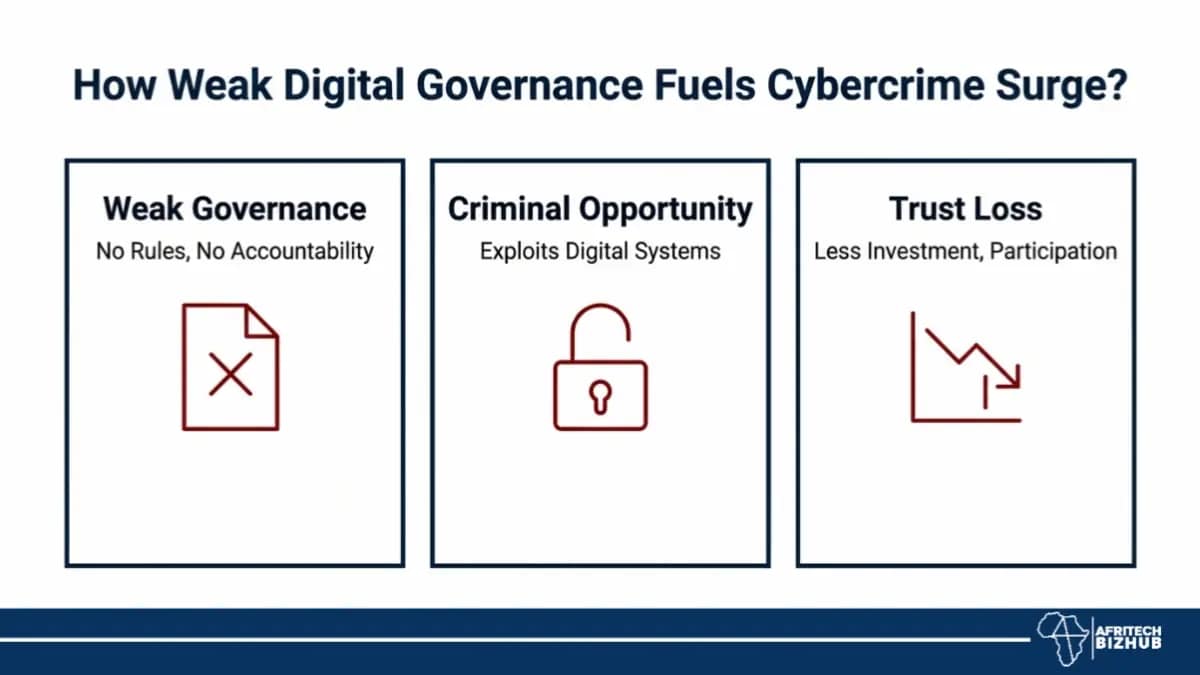
Africa’s cybercrime problem is increasingly not a shortage of technology.
It is a shortage of coordination.
Digital governance determines how institutions share information, enforce standards, protect data, manage digital identities, investigate cybercrime, and respond to incidents.
When those systems are fragmented, cybercriminals inherit advantages that technology alone cannot eliminate.
Strong cybersecurity tools can protect individual systems.
Strong digital governance protects the environment in which those systems operate.
That distinction matters because trust sits at the centre of every digital economy.
Consumers share information because they trust platforms.
Businesses invest because they trust systems.
Financial institutions expand services because they trust enforcement mechanisms.
Once that trust weakens, digital growth becomes more difficult to sustain.
Africa’s digital future will not be determined solely by how many people come online or how many services become digital.
It will be determined by whether institutions can build governance systems capable of protecting those services once they scale.
The next phase of Africa’s cybercrime challenge is unlikely to be won by technology alone.
It will be won by the countries that coordinate faster than the criminals they are trying to stop.


Recent Comments