


Featured Summary:
- African cybersecurity is shifting from perimeter defense to continuous verification as digital systems become more interconnected.
- Cloud computing Africa is increasing business efficiency while expanding the number of potential security exposure points.
- AI cybersecurity risks are creating new challenges around automation, identity verification, and threat detection.
- Digital transformation in Africa is changing how organizations define trust, access, and enterprise security.
Africa’s digital economy is becoming more connected, more data-driven, and more dependent on cloud infrastructure.
Governments are digitizing services, banks are expanding digital platforms, businesses are moving operations into cloud environments, and artificial intelligence is increasingly being integrated into everyday workflows.
These developments are creating new opportunities for growth, but they are also exposing a weakness in traditional security models.
Many security frameworks were built on an assumption that is becoming increasingly difficult to defend: that users, devices, and systems inside a network can be trusted by default.
Digital transformation is making that assumption harder to sustain.
The challenge is no longer simply preventing cyberattacks.
The challenge is determining who and what should be trusted in increasingly complex digital environments.
As Africa cybersecurity evolves alongside rapid technological adoption, trust itself is becoming a security issue.
Why Is Africa Cybersecurity Moving Toward Zero Trust?
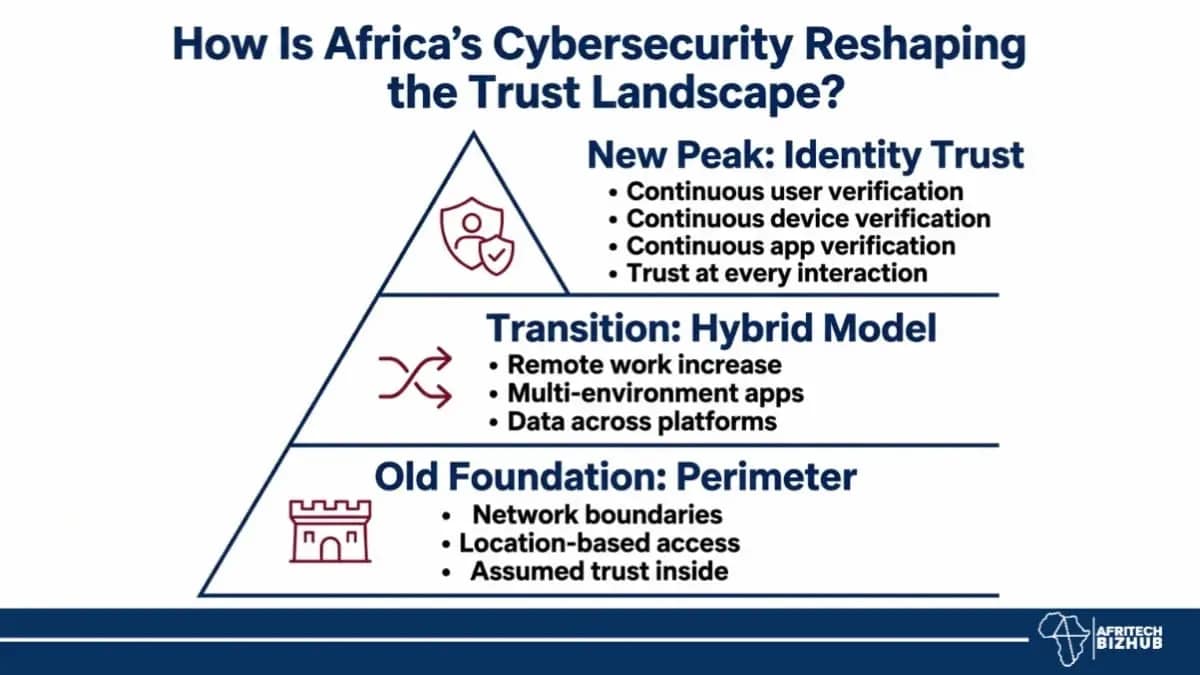
Africa cybersecurity is increasingly moving toward Zero Trust because organizations can no longer rely on traditional network boundaries to determine who should have access to critical systems.
Employees work remotely, applications operate across multiple environments, and sensitive information moves continuously between cloud platforms, partners, and third-party services.
As a result, security strategies are becoming identity-focused.
Organizations increasingly verify users, devices, and applications continuously rather than granting broad access based solely on location or network presence.
The shift reflects a practical reality.
Trust can no longer be assumed simply because a user appears to be operating inside an organization’s digital environment.
The consequence is significant.
Africa cybersecurity is becoming less about protecting a perimeter and more about validating trust at every stage of digital interaction.
Organizations that continue relying on assumptions of trust may discover that the network edge disappeared long before their security strategy adapted.
Why Is Cloud Computing Africa Expanding Security Exposure?
Cloud computing Africa is expanding security exposure because it increases the number of systems, applications, users, and third-party services connected to organizational operations.
Businesses gain scalability, flexibility, and lower infrastructure costs, but they also increase the number of locations where sensitive information can be accessed, transferred, or stored.
The risk is not cloud technology itself.
The risk emerges when organizations move critical operations into cloud environments without strengthening governance, visibility, and security controls.
Weak access management, misconfigured cloud environments, and poor oversight remain among the most common causes of security incidents globally.
Cloud adoption creates a trade-off.
It improves business agility while simultaneously increasing the importance of disciplined security management.
As cloud computing Africa continues expanding, the institutions that treat security as a strategic function rather than a technical afterthought will be the ones best positioned to manage digital risk.
How Is Cloud Computing Reshaping Enterprise Security?
Cloud computing is reshaping enterprise security by changing how organizations manage access, monitor activity, and protect information across increasingly distributed environments.
Traditional security models focused heavily on protecting company-owned infrastructure.
Modern environments require organizations to secure users, identities, applications, and data that may exist across multiple platforms.
This shift requires greater emphasis on authentication, access management, encryption, monitoring, and governance.
Enterprise security increasingly depends on visibility.
Organizations must know who is accessing information, when access occurs, what systems are involved, and whether unusual behavior is taking place.
For many organizations, enterprise security is becoming an operational discipline rather than a purely technical one.
Security failures increasingly emerge from governance weaknesses as much as technology weaknesses.
The organizations that succeed will be those that treat security decisions as business decisions rather than IT decisions.
What Is Driving AI Cybersecurity Risks Across Africa?
AI cybersecurity risks are being driven by the growing ability of artificial intelligence to automate activities that previously required significant human effort.
AI can strengthen defensive capabilities through threat detection, automation, and monitoring.
It can also be used to generate sophisticated phishing campaigns, create convincing synthetic content, automate reconnaissance, and support adaptive cyberattacks.
The challenge is not that AI creates entirely new forms of cybercrime.
The challenge is that AI allows existing threats to operate faster, at greater scale, and with far less human effort.
Attackers can potentially reach more targets, test more vulnerabilities, and refine attacks more efficiently than before.
According to the National Institute of Standards and Technology’s Zero Trust Architecture framework, modern security environments increasingly require continuous verification of users, devices, and systems rather than assumptions of trust based on network location.
The debate around AI cybersecurity is often framed as a technology discussion.
It is increasingly a trust discussion.
The question is no longer whether organizations will use AI.
The question is whether their security frameworks can evolve as quickly as the technology itself.
Will Digital Transformation Make Trust Africa’s New Security Challenge?
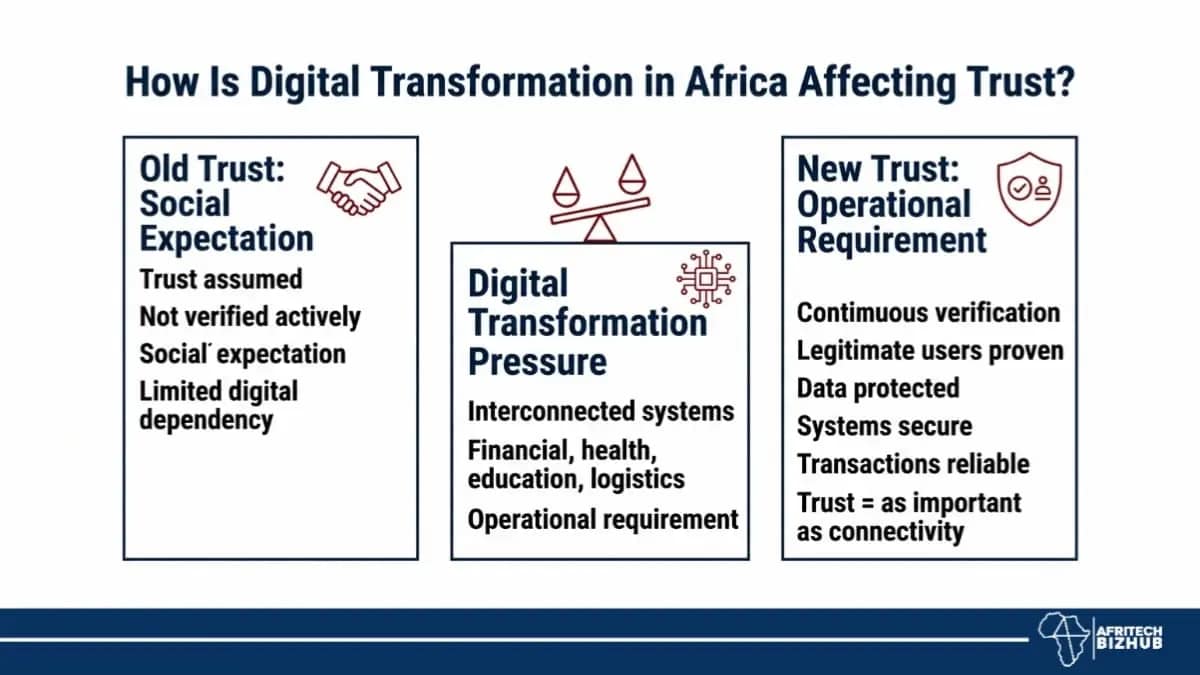
Digital transformation is changing how trust is established across Africa’s economy.
Financial services, healthcare systems, logistics networks, public administration platforms, educational services, and enterprise operations increasingly depend on digital infrastructure and continuous data exchange.
As these systems become more interconnected, trust becomes an operational requirement rather than a social expectation.
Organizations must continuously demonstrate that users are legitimate, data is protected, systems are secure, and transactions can be relied upon.
Trust is increasingly being built through verification rather than assumption.
The first phase of Africa’s digital transformation focused on expanding access.
The next phase will focus on proving trust.
Organizations that fail to verify users, devices, and systems continuously will discover that digital growth and cyber resilience do not automatically arrive together.
Connectivity built Africa’s digital economy.
Trust will determine whether it remains secure.


Recent Comments