


Featured Summary:
- A vessel that recently delivered a Nigeria LNG cargo became the first LNG carrier in four months to transit the Bab el-Mandeb Strait.
- The voyage highlights how geopolitical tensions continue to influence shipping decisions, freight costs and maritime risk across global energy markets.
- Nigeria gas exports benefit from an Atlantic location, but global shipping disruption still affects freight availability, insurance costs and buyer confidence.
- Energy exporters that combine reliable production with flexible logistics are likely to strengthen their position as geopolitical uncertainty reshapes global LNG trade.
Global energy markets are being shaped by the ability to deliver fuel safely as much as by the capacity to produce it.
Maritime chokepoints such as the Bab el-Mandeb Strait, the Suez Canal and the Strait of Hormuz now influence vessel availability, freight economics and supply security across interconnected LNG markets.
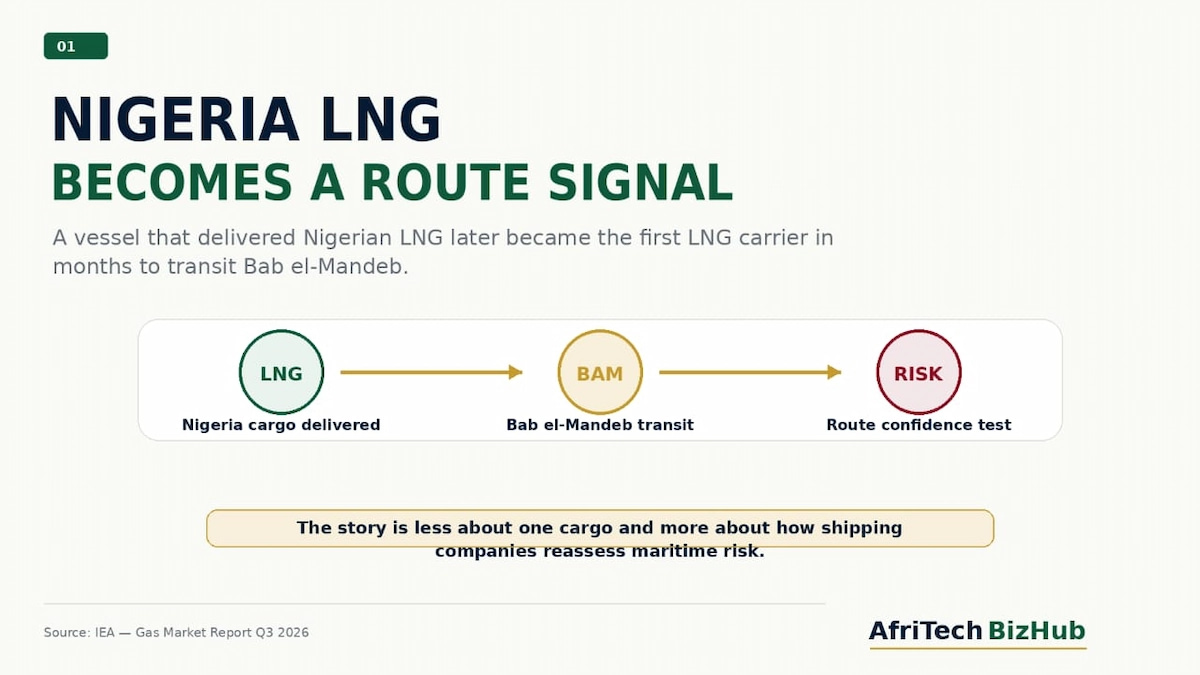
That risk returned to focus after GasLog Salem discharged a Nigeria LNG cargo in Bangladesh and then became the first LNG carrier since March 2026 to transit the Bab el-Mandeb Strait.
The Nigerian cargo did not pass through the Red Sea, making the voyage less a change in Nigeria’s export strategy than a test of whether LNG shipping could begin using a corridor operators had largely avoided for four months.
Why Did Nigeria LNG Cross the Strait?
Nigeria LNG did not send its cargo through the Bab el-Mandeb Strait.
GasLog Salem had already delivered the Nigeria-origin shipment in Bangladesh before sailing north towards the Red Sea.
The sequence matters because the transit reflected a vessel-routing decision after cargo discharge rather than a new route for Nigerian gas exports.
The carrier had remained off Sri Lanka for about a week before proceeding towards the strait.
Its passage attracted market attention because no LNG carrier had used the corridor since March 2026, signalling that at least one commercial operator was prepared to test the route despite continuing security uncertainty.
One successful transit does not establish that regular LNG traffic has returned or that shipowners now view the corridor as low risk.
It provides a limited indication that route decisions are being reassessed voyage by voyage.
The movement represented a test of commercial confidence rather than a change in Nigeria LNG’s export strategy.
How is the Red Sea Route Facing Risks?
The Bab el-Mandeb Strait connects the Red Sea with the Gulf of Aden and forms part of the maritime route linking Asia and Europe through the Suez Canal.
Security threats along the corridor have pushed LNG carriers and other commercial vessels towards alternative routes, particularly the longer passage around the Cape of Good Hope.
Diversions carry direct operating consequences.
Longer voyages consume more fuel, keep vessels occupied for additional days and reduce the number of ships available for new cargoes.
Higher security exposure can also affect insurance terms, charter decisions and the willingness of crews and vessel owners to accept particular routes.
The Red Sea route therefore influences more than the delivery time of an individual shipment.
Extended diversions can tighten shipping availability and raise transport costs across the wider LNG market, including for cargoes that never enter the corridor.
Maritime insecurity has become a commercial variable built into energy-shipping decisions.
Can Nigeria Gas Exports Survive Disruptions
Nigeria gas exports benefit from the location of the NLNG plant and export terminal on Bonny Island in the Atlantic Basin.
Cargoes bound for Europe, the Americas and other Atlantic markets do not need to cross the Red Sea or the Strait of Hormuz, reducing Nigeria’s direct dependence on the maritime chokepoints disrupting Gulf exporters.
That geographical advantage does not isolate Nigeria from global shipping pressure.
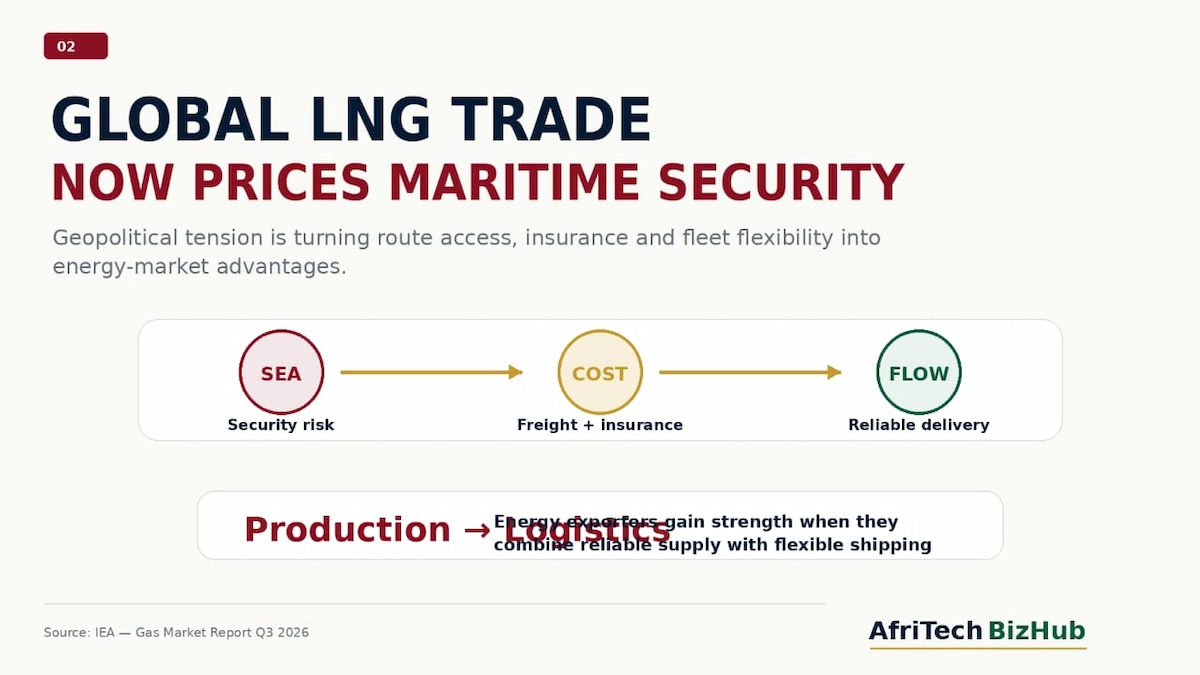
LNG vessels operate across interconnected markets, and longer voyages elsewhere can reduce charter availability, raise freight costs and change where shipowners deploy their fleets.
Buyers may also reassess delivery terms and destination flexibility when geopolitical risks alter normal trading routes.
Nigeria LNG can strengthen its resilience through reliable production, dependable vessel access and the flexibility to serve customers through different commercial arrangements.
Its Atlantic location creates route options, but export competitiveness still depends on whether cargoes can be delivered on time and at costs buyers are prepared to accept.
How Is Geopolitical Risk Reshaping Global LNG Trade?
The International Energy Agency said the Middle East conflict had disrupted a global gas market that was previously moving towards looser supply conditions.
The effective closure of the Strait of Hormuz interrupted LNG flows representing almost 20% of global supply, creating price volatility and forcing buyers and traders to reassess the security of major export routes.
Supply growth from North America, Africa and Australia is expected to offset much of the decline in Gulf exports during 2026.
That shift gives non-Gulf producers greater strategic importance as buyers diversify supply and reduce dependence on cargoes exposed to the same maritime chokepoints.
Geopolitical risk is therefore changing how global LNG trade values production.
Export volume remains important, but buyers are placing greater weight on route flexibility, vessel access and the ability to deliver through disruption.
Energy markets are rewarding supply chains that can redirect cargoes without losing commercial reliability.
How Will Maritime Security Shape Future Energy Markets?
Maritime security is becoming part of the competitive structure of global energy markets.
Exporters, buyers and shipping companies can no longer assume that the shortest route will remain available throughout a supply contract.
Voyage planning must account for security exposure, insurance, fleet deployment and the cost of redirecting cargoes when a chokepoint becomes commercially unusable.
The GasLog Salem transit does not show that the Red Sea has returned to normal.
It shows that operators are testing whether individual voyages can resume under changing risk conditions.
Nigeria LNG may benefit from an Atlantic export base, but its position will still depend on reliable production and access to vessels capable of serving different markets when established routes are disrupted.
The larger advantage will belong to exporters that can combine dependable supply with flexible logistics, diverse destinations and resilient shipping arrangements.
As geopolitical uncertainty reshapes global LNG trade, energy competitiveness will be measured not only by how much gas a country produces, but by how reliably it can deliver that gas to the customer.


Recent Comments