


Featured Summary:
- Company incorporation in Nigeria and Rwanda is moving towards faster, fully digital systems that reduce the administrative burden of creating a formal enterprise.
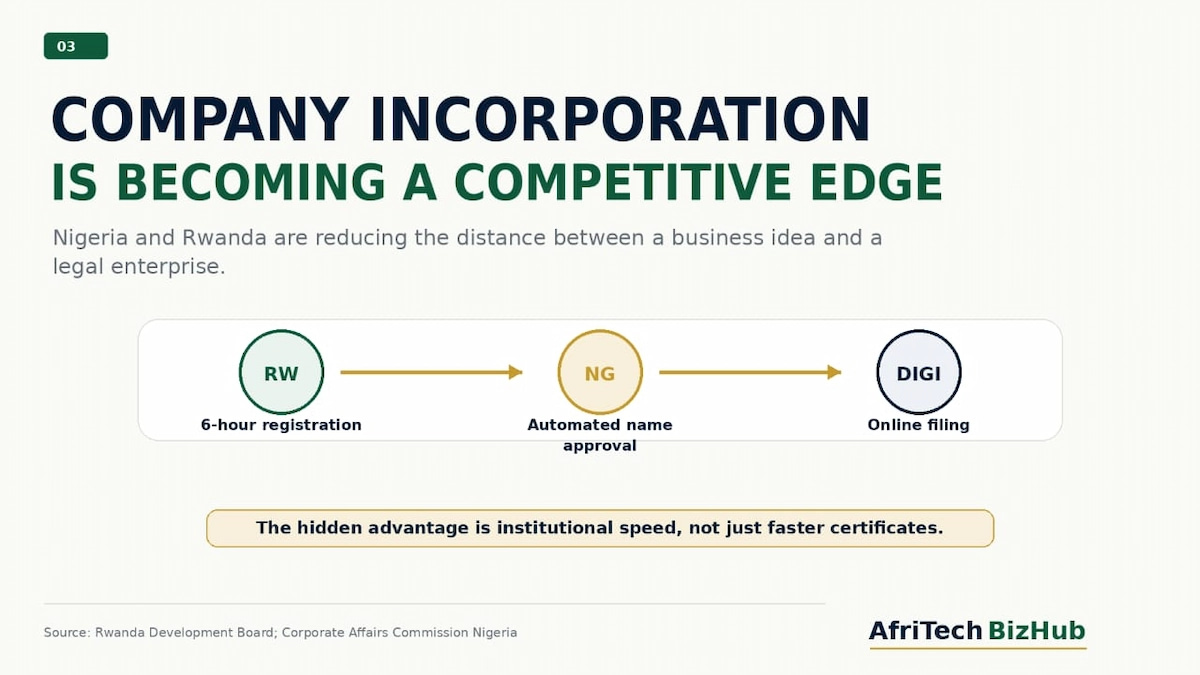
- Rwanda completes compliant business-registration applications within six working hours, while Nigeria has automated name approval and some business-name registrations through its intelligent registration portal.
- Faster registration lowers entry costs, but entrepreneurs still need access to finance, licences, tax systems and reliable infrastructure before incorporation can translate into operating growth.
- The deeper advantage lies in institutional capacity: countries that connect registration, identity, tax and compliance systems make it easier for businesses to enter, scale and operate formally.
Company incorporation is becoming part of the competition among African economies for entrepreneurs, capital and regional business activity.
Rwanda completes compliant registration applications within six working hours and offers the service without a registration fee, while Nigeria has moved company and business-name filings onto an end-to-end digital portal with electronic certificates and integrated payments.
The hidden advantage is not certificate speed alone.
Nigeria and Rwanda are reducing the institutional distance between a business idea and a legally recognised enterprise by moving identity checks, name approval, payments and corporate records into digital systems.
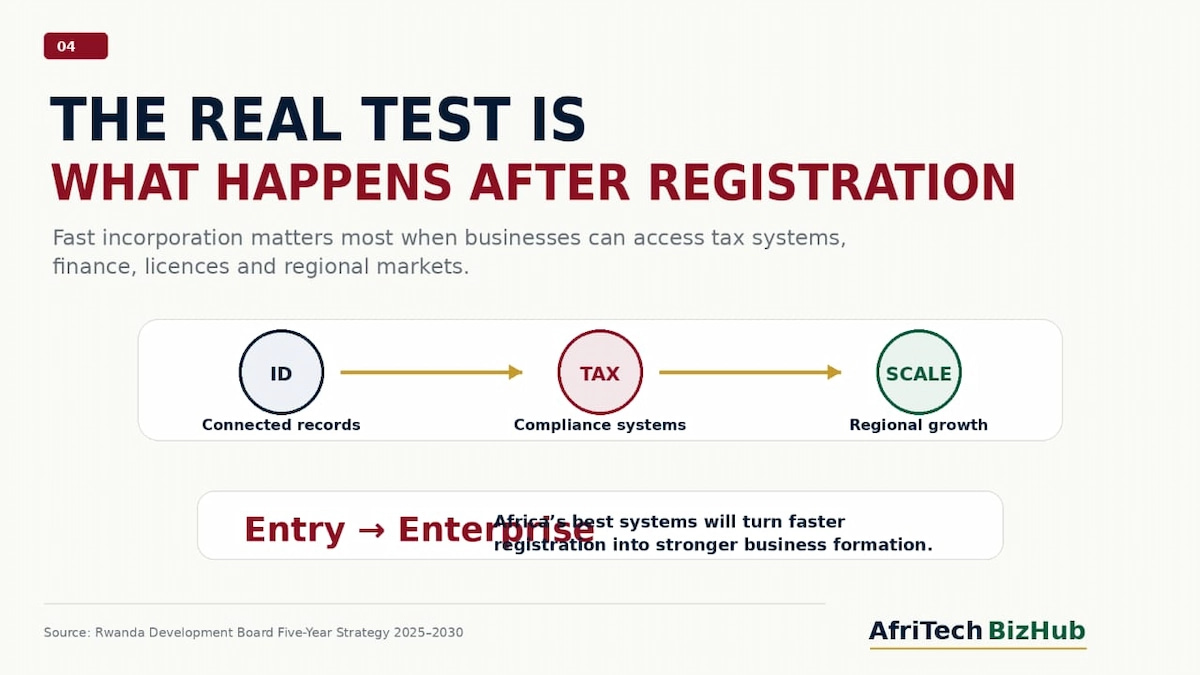
Faster registration matters because it gives founders earlier access to formal contracts, banking relationships and regulated commercial opportunities, but its lasting value depends on how effectively the rest of the business environment connects to that first legal step.
Why is Company Incorporation Faster in Nigeria and Rwanda?
Company incorporation is faster in Rwanda because business registration is concentrated within the Rwanda Development Board and structured as an integrated administrative service.
Compliant applications are processed within six official working hours, while the wider one-stop model connects incorporation with tax and employee social-security registration instead of requiring founders to begin separate processes across several agencies.
Nigeria is using automation to reduce delays within a much larger registry.
The Corporate Affairs Commission’s intelligent Company Registration Portal provides real-time name checks, instant approval for ordinary name reservations after payment and automated processing for qualifying business-name applications.
Private companies, limited partnerships, limited liability partnerships and incorporated trustees still pass through manual regulatory review, meaning the system has accelerated selected stages without making every form of incorporation instantaneous.
The two countries therefore represent different reform models.
Rwanda has built a tightly integrated registration process around a smaller administrative system, while Nigeria is using automation to manage a far larger volume of entities and filings.
Their common advantage is the reduction of avoidable manual intervention before a compliant business receives legal recognition.
Can Starting a Business in Africa Become Easier Now?
Starting a business in Africa becomes easier when founders spend less time securing the legal status required to trade formally.
Delayed incorporation can postpone corporate bank accounts, enforceable contracts, regulated licences and access to customers or institutions that require verified company records.
Nigeria’s CAC identifies legal recognition, corporate banking, formal contracting and access to financial or government services among the commercial benefits of registration.
A faster certificate does not remove the wider cost of operating a company.
New enterprises may still need tax activation, sector approvals, municipal permits, finance, insurance, electricity and reliable digital infrastructure before they can generate revenue.
Complicated post-registration obligations can also push smaller businesses back towards informality even where initial registration is quick.
Company incorporation therefore reduces one important barrier rather than completing the entire business-entry process.
Registration reform becomes economically meaningful when tax, licensing and compliance systems remain clear enough for new companies to begin operating and remain formal after their certificates are issued.
How Is African Expansion Reshaping Startup Opportunities?
African expansion is raising the commercial value of rapid incorporation because companies entering new markets often need a recognised local entity before employing staff, receiving payments, signing major contracts or applying for regulated licences.
Each additional registration process introduces cost and delays revenue, making administrative speed part of a country’s offer to regional startups and multinational businesses.
Nigeria and Rwanda provide different market propositions.
Nigeria offers access to a large consumer and enterprise base, while Rwanda positions its smaller market around administrative efficiency and its role as a regional business location.
Faster incorporation can make either country more attractive as an operating base, but the decision will also depend on taxation, sector regulation, payments, talent and the ability to serve customers in neighbouring markets.
Regional trade integration does not remove national corporate requirements.
Businesses expanding across African markets still encounter separate company, tax and employment systems in each jurisdiction.
The larger opportunity lies in improving interoperability between business registries, digital identities, tax agencies and payment infrastructure so companies can expand without rebuilding the same administrative information from the beginning in every market.
Why Is Digital Business Registration Transforming Africa?
Digital business registration changes more than the method used to submit an application.
Online systems can check whether required information is complete, collect fees electronically, validate proposed names and create standardised company records that can be searched and updated.
Nigeria’s intelligent portal automates qualifying name reservations and business-name registrations, while Rwanda’s registry delivers compliant registration services within six working hours.
The deeper institutional gain comes from creating records that other public systems can use.
Rwanda’s registration model brings incorporation, taxation and employee social-security requirements into one administrative framework.
Nigeria’s portal allows applicants to complete filings, payments and document delivery digitally, while its public search service allows third parties to verify registration status and company information.
Connected records can also improve regulation after incorporation.
Authorities gain clearer information on active businesses, directors and changes in legal status, while banks, investors and commercial partners can verify companies more efficiently.
Digitalisation becomes transformative when it builds a reliable business-information system rather than merely replacing a paper form with an online version.
How Are Faster Business Systems Reshaping Africa’s Competitive Markets?
Nigeria and Rwanda lead the incorporation race because they are treating regulatory administration as economic infrastructure.
Rwanda has concentrated registration within a fast, integrated public system, while Nigeria is applying automation to a registry serving a substantially larger market.
The common principle is that entrepreneurs should not lose productive time to processes that technology and institutional coordination can complete more efficiently.
That advantage can influence where founders place capital, staff and management attention, but registration speed alone will not determine the strongest African business locations.
Investors also assess whether companies can obtain licences, open accounts, access finance, pay taxes, enforce contracts and comply with regulation without unpredictable delays.
The hidden reason behind the two countries’ position is therefore institutional capacity rather than speed by itself.
Company incorporation becomes a durable competitive advantage when it is connected to identity, taxation, compliance and commercial infrastructure throughout the life of the enterprise.
African markets that build those connections will be better positioned to turn faster entry into stronger business formation, regional expansion, employment and long-term productivity.


Recent Comments