


Featured Summary:
- SME finance in Africa could take a new turn as Nigeria’s Factoring Bill gives businesses a clearer route to unlock cash trapped in unpaid invoices
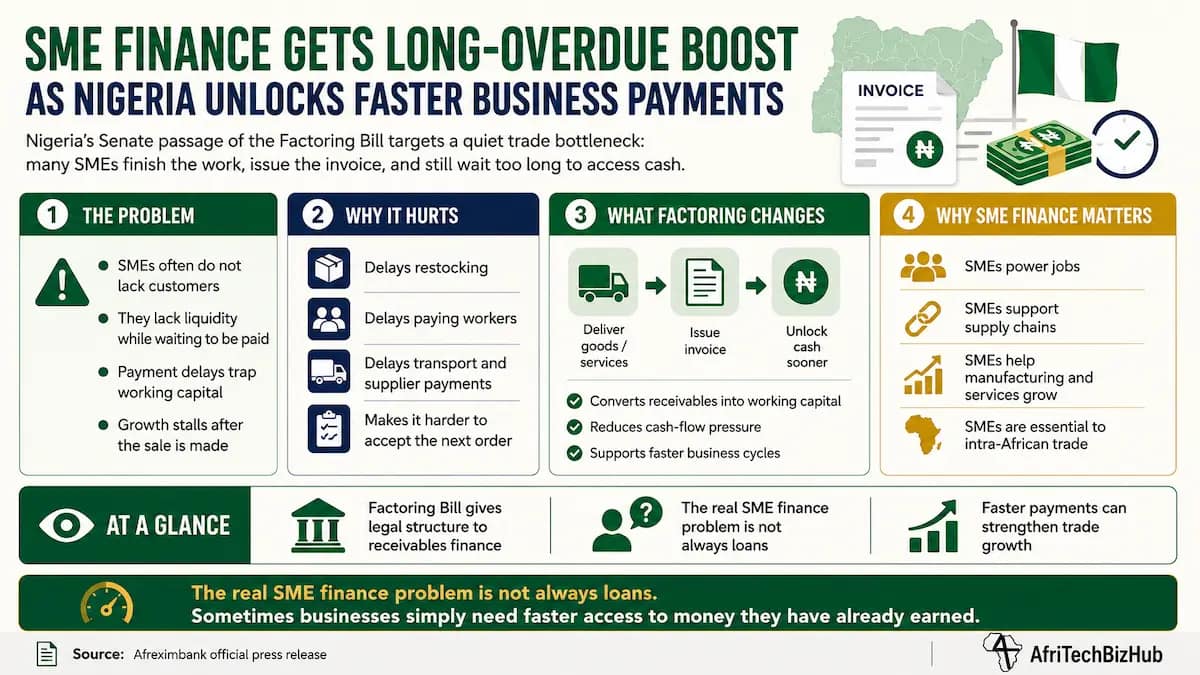
- The bill matters because many SMEs do not lack customers; they lack liquidity while waiting to be paid
- Afreximbank and FCI see factoring as a practical tool for closing Africa’s SME finance gap and strengthening intra-African trade
- The bigger test is whether Nigeria can turn legislation into a functioning receivables finance market that other African countries can learn from
Africa keeps asking SMEs to carry growth before fixing the payment delays that weaken them.
These businesses are expected to create jobs, feed supply chains, support manufacturing, enter export markets, and drive intra-African trade.
Yet many are held back after the sale has already been made, the goods have already moved, and the invoice has already been issued.
Nigeria’s Senate passage of the Factoring Bill brings that contradiction into view.
The problem is not always that SMEs need more loans. Often, they need faster access to money they have already earned.
Africa Wants SMEs to Drive Trade. Payment Delays Keep Holding Them Back
Africa’s trade ambitions increasingly rest on small and medium-sized businesses.
Governments expect SMEs to create jobs, strengthen manufacturing, expand exports, and power intra-African commerce.
Yet many of these businesses remain constrained after the hardest part of the transaction has already been completed.
The sale is made, the goods are delivered, but the cash is still out of reach.
That disconnect has quietly become one of Africa’s overlooked trade constraints. SMEs do not always struggle because demand is weak or opportunities are scarce.
Many struggle because working capital remains tied up in unpaid invoices long after business has been done.
Until businesses can convert completed sales into usable cash more quickly, Africa’s ambition for SME-led trade will continue moving faster than the financial systems supporting it.
The Real SME Finance Problem Is Not Always Loans
The usual SME finance debate focuses on bank lending, collateral, interest rates, and credit access.
Those issues matter, but they do not explain the whole problem. Some businesses are not waiting for risky expansion capital. They are waiting for invoices to be paid.
Factoring changes the frame. It allows a business to convert receivables into working capital instead of waiting weeks or months for a customer to settle.
That can support invoice financing, receivables financing, supply chain finance, faster cash-flow cycles, and reduced payment delays.
The more uncomfortable point is this: some African SMEs do not need another loan first. They need a faster route to cash from work they have already done.
How Nigeria’s Factoring Bill Reshapes SME Finance
Nigeria’s Factoring, Assignments and Receivables Financing Bill, 2026, matters because it tries to give legal structure to a market that depends on trust.
Receivables financing cannot grow at scale if financiers are unsure whether invoices can be assigned, enforced, prioritised, and settled transparently.
Legal uncertainty makes capital cautious. Cautious capital rarely reaches SMEs at the speed they need.
The Factoring Bill attempts to turn unpaid invoices into financeable assets. If the framework works, businesses will have a clearer path to unlock cash tied up in completed sales.
That could strengthen suppliers, distributors, exporters, manufacturers, and service providers that often carry the burden of delayed payment.
SME finance would then move beyond the narrow question of who can borrow, toward a more practical question: how quickly can businesses convert real sales into working capital?
Why Does Afreximbank See SME Finance as a Trade Strategy?
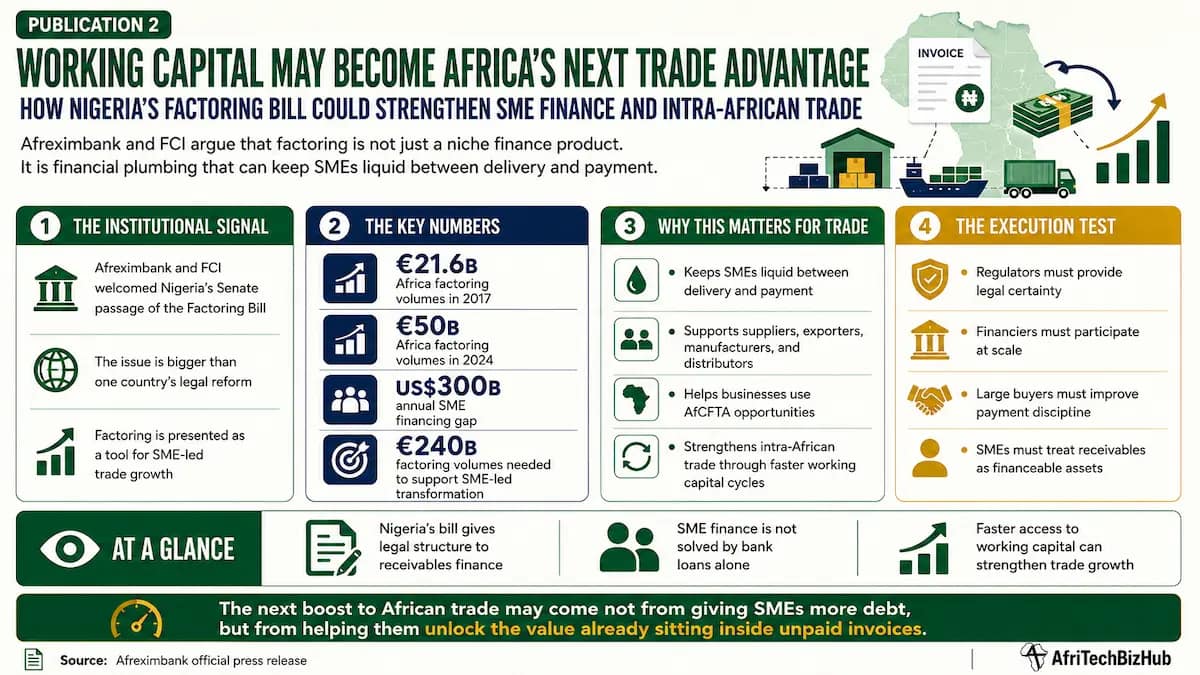
Afreximbank and FCI welcomed Nigeria’s Senate passage of the Factoring Bill because the issue is larger than one country’s legal reform.
Afreximbank has spent years promoting factoring and supply chain finance as tools for SME-led trade growth across Africa.
The bank says Africa’s factoring volumes more than doubled from €21.6 billion in 2017 to €50 billion in 2024. That growth is real, but it is still far below what the continent needs.
Afreximbank estimates Africa’s SME financing gap at about US$300 billion annually and says factoring volumes need to rise to at least €240 billion to support SME-led transformation.
That is the institutional weight behind the Nigerian bill. The argument is not that factoring is a niche financial product for specialists.
It is that intra-African trade needs financial plumbing that keeps SMEs liquid between delivery and payment. AfCFTA can open markets, but businesses still need cash flow to use those markets.
Working Capital May Become Africa’s Next Trade Advantage
The opportunity now extends beyond passing legislation.
Nigeria’s Factoring Bill creates the legal foundation for a different financing model, but markets will determine whether that foundation becomes economic activity.
Regulators must provide certainty, financiers must participate, large buyers must respect payment discipline, and SMEs must have the confidence to treat receivables as financeable assets rather than delayed cash.
The law opens the market. Execution will determine its scale.
The bigger continental lesson is sharper. Africa’s trade ambitions will not be unlocked by tariff reduction alone, and SME Finance will not be solved by bank loans alone.
If businesses continue waiting months to access money from completed sales, many will remain too weak to expand into regional value chains.
Nigeria’s Factoring Bill points to a quieter competitive advantage: faster access to working capital.
The next boost to African trade may come not from giving SMEs more debt, but from helping them unlock the value already sitting inside unpaid invoices.


Recent Comments