


Featured Summary:
- Mozambique LNG projects now span operating, under-construction, and restarted developments across the Rovuma Basin.
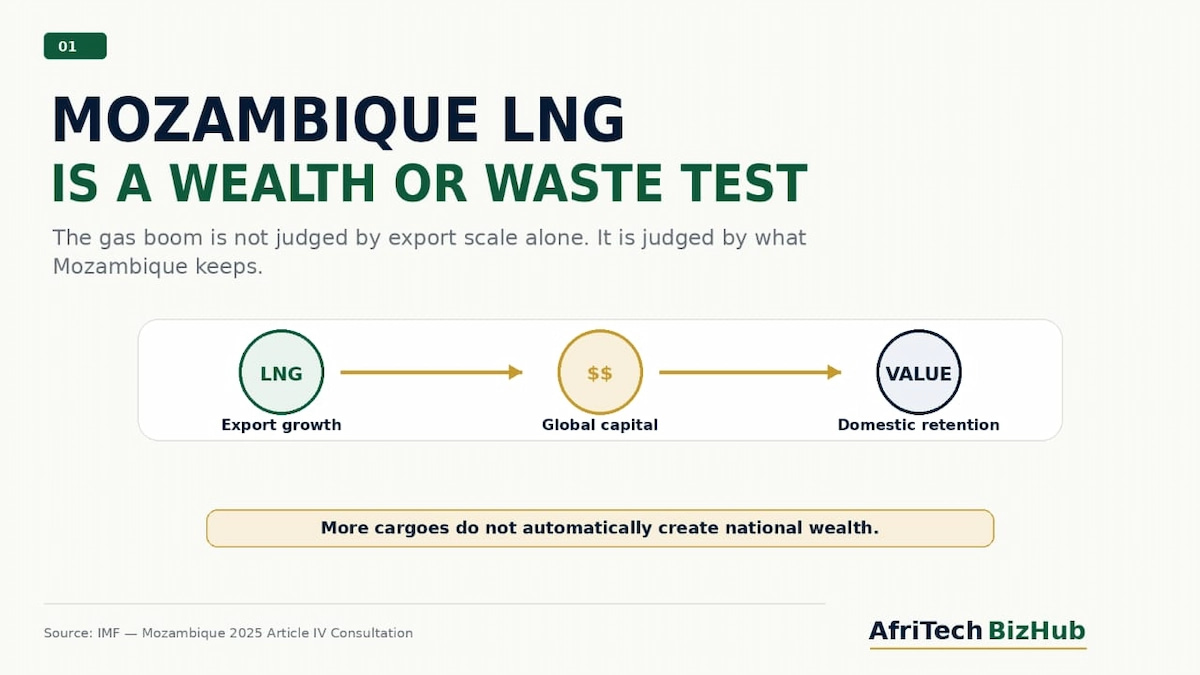
- Export growth will strengthen Mozambique’s position in global energy markets without automatically creating broad domestic prosperity.
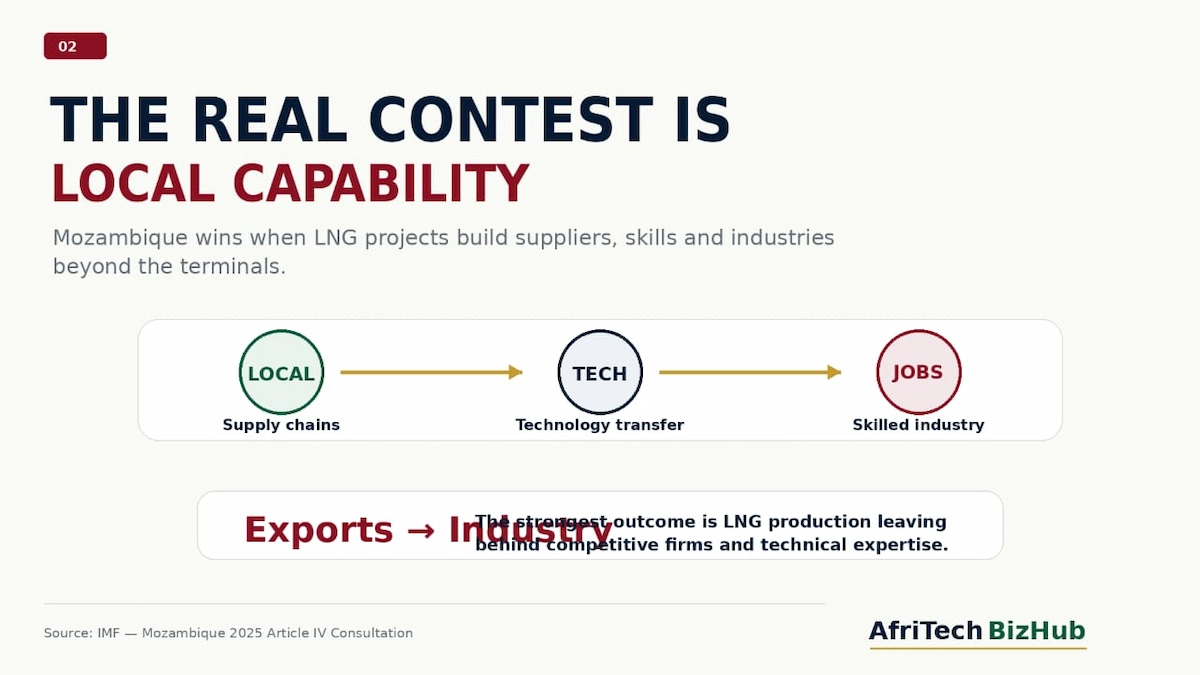
- Local supply chains must progress from peripheral support contracts into engineering, fabrication, maintenance, and specialist services.
- Technology transfer will matter only when Mozambican workers and businesses can retain and apply advanced LNG capabilities.
- The gas boom becomes national wealth when LNG production builds competitive companies, skilled workers, and productive industries beyond the export terminals.
Mozambique has moved closer to becoming one of Africa’s most important liquefied natural gas producers as Coral South exports cargoes, Coral North advances toward production, and the TotalEnergies-led onshore development resumes after a five-year security-related interruption.
The wider gas pipeline, including developments that remain at different approval and execution stages, has placed tens of billions of dollars around the Rovuma Basin and pushed the country deeper into global energy calculations.
Investment scale, however, does not reveal how much economic value Mozambique will retain.
LNG exports can rise while engineering design, equipment manufacturing, specialist maintenance, and high-value procurement remain concentrated outside the domestic economy.
Mozambique LNG projects will therefore be judged less by the capital attached to them than by whether that investment creates Mozambican businesses and technical capabilities that survive beyond construction.
How Do Mozambique LNG Projects Impact Global Energy Markets?
Mozambique already supplies global energy markets through Eni’s Coral South floating LNG facility, which began exports in 2022 and reached its 100th cargo in April 2025.
Coral North reached a final investment decision in October 2025, completed its hull launch in January 2026, and is scheduled to begin production in 2028 with 3.6 million tonnes of annual capacity.
Together, the two floating facilities are expected to lift Mozambique’s LNG output to about seven million tonnes a year.
The TotalEnergies-led Mozambique LNG project occupies a different stage.
The consortium lifted force majeure in November 2025 and announced the full restart of onshore and offshore activities on January 29, 2026, targeting the first LNG in 2029 from two trains designed to produce about 13 million tons annually.
These developments give international petroleum companies another supply base serving buyers in Europe and Asia, but global relevance does not determine whether the surrounding engineering, procurement, and operating value remains in Mozambique.
Can Local Supply Chains Support International Petroleum Companies?
The commercial opportunity for local supply chains extends far beyond catering, transport, and temporary construction services.
LNG developments require marine logistics, civil works, electrical systems, inspection, fabrication, environmental services, asset integrity, professional advice, and long-term maintenance.
Eni reported that Coral South had awarded approximately $800 million in contracts to Mozambican small and medium-sized enterprises by April 2025, demonstrating that domestic businesses can capture meaningful expenditure when procurement opportunities are deliberately opened.
The remaining challenge concerns the quality of participation.
Mozambican firms can win more peripheral contracts while foreign suppliers retain engineering-intensive work because international petroleum companies require technical certification, reliable financing, specialized equipment, and experience delivering complex projects to strict safety standards.
Supplier development must therefore combine access to procurement with credit, certification, and joint ventures that allow local companies to move from supporting LNG activity to performing work at the center of the value chain.
Will Technology Transfer Drive Future LNG Production Success?
Training workers for individual project roles does not automatically amount to technology transfer.
Mozambique captures lasting value when local engineers and technicians gain the capacity to operate, inspect, repair, and improve LNG facilities without permanent dependence on imported expertise.
Coral South had trained more than 200 young Mozambicans across fields including logistics, gas production, and asset integrity by April 2025, alongside a reported $33 million investment in graduate training, but the long-term test is whether those skills lead to advanced responsibility and knowledge retention inside the domestic economy.
Genuine technology transfer requires apprenticeships connected to recognized certification, research partnerships with universities, supplier joint ventures, and career pathways that move Mozambicans into engineering leadership and operational decision-making.
Coral North can deepen this process because it builds on a facility already operating in the country, while the restarted onshore project creates a larger platform for workforce and supplier development.
LNG production will strengthen Mozambique’s industrial capability only when technical knowledge becomes embedded in local companies and institutions rather than leaving with contractors after construction.
Are Mozambique LNG Projects Ready to Convert International Investment Into Domestic Growth?
Project momentum has improved, but Mozambique’s broader economic readiness remains fragile.
Security risks persist in Cabo Delgado, public finances face high deficits and debt pressures, infrastructure remains inadequate, and growth outside the extractive sector remains weak.
The IMF’s 2025 Article IV assessment warned that capital-intensive LNG development has not yet produced enough job-rich structural transformation, while fiscal vulnerabilities and limited institutional capacity could weaken the country’s ability to convert future resource revenue into inclusive growth.
The same weaknesses affect domestic value retention.
Local firms need electricity, transport, finance, and predictable regulation before they can compete for sophisticated LNG contracts, while government institutions need transparent revenue systems and stronger public investment management before export income can support diversification.
The restart of construction proves that international investment can return; it does not prove that Mozambique is ready to turn that capital into broad productive capacity.
How Can Local Supply Chains Turn Mozambique LNG Projects Into Long-Term Wealth?
Mozambique’s strongest commercial opportunity lies in the industries that LNG production will require for decades after the construction boom fades.
Engineering firms, fabrication businesses, marine operators, maintenance providers, technical training institutions, and manufacturers can build recurring income around operating assets rather than depend on temporary project spending.
Government and international operators must open procurement pipelines earlier, finance supplier upgrades, and tie major contracts to measurable local capability instead of treating local content as a count of jobs or small purchases.
The winners will be companies that acquire recognized technical standards and use LNG contracts to enter wider African energy and industrial markets.
The losers will be businesses confined to low-margin services while foreign contractors control the expertise and equipment that command the greatest value.
Mozambique’s gas boom becomes national wealth only when exported LNG leaves behind competitive firms, skilled workers, and industrial systems capable of creating value after construction ends and long after the final cargo leaves the Rovuma Basin.


Recent Comments