


Featured Summary:
- Egypt’s digital economy is evolving toward artificial intelligence, advanced infrastructure, and innovation-driven industries.
- The World Bank partnership supports Egypt’s national strategy through institutional cooperation and policy alignment.
- Rural internet access must be paired with affordability and skills to drive real economic inclusion.
- Digital skills development is expanding, but quality and industry relevance remain critical.
- Public-private partnerships will determine whether Egypt can convert digital investments into regional competitiveness.
Egypt’s digital transformation is entering a more complex phase where economic productivity, competitiveness, and innovation matter more than infrastructure rollout alone.
Digital technologies are now central to how emerging economies generate growth, create jobs, and improve service delivery, and Egypt is positioning itself to leverage these tools across multiple sectors.
Recent engagement between Egypt’s Ministry of Communications and Information Technology and the World Bank reflects a deeper alignment around institutional reform, digital governance, and ecosystem development.
The World Bank’s Country Partnership Framework for Egypt (2023–2027) reinforces this direction by prioritizing private-sector growth, human capital development, and digital transformation as key drivers of inclusive economic expansion.
How Is Egypt’s Digital Economy Transforming Through AI Growth?
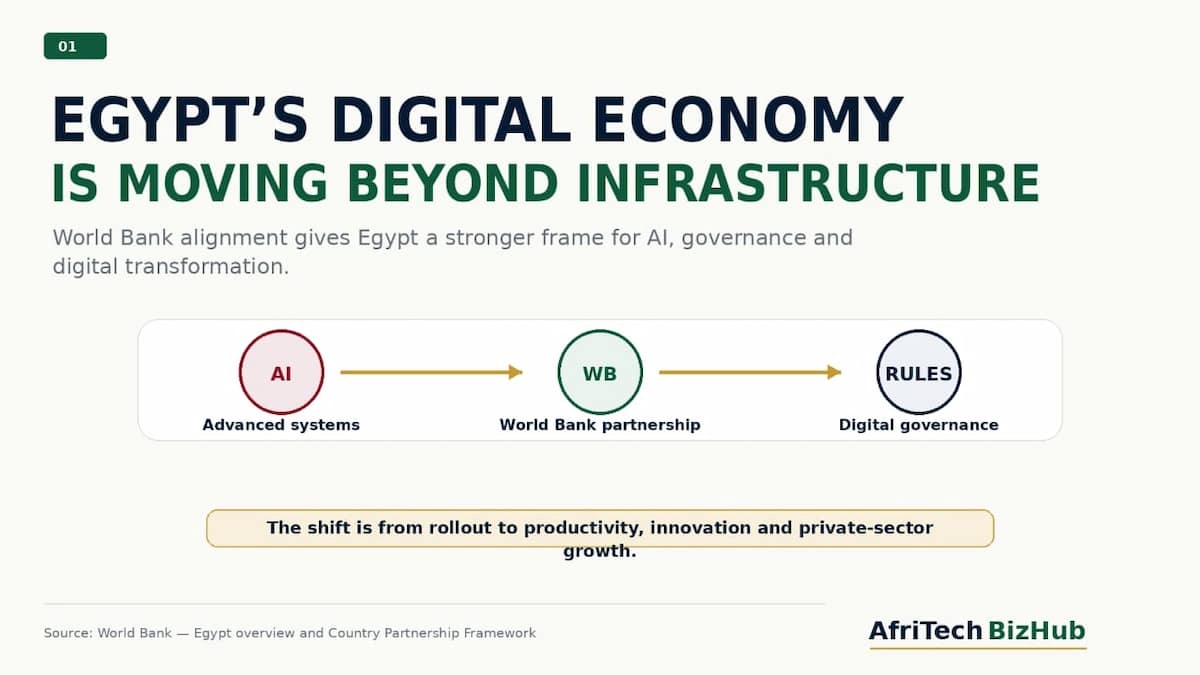
Egypt’s digital economy is transitioning from basic digitization toward a more advanced, AI-driven model that integrates data, automation, and intelligent systems into core economic activities.
The National Artificial Intelligence Strategy aims to embed AI across sectors such as healthcare, agriculture, logistics, and finance, enabling predictive analytics, operational efficiency, and new service models.
However, the real transformation depends on diffusion rather than policy ambition.
Large enterprises may adopt AI faster due to access to capital and expertise, but small and medium enterprises critical to Egypt’s economy face structural barriers, including limited access to cloud infrastructure, data ecosystems, and specialized talent.
Without addressing these constraints, AI risks becoming concentrated in a few sectors rather than driving economy-wide productivity gains.
How Is the World Bank Partnership Accelerating Egypt’s Digital Transformation?
The World Bank partnership strengthens Egypt’s digital transformation by focusing on institutional capacity, regulatory frameworks, and ecosystem development rather than simply financing infrastructure.
Through its Country Partnership Framework, the World Bank supports reforms that improve market competition, enhance digital governance, and create conditions for private-sector participation.
This approach reflects a broader understanding that sustainable digital economies require integrated systems, digital public infrastructure, transparent regulations, cybersecurity frameworks, and data governance mechanisms.
For Egypt, the partnership helps align national strategies with global standards, reducing policy uncertainty and improving investor confidence.
However, its effectiveness ultimately depends on how well these frameworks translate into real business activity, innovation, and scalable digital enterprises.
Why Rural Internet Access Will Determine Egypt’s Digital Inclusion
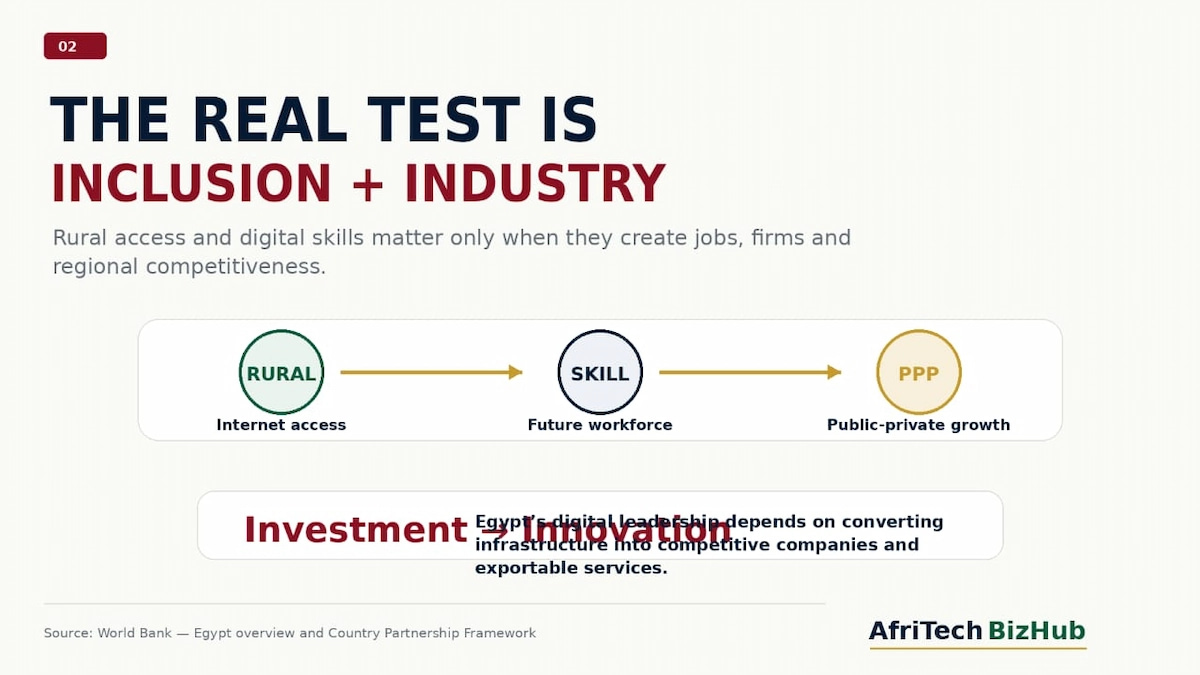
Rural internet access is a decisive factor in whether Egypt’s digital economy becomes inclusive or remains concentrated in urban centers.
Expanding broadband connectivity can unlock economic participation by enabling rural businesses to access digital marketplaces, farmers to use data-driven tools, and households to benefit from digital financial services and remote education.
Yet, connectivity alone does not guarantee inclusion.
The economic impact of rural internet access depends on affordability, device availability, digital literacy, and the presence of relevant services.
Without these complementary factors, infrastructure investments risk underutilization.
True inclusion requires an integrated approach where connectivity is paired with skills development, localized digital services, and financial accessibility to ensure that rural populations can actively participate in and benefit from the digital economy.
Can Digital Skills Development Build Egypt’s Future Workforce?
Digital skills development is central to Egypt’s ambition to build a competitive, technology-driven workforce capable of supporting advanced industries.
Government-led initiatives aim to produce talent in high-demand fields such as software engineering, data science, cybersecurity, and artificial intelligence, while also promoting entrepreneurship and innovation.
However, the effectiveness of these programs depends on depth and alignment rather than scale alone.
Training large numbers of participants is insufficient if curricula do not match industry needs or if graduates lack practical experience.
The key challenge lies in bridging the gap between education and employment by ensuring that training programs are industry-driven, continuously updated, and linked to real job opportunities.
Long-term success will depend on whether Egypt can cultivate a pipeline of highly skilled professionals who can contribute to innovation, build competitive companies, and support export-oriented digital services.
Can Public-Private Partnerships Turn Egypt’s Digital Expansion Into Regional Leadership?
Public-private partnerships are the critical mechanism through which Egypt can convert digital investments into sustained economic growth and regional competitiveness.
While the government provides infrastructure, regulatory frameworks, and strategic direction, private companies drive innovation, develop products, and scale solutions across markets.
For Egypt to achieve digital leadership, these partnerships must go beyond traditional collaboration and focus on creating dynamic ecosystems where startups, established firms, investors, and research institutions interact effectively.
This includes improving access to venture capital, fostering innovation clusters, and ensuring regulatory predictability.
Regional leadership will ultimately depend on Egypt’s ability to produce globally competitive digital firms, expand exports of technology services, and integrate into international value chains outcomes that can only be achieved through strong, well-structured public-private collaboration.


Recent Comments