

Featured Summary:
- Anti-money laundering rules are becoming more important for African countries because weak financial controls can slow trade, investment, and cross-border banking.
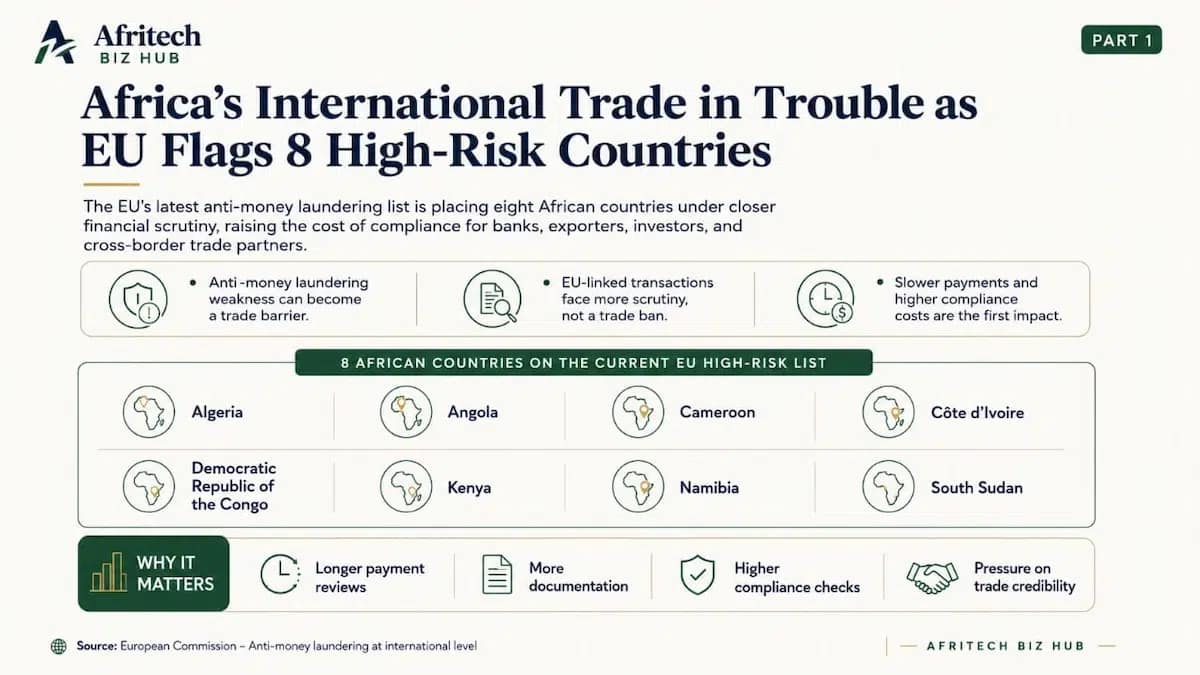
- High-risk countries on the current EU list include Algeria, Angola, Cameroon, Côte d’Ivoire, Democratic Republic of the Congo, Kenya, Namibia, and South Sudan.
- The Financial Action Task Force influences EU decisions by identifying jurisdictions with strategic AML/CFT weaknesses and tracking reform progress.
- Africa international trade could face slower transactions, higher compliance checks, and greater pressure on listed countries to strengthen financial oversight.
Africa’s trade problem is no longer only about ports, tariffs, roads, or currency pressure.
It is also about trust inside the financial system.
When a country is placed on the EU high-risk list, its exporters, importers, banks, investors, and payment channels can face closer checks before money moves across borders.
That is why the latest EU list matters for Africa international trade.
The designation does not stop trade with the affected countries, but it changes the way EU-linked banks and companies handle transactions connected to them.
Payments can take longer. Documentation can become heavier.
Compliance costs can rise. For African countries trying to attract investment and expand exports, anti-money laundering weakness can become a trade barrier even when goods are ready to move.
Why Is Anti-Money Laundering Critical for African Countries?
Financial credibility has become part of trade competitiveness.
African countries need banks, investors, correspondent lenders, insurers, exporters, and payment firms to trust that transactions can be processed safely.
When anti-money laundering controls are weak, that trust becomes harder to maintain.
The impact can reach far beyond financial regulation.
A weak AML system can affect import payments, export receipts, remittances, development finance, banking relationships, and investor confidence.
For businesses, the issue becomes practical: payments may need more documents, banks may ask more questions, and transactions may take longer to clear.
For governments, strong anti-money laundering systems are no longer only about fighting crime.
They are about protecting market access, trade credibility, and the ability to attract capital.
Which Countries Made the Latest EU High-Risk List?
Eight African countries are currently identified on the EU high-risk list: Algeria, Angola, Cameroon, Côte d’Ivoire, Democratic Republic of the Congo, Kenya, Namibia, and South Sudan.
Their inclusion does not mean each country carries the same level of risk or faces the same economic conditions.
It means the EU has identified strategic weaknesses in anti-money laundering and counter-terrorist financing systems that require enhanced scrutiny from EU-regulated entities.
The list also shows that the process can change when countries improve their frameworks. Burkina Faso, Mali, Mozambique, Nigeria, South Africa, and Tanzania were removed from the EU list after progress in addressing identified deficiencies.
That matters for the listed Africa countries because the designation is not permanent if reforms are credible.
The route out of the high-risk category depends on stronger supervision, enforcement, beneficial ownership transparency, financial intelligence, and sustained cooperation with global standards.
How Does the Financial Action Task Force Influence EU Decisions?
The EU list does not operate in isolation from the global financial crime framework.
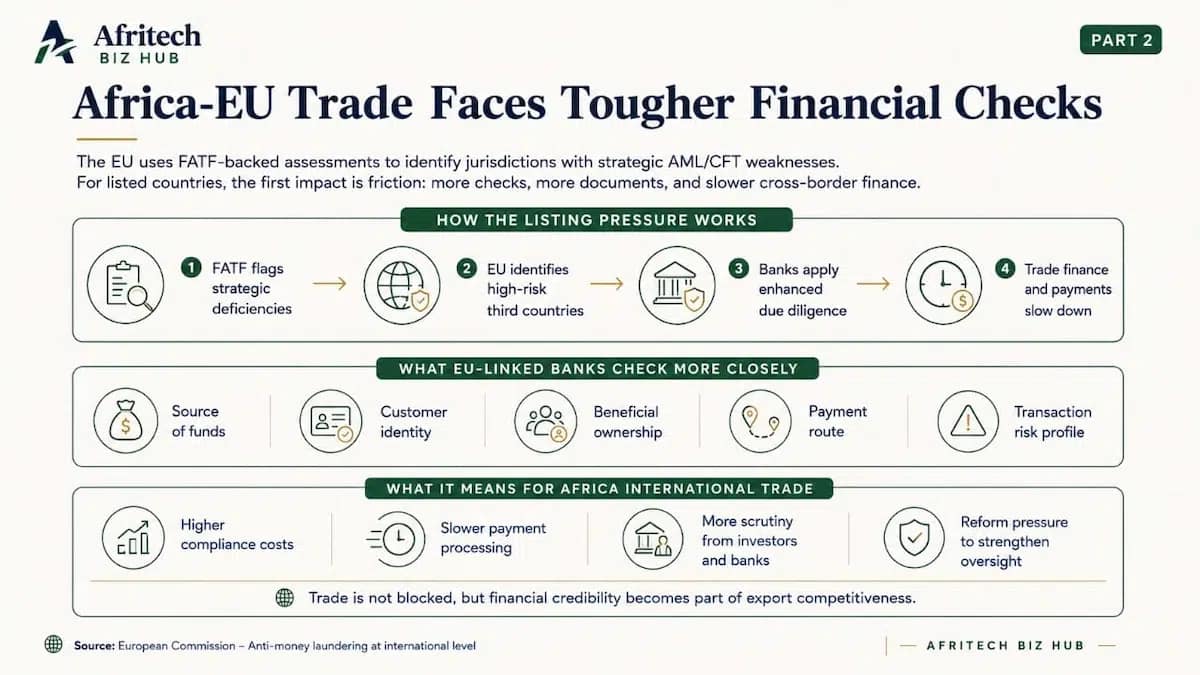
The Financial Action Task Force shapes the process because its assessments, public statements, and monitoring lists help identify countries with strategic AML/CFT weaknesses.
When FATF places a jurisdiction under increased monitoring or recognises reform progress, the EU often uses that information in its own assessment.
That link gives FATF influence over how markets interpret financial risk.
A country flagged by FATF or aligned EU processes may face more questions from banks, investors, and compliance departments.
A country removed after reform can gain reputational relief.
For African governments, this makes FATF engagement more than a technical exercise.
It affects how easily businesses can move money, how investors assess risk, and how Africa-EU financial relationships are managed.
Why Is Africa-EU Trade Facing Tougher Financial Checks?
Trade between Africa and Europe depends on payment systems as much as physical goods.
A shipment can be ready, a buyer can be confirmed, and a contract can be signed, but the transaction still depends on banks being comfortable with the money trail.
When a country appears on the EU high-risk list, EU-regulated entities must apply enhanced checks to business relationships and transactions involving that jurisdiction.
The European Commission says high-risk third countries are identified because strategic AML/CFT deficiencies can pose threats to the EU financial system.
It also says banks and other gatekeepers are required to apply increased checks and controls when dealing with listed jurisdictions.
This is why Africa-EU trade can become more complicated for affected countries.
The concern is not only the product being traded.
It is the source of funds, the customer, the beneficial owner, the route of payment, and the risk attached to the transaction.
How Will Africa International Trade Be Affected Now?
The first impact will be friction, not a full stop.
Listed countries can still trade with Europe, but transactions may face longer reviews, stronger documentation demands, higher compliance costs, and closer monitoring by financial institutions.
That can affect exporters, importers, logistics firms, banks, fintechs, investors, and companies using cross-border payment channels.
The wider effect is reputational.
Africa international trade depends on confidence that goods, money, ownership structures, and counterparties can be verified.
Countries on the EU high-risk list may need to work harder to reassure banks and investors that transactions are legitimate and properly supervised.
The pressure could be difficult in the short term, but it also creates a reform signal.
Stronger anti-money laundering systems can help affected countries protect trade access, reduce financial crime exposure, and improve the credibility of Africa-EU business relationships.


Recent Comments