


Featured Summary:
- Battery gigafactory investment is moving Morocco beyond vehicle assembly into the production of battery cells, cathodes, anodes and other higher-value components.
- Electric vehicle batteries could deepen Morocco’s supplier base, protect its automotive exports and create capabilities that extend into energy storage and advanced manufacturing.
- Chinese battery companies provide the capital, technology and industrial experience needed to build an integrated battery supply chain, but local value will depend on skills and supplier development.
- The European EV market gives Morocco a nearby source of demand, although long-term competitiveness will depend on production costs, trade compliance and the ability to integrate local industries into the new supply chain.
Morocco has already built one of Africa’s strongest automotive industries, with Renault and Stellantis plants, an established component-supplier network and annual vehicle production capacity of about 700,000 units.
That success was created around combustion-engine and conventional vehicle manufacturing. y
The transition to electric mobility now presents a harder industrial test: Morocco must add battery cells, active materials and specialised electronics or risk losing part of the value and employment created by its existing automotive base.
The battery gigafactory planned by China’s Gotion High-Tech is intended to close that gap.
Its initial phase requires about $1.3 billion and is designed to produce 20 gigawatt-hours of lithium iron phosphate batteries annually, with the wider project capable of reaching 100 GWh.
The project changes the economic question from whether Africa can attract electric vehicle assembly to whether it can retain the more valuable industrial stages surrounding it.
Morocco is not relying on mineral availability alone.
It is combining Chinese battery expertise with automotive factories, export infrastructure, trade links and proximity to European customers.
The gigafactory is therefore part of a broader attempt to turn the country into an integrated production platform where battery materials, cells, components and vehicles can move through the same industrial ecosystem.
China is supplying the manufacturing capability, but Morocco’s strategic advantage lies in connecting that capability to African inputs and European demand.
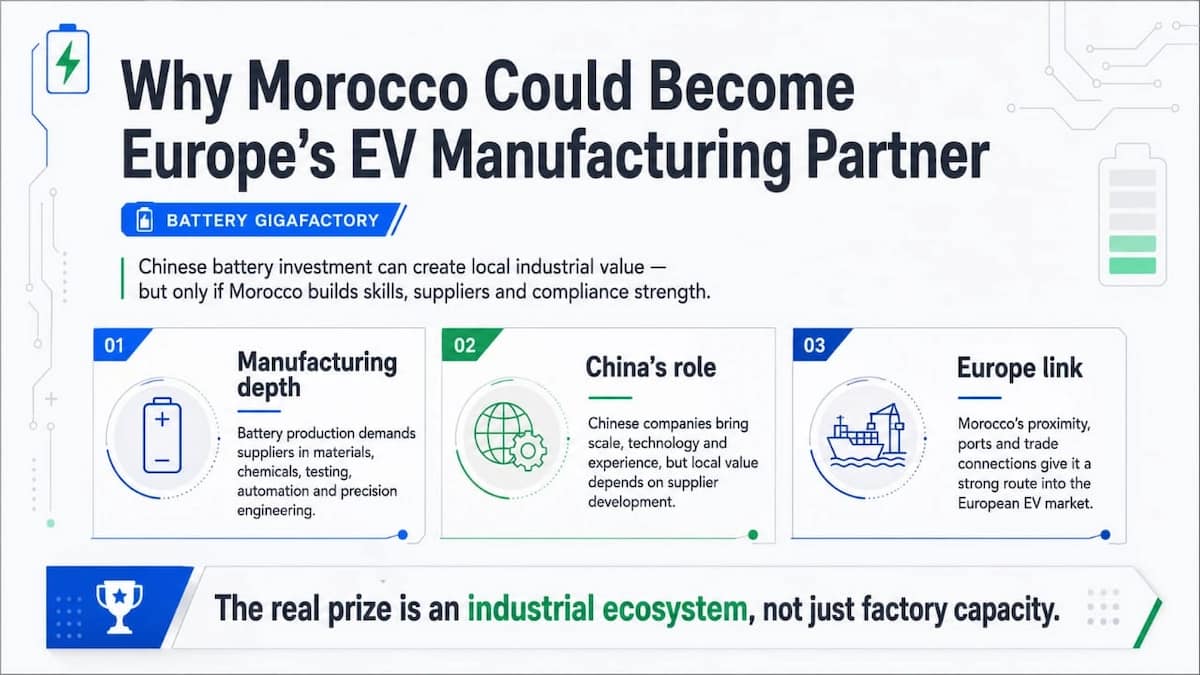
How Will Morocco’s Battery Gigafactory Transform Africa’s EV Industry?
The battery gigafactory will transform Africa’s EV industry by introducing large-scale cell manufacturing into a continent that has remained concentrated at the raw-material and vehicle-assembly ends of the supply chain.
Gotion Power Morocco’s first phase will produce lithium iron phosphate batteries and integrate cathode and anode production rather than importing all major components for final assembly.
The African Development Bank approved a €100 million loan for the project in July 2026 and said it would seek to mobilise up to another €141 million from financial partners.
The planned factory is expected to begin with 20 GWh of annual capacity, enough to establish a material industrial base rather than a limited demonstration plant.
Its importance extends beyond the number of batteries produced.
Vehicle assemblers require predictable access to cells, battery packs, electronics and certified materials as production shifts away from internal-combustion engines.
Locating those stages in Morocco reduces the country’s dependence on imported battery systems and gives existing manufacturers a reason to retain or expand electric vehicle production locally.
Other African economies may still supply minerals or develop their own assembly operations, but Morocco is positioning itself at the point where materials, technology and export manufacturing converge.
The project therefore changes Africa’s role from supplying selected inputs to hosting a production system capable of delivering one of the most valuable components in an electric vehicle.
How Are Electric Vehicle Batteries Expanding Morocco’s Manufacturing Capability?
Electric vehicle batteries expand Morocco’s manufacturing capability because their production requires a denser industrial network than conventional vehicle assembly.
Cell manufacturing depends on cathode and anode materials, copper components, separators, electrolytes, industrial chemicals, testing systems, automation and precision engineering.
Chinese companies are already building several parts of that chain.
BTR New Material Group plans a cathode-material facility with annual capacity of 50,000 tonnes, while Hailiang and Shinzoom have announced projects for copper components and anode materials.
CNGR Advanced Material has also planned cathode production at Jorf Lasfar.
That concentration can create supplier demand beyond the companies named in the original investment agreements.
Local firms can enter maintenance, industrial packaging, logistics, laboratory services, automation, component fabrication and quality assurance if they can meet the required technical standards.
Battery production also gives universities, vocational institutions and engineering firms a commercial reason to develop skills in electrochemistry, process control and advanced manufacturing.
The industrial gain will not come automatically from factory construction.
It will depend on whether Moroccan suppliers and workers secure roles inside the production process rather than providing only low-value services around foreign-owned plants.
How is the Clean Energy Transition Accelerating Industrial Growth?
The clean energy transition is accelerating industrial growth because electric mobility is creating demand for an entirely new production base.
The International Energy Agency expects global electric car sales to reach about 23 million in 2026, equal to 28% of total car sales, with Europe recording the strongest growth among the major markets.
Every increase in electric vehicle production creates corresponding demand for battery cells, active materials, power electronics, software and energy-storage expertise.
Industrial policy is following that demand as governments seek to secure more of the value chain within their own regions.
Morocco’s opportunity lies in using that demand to renew an automotive sector that already supports a large manufacturing workforce.
The government has linked battery investment to the need to preserve about 220,000 automotive jobs as production moves from combustion engines to electric drivetrains.
The transition therefore presents both growth and displacement risk.
Battery factories can create engineering roles and attract new suppliers, but conventional engine and transmission activities may lose relevance.
Morocco is using clean-technology investment to replace vulnerable industrial functions with new ones before its existing export model is weakened by the changing product strategies of European manufacturers.
How are Chinese Battery Companies Expanding Africa’s Manufacturing Base?
Electric vehicle batteries expand Morocco’s manufacturing capability because their production requires a denser industrial network than conventional vehicle assembly.
Cell manufacturing depends on cathode and anode materials, copper components, separators, electrolytes, industrial chemicals, testing systems, automation and precision engineering.
Chinese companies are already building several parts of that chain.
BTR New Material Group plans a cathode-material facility with annual capacity of 50,000 tonnes, while Hailiang and Shinzoom have announced projects for copper components and anode materials.
CNGR Advanced Material has also planned cathode production at Jorf Lasfar.
That concentration can create supplier demand beyond the companies named in the original investment agreements.
Local firms can enter maintenance, industrial packaging, logistics, laboratory services, automation, component fabrication and quality assurance if they can meet the required technical standards.
Battery production also gives universities, vocational institutions and engineering firms a commercial reason to develop skills in electrochemistry, process control and advanced manufacturing.
The industrial gain will not come automatically from factory construction.
It will depend on whether Moroccan suppliers and workers secure roles inside the production process rather than providing only low-value services around foreign-owned plants.
How Is the Clean Energy Transition Accelerating Industrial Growth?
The clean energy transition is accelerating industrial growth because electric mobility is creating demand for an entirely new production base.
The International Energy Agency expects global electric car sales to reach about 23 million in 2026, equal to 28% of total car sales, with Europe recording the strongest growth among the major markets.
Every increase in electric vehicle production creates corresponding demand for battery cells, active materials, power electronics, software and energy-storage expertise.
Industrial policy is following that demand as governments seek to secure more of the value chain within their own regions.
Morocco’s opportunity lies in using that demand to renew an automotive sector that already supports a large manufacturing workforce.
The government has linked battery investment to the need to preserve about 220,000 automotive jobs as production moves from combustion engines to electric drivetrains.
The transition therefore presents both growth and displacement risk.
Battery factories can create engineering roles and attract new suppliers, but conventional engine and transmission activities may lose relevance.
Morocco is using clean-technology investment to replace vulnerable industrial functions with new ones before its existing export model is weakened by the changing product strategies of European manufacturers.
How Are Chinese Battery Companies Expanding Africa’s Manufacturing Base?
Chinese battery companies are expanding Africa’s manufacturing base by transferring an industrial system in which they already hold global scale.
China accounted for more than 80% of battery-cell manufacturing capacity in 2025, about 85% of cathode active-material production and more than 90% of anode active-material output.
Companies operating within that ecosystem possess established production technology, supplier relationships and the experience required to commission large factories.
Their investment allows Morocco to enter battery manufacturing more quickly than it could by attempting to develop every technology and supplier independently.
The risk is that production capacity can expand without creating a broad domestic industrial base.
The IEA notes that building a factory is only the first step and that battery plants can take more than five years after opening to approach their nominal output.
Morocco must therefore measure these partnerships through local procurement, technical training, engineering participation and the development of domestic suppliers, not only pledged investment and installed capacity.
Chinese battery companies can provide the platform, but Morocco will capture the larger economic return only if the knowledge and commercial opportunities surrounding production become embedded in its own economy.
Why is Morocco Becoming Europe’s EV Manufacturing Partner?
Morocco is becoming Europe’s EV manufacturing partner because it offers a combination of proximity, industrial capacity and trade connectivity that few African markets can match.
Its factories already supply European vehicle markets, while ports and established logistics routes allow components and finished vehicles to cross the Mediterranean without the longer shipping times associated with East Asian production.
The country also has existing plants operated by Renault and Stellantis and a local supplier network built around their production.
These assets reduce the time and cost required to connect a new battery plant to vehicle manufacturing and export customers.
European demand strengthens that position, but it does not guarantee Morocco’s long-term role. Electric car sales in Europe rose by more than 30% in 2025 to 4.2 million units, while the European Union produced almost 3.2 million electric cars.
The region is seeking more resilient battery supply chains while also tightening scrutiny of subsidies, origin rules and dependence on Chinese manufacturing.
Morocco must therefore prove that its battery ecosystem is more than an offshore extension of Chinese production.
Its durable advantage will come from combining competitive manufacturing with verifiable local value, reliable energy, trade-rule compliance and direct integration into European vehicle programmes.
The battery gigafactory can make Morocco Africa’s EV powerhouse, but only an industrial ecosystem built around it can keep the country central to Europe’s changing supply chain.


Recent Comments