


Featured Summary:
- Marriott Cairo Egypt is part of a wider developer-funded hospitality pipeline valued at about $1.1 billion and covering more than 1,800 rooms across Egyptian cities and coastal destinations.
- Hospitality in Egypt is attracting global operators because visitor growth, branded-hotel shortages and large mixed-use developments support long-term demand.
- Luxury hotel development is shifting the market towards higher room rates, branded residences, business travel and greater visitor spending.
- North Africa tourism is attracting more hospitality capital as Egypt and Morocco combine destination scale with expanding transport and hotel infrastructure.
Marriott International has signed agreements with Egyptian developers Misr Italia Properties and People & Places Developments for a portfolio of hotels, resorts and branded residences valued at about EGP56 billion, or roughly $1.1 billion.
The programme is expected to add more than 1,800 rooms and suites across urban and coastal destinations.
Although the headline opportunity is commonly described as a Marriott investment, the capital is being committed principally through local real-estate developments, while Marriott supplies global brands, distribution systems and hotel-management expertise.
Reports differ over whether the agreements cover nine hotel projects or 11 individual hotels within several mixed-use developments, but they point to the same commercial shift: international hotel groups are seeking a larger role in Egypt’s tourism and real-estate expansion.
The attraction is not room growth alone. Egypt recorded about 19 million international visitors in 2025 and is targeting 30 million annually by 2030, while UN Tourism reported that arrivals rose another 16% in the first quarter of 2026 and stood 40% above their 2019 level.
Demand is therefore rising faster than many destinations can add internationally branded accommodation, transport links and integrated visitor facilities.
Global operators are responding by attaching their brands to projects that combine hotels with residences, retail, leisure facilities and long-term real-estate value.
Marriott’s agreement is evidence that hospitality in Egypt is being treated as investable infrastructure rather than a seasonal tourism product.
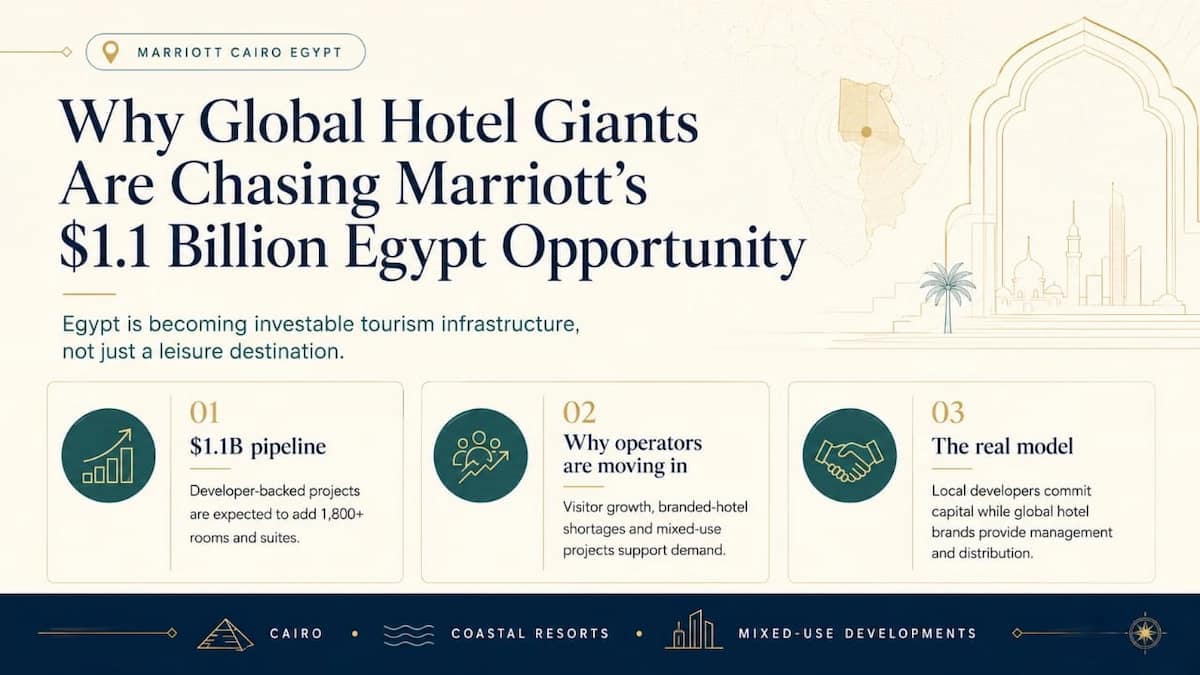
Why is Marriott Investing $1.1 Billion in Egypt’s Tourism Market?
Marriott is expanding in Egypt because the market offers rising visitor demand, limited branded supply in several destinations and developers willing to finance large hospitality projects.
The new portfolio extends beyond Marriott Cairo Egypt and includes hotels and resorts planned across established cities and coastal locations, giving the group exposure to business travel, domestic tourism, international leisure demand and branded residential sales.
More than 1,800 rooms provide scale, but Marriott’s commercial risk remains lower than the headline figure suggests because international hotel groups commonly grow through management and franchise agreements rather than owning the underlying properties.
Local developers supply the land and construction capital, while the operator contributes its brand, reservation network, loyalty programme and operating standards.
That structure explains why Marriott can make a substantial strategic commitment without placing the full $1.1 billion on its own balance sheet.
The company gains management and brand-fee income if the hotels open and perform, while developers use Marriott’s name to strengthen financing, residential sales and room demand.
Egypt offers the conditions needed to support that arrangement: a large domestic market, internationally recognised cultural assets, Red Sea and Mediterranean resorts, expanding urban centres and a government target to lift annual arrivals to 30 million.
Marriott is therefore not pursuing a short-term rebound.
It is securing operating positions inside projects designed to earn revenue from tourism, property and mixed-use development over several decades.
Why is Egypt’s Tourism Market Attracting Global Hotel Investment?
Egypt’s tourism market is attracting global hotel investment because demand is broadening across several visitor segments at the same time.
Cairo and Giza support cultural, corporate and conference travel; Red Sea destinations attract year-round leisure demand; Mediterranean projects target premium regional travellers; and new urban developments create demand for hotels linked to business districts, residences and retail centres.
International arrivals reached about 19 million in 2025, while growth continued into 2026 despite uncertainty across the wider Middle East.
That performance gives developers greater confidence that new rooms can be absorbed across more than one destination or travel season.
Supply conditions strengthen the investment case.
Egypt led Africa’s hotel-development pipeline in 2026 with 185 projects and almost 46,000 planned rooms, more than four times Morocco’s room pipeline.
Greater Cairo alone accounted for about 80 projects and 16,400 rooms, while Sharm El Sheikh and Marsa Alam also carried large luxury and upper-upscale developments.
A large pipeline creates execution risk if too many rooms open before supporting infrastructure is ready, but it also shows that investors expect Egypt to accommodate a much larger tourism economy.
Marriott, Accor, Hyatt, Minor Hotels and other global groups are competing for management contracts now because the strongest sites, developers and mixed-use schemes may already be committed by the time visitor volumes approach the government’s 2030 target.
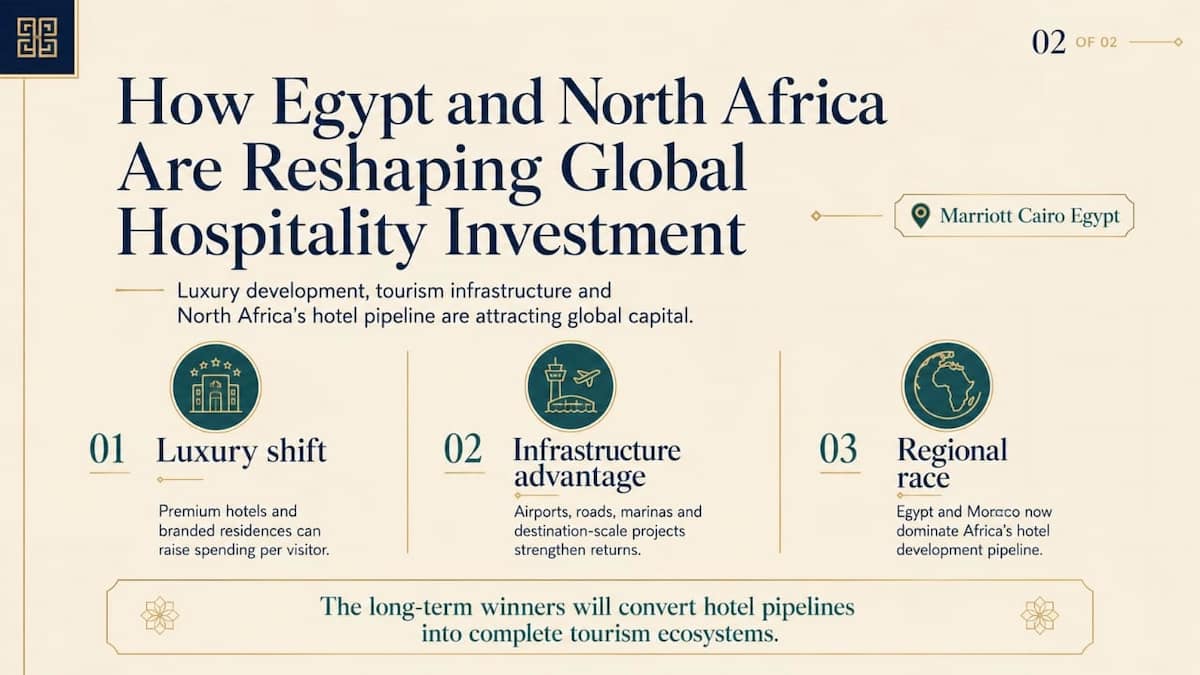
How Is Luxury Hotel Development Changing Egypt’s Tourism Market?
Luxury hotel development is changing Egypt’s tourism market by increasing the economic value generated from each destination rather than relying only on higher arrival numbers.
Premium hotels can command stronger room rates, attract international meetings and events, and support spending on restaurants, retail, wellness, transport and entertainment.
Branded residences add another revenue stream by allowing developers to sell homes linked to hotel services and internationally recognised hospitality brands.
This structure can help finance construction before a hotel reaches full operation, making large mixed-use projects more commercially viable than standalone accommodation.
The shift also changes Egypt’s market positioning.
The country has traditionally competed through cultural heritage, beach tourism and comparatively affordable travel, but a larger supply of luxury and upper-upscale hotels allows it to target travellers who prioritise service quality, destination experiences and internationally consistent standards.
The Marriott-linked projects, the $1 billion Monte Galala marina and hotel development, and other coastal schemes show that investors are combining hospitality with residences, marinas and leisure infrastructure.
The risk is that premium construction outpaces demand or concentrates investment in enclaves with weak links to surrounding economies.
The opportunity emerges when luxury hotels strengthen local supply chains, employment, destination quality and visitor spending beyond the property itself.
How is Tourism Infrastructure Strengthening Egypt’s Investment Appeal?
Tourism infrastructure strengthens Egypt’s investment appeal by reducing the operational risks that hotel developers cannot solve inside their properties.
Airports determine whether international visitors can reach a destination directly; roads and rail links affect travel time; utilities shape operating reliability; and museums, convention centres, marinas and public spaces influence how long visitors stay and how much they spend.
Egypt’s investment programme links new hotels to wider destination development, including coastal cities, urban extensions and projects such as the Monte Galala Towers and Marina scheme on the Gulf of Suez.
These assets create demand around hotels while giving developers several income sources across accommodation, property, leisure and commercial activity.
UN Tourism reported that Egypt’s international arrivals rose 16% in the first quarter of 2026 and had reached 40% above 2019 levels by 2025.
Sustaining that trajectory requires capacity beyond hotel rooms: airports must process more passengers, transport networks must connect destinations, heritage sites must manage heavier traffic and utilities must support large coastal developments.
Infrastructure therefore determines whether strong demand becomes a durable return or produces congestion, service failures and declining visitor satisfaction.
Global operators are entering Egypt because public and private capital is being directed towards destination-scale projects, but their long-term performance will depend on whether the supporting systems develop at the same pace as the hotel pipeline.
How is North Africa Tourism Reshaping Global Hospitality Investment?
North Africa tourism is reshaping global hospitality investment because the region combines established visitor demand with a large shortage of internationally branded and professionally managed rooms.
Egypt and Morocco dominate Africa’s hotel pipeline, while coastal destinations, heritage tourism, business travel and Gulf-backed property investment provide several routes to revenue.
Egypt alone represented more than one-third of Africa’s planned chain-hotel rooms in early 2026, and Morocco held the continent’s second-largest pipeline.
Global hotel groups are chasing these markets because they can expand through management contracts while local and regional developers absorb much of the property-development cost.
Marriott’s $1.1 billion Egypt opportunity captures the model shaping the region: domestic developers commit capital to integrated projects, global operators provide brands and distribution, and governments invest in the infrastructure needed to increase visitor capacity.
The winners will not be determined by the number of hotel announcements alone.
Destinations must convert pipelines into completed properties, maintain transport and utility systems, protect cultural and coastal assets, and keep investment rules predictable across long development periods.
Global hotel giants are chasing Marriott because Egypt demonstrates where hospitality capital is moving towards tourism ecosystems large enough to support hotels, residences, leisure assets and year-round economic activity rather than isolated rooms built around temporary visitor growth.


Recent Comments