


Featured Summary:
- Standard Bank warns that restrictive migration policies could weaken the South Africa economy by reducing labour supply, consumer demand and regional economic integration.
- South Africa’s high unemployment rate exists alongside shortages in sectors that rely on specialised, mobile or difficult-to-recruit workers.
- Brexit shows how restrictions on labour mobility can disrupt hiring, raise business costs and weaken investment without resolving deeper productivity constraints.
- Economic growth in South Africa will depend on combining lawful migration management with domestic skills development and higher workforce participation.
South Africa entered 2026 with an unemployment rate of 32.7%, more than 8 million people without work and another 10.6 million young people outside the labour force.
Those numbers appear to support demands for tighter controls on foreign workers.
Yet businesses in construction, agriculture, retail, transport, hospitality and digital delivery still depend on migrants to fill vacancies, operate small enterprises and sustain commercial activity in areas where labour supply is not as interchangeable as the national unemployment figure suggests.
Standard Bank Group Chief Executive Sim Tshabalala has warned that policies or protests that force migrants out could damage South Africa and weaken the regional integration on which African economic growth depends.
His intervention exposes the tension beneath the debate: a country can have mass unemployment and still suffer labour shortages where available workers lack the required skills, location, experience or willingness to take specific roles.
Migration policy therefore affects more than border control.
It influences production, demand, investment confidence and the capacity of businesses to expand.
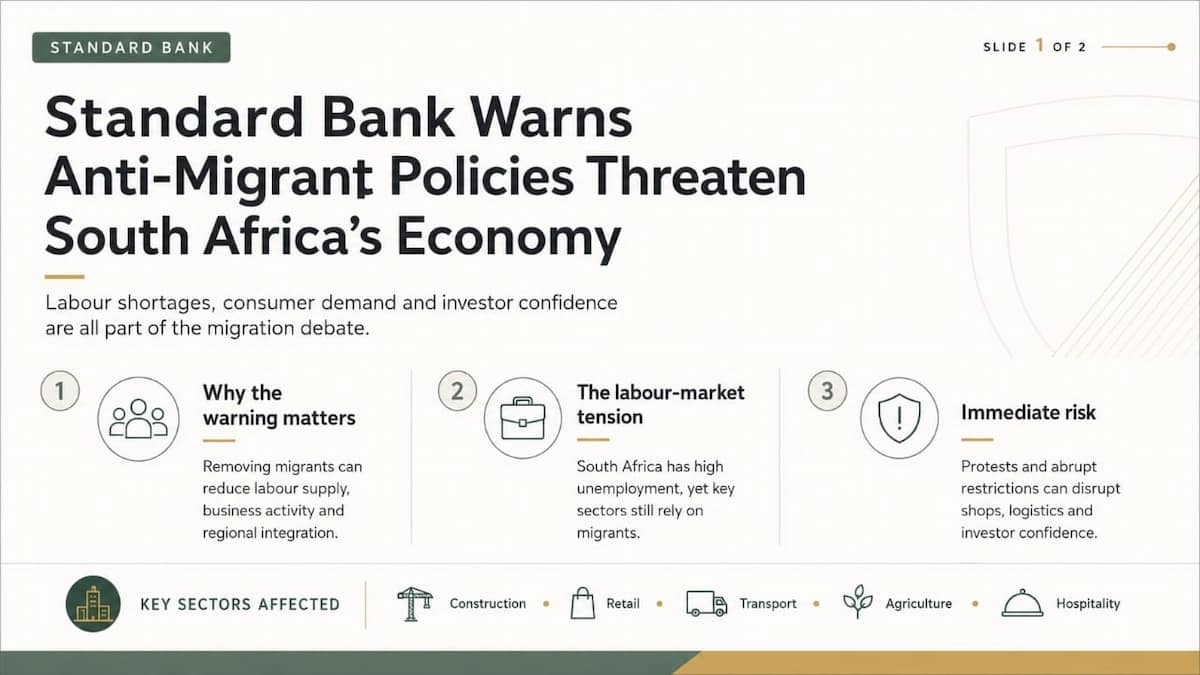
Why Is Standard Bank Warning Against Anti-Migrant Policies?
Standard Bank is warning against anti-migrant policies because the departure of foreign workers would remove labour, entrepreneurs and consumers from an economy already struggling to generate growth.
Migrants account for about 5.1% of South Africa’s population, while employed immigrants represented 8.9% of the workforce in 2022.
Their participation is concentrated in private households, construction, wholesale and retail, transport, farming and other sectors where small businesses and large employers rely on flexible labour.
For a bank operating across the continent, a reduction in that activity would affect household spending, merchant turnover, credit demand and cross-border financial flows rather than only the people directly targeted by migration restrictions.
The warning also reflects the risk that anti-foreigner sentiment adds another layer of uncertainty to South Africa’s investment climate.
Businesses invest when they can predict whether workers, suppliers and customers will remain available.
Protests, forced departures and unclear labour rules can interrupt delivery networks, close shops and weaken confidence before any formal policy is enacted.
Reuters reported disruptions to retail and delivery services during recent protests, while investors described the escalation as a new country-risk factor.
Standard Bank is therefore treating migration as an economic variable because labour stability and social stability have become part of the same investment calculation.
How Could Migration Strengthen South Africa’s Labour Market?
Migration can strengthen South Africa’s labour market by supplying workers where the domestic labour pool does not match the vacancies businesses need to fill.
A national unemployment rate above 30% does not guarantee that employers can find qualified engineers, technicians, healthcare professionals, software specialists, artisans, farm workers or transport operators in the right place and at the right cost.
Labour shortages emerge when skills, geography and job requirements do not align.
Migrants can reduce those mismatches, allowing firms to complete projects, operate longer hours and expand production instead of leaving equipment, contracts or customer demand unused.
The economic contribution extends beyond filling existing jobs.
Migrants establish shops, hire local workers, rent property, purchase goods and connect South African businesses to regional markets.
Statistics South Africa found that immigrants had a labour-force participation rate of 78.3% in 2022, well above the participation rate of the wider population, while an ILO study cited in recent analysis found that stronger immigrant participation was associated with more employment opportunities for South African-born workers.
Migration does not remove the need to train and employ citizens; it can support that objective by expanding businesses and increasing the number of productive enterprises able to hire them.
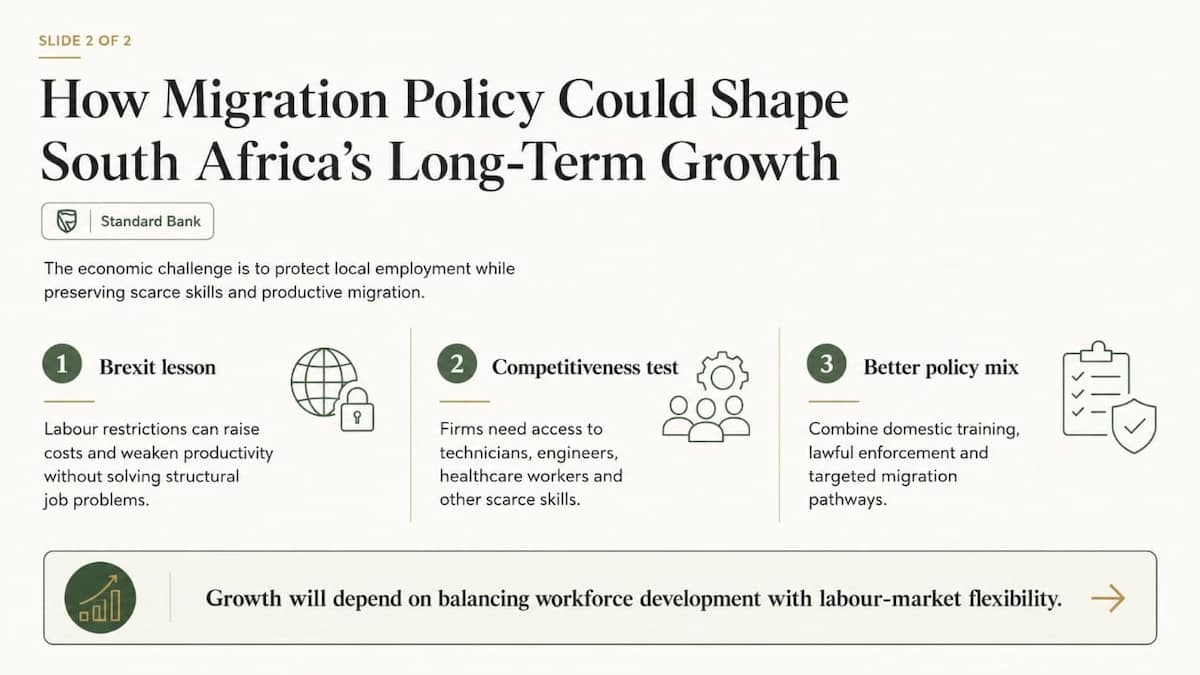
What Does Brexit Reveal About South Africa’s Economic Choices?
Brexit shows that restricting labour mobility can change the composition of migration without resolving the economic weaknesses that produced public dissatisfaction.
The end of free movement reduced the supply of European workers in several UK industries, including agriculture, hospitality, transport and social care.
Employers responded with higher recruitment costs, reduced operating capacity, automation and greater reliance on workers from outside Europe.
Migration changed, but labour demand did not disappear, leaving businesses to absorb adjustment costs while productivity and investment remained weak.
The comparison does not imply that South Africa and the United Kingdom face identical conditions.
Britain left an integrated labour market with much lower unemployment, while South Africa confronts deep joblessness, informality and uneven skills development.
The relevant lesson is narrower: removing workers does not automatically create a trained replacement workforce or raise productivity.
A 2026 survey of UK economists found that most believed post-Brexit restrictions on UK-EU labour mobility had worsened the economic outlook through weaker labour supply, investment and productivity.
South Africa therefore risks repeating the policy error if it treats labour exclusion as a substitute for education, training, business formation and stronger employment demand.
How Do Labour Market Shortages Affect South Africa’s Competitiveness?
Labour market shortages weaken South Africa’s competitiveness when businesses cannot recruit the skills needed to use capital efficiently.
A manufacturer may have financing and machinery but still operate below capacity without technicians and engineers.
A construction company may hold contracts but miss deadlines without artisans and project managers.
Technology firms can relocate development work when software and data skills are unavailable, while farms and logistics businesses may reduce output when seasonal or operational roles remain unfilled.
These constraints raise costs, delay investment returns and make competing locations more attractive.
South Africa’s labour problem is therefore a mismatch between widespread underutilisation and concentrated scarcity.
Stats SA recorded 13.3 million underutilised people in the third quarter of 2025, yet higher-skilled occupations represented a small share of youth employment in early 2026.
Managers accounted for 4.7% of employed young people, professionals 6.1% and technicians 9.1%, while elementary, sales and clerical roles remained dominant.
Restricting access to migrant labour would not correct that skills structure.
Competitiveness requires domestic training, faster recognition of qualifications and targeted migration rules that allow firms to fill genuine shortages while the local workforce develops.
How Could Migration Policy Shape South Africa’s Long-Term Economic Growth?
How Could Migration Policy Shape South Africa’s Long-Term Economic Growth?
Migration policy could support economic growth in South Africa if it separates legitimate enforcement from broad restrictions that reduce productive capacity.
The government needs control over entry, work authorisation and employer compliance, particularly where undocumented labour allows businesses to avoid wage, tax and safety obligations.
That enforcement should operate alongside predictable skilled-work permits, faster processing for occupations in short supply and pathways that allow established entrepreneurs and workers to participate formally in the economy.
A system that cannot distinguish between unlawful employment and economically useful migration risks driving productive activity underground or out of the country.
Standard Bank’s warning matters because South Africa is seeking investment while weakening one of the inputs investors assess before committing capital: access to labour and regional markets.
Domestic skills development remains the central solution to unemployment, but it takes years to produce experienced specialists and cannot immediately fill every operational shortage.
The stronger strategy combines education, apprenticeships and higher workforce participation with targeted migration that supports expansion, technology transfer and regional commerce.
Anti-migrant policies threaten the economy when they shrink labour supply without addressing the structural reasons millions of South Africans remain excluded from productive work.


Recent Comments