


Featured Summary:
- Job opportunities in South Africa are being reshaped by proposed foreign-worker quotas, stricter employer obligations and stronger enforcement against unlawful recruitment.
- The reforms do not prohibit foreign employment; they seek to give local workers greater access where South Africans with suitable skills are available.
- The Critical Skills Visa and skilled-migration system remain open to professionals whose expertise cannot be sourced adequately within the domestic labour market.
- Strategic investors continue to receive facilitated immigration support because capital, technology transfer and business growth can create employment rather than merely compete for existing jobs.
South Africa is tightening the connection between immigration policy and domestic employment as severe labour-market pressure tests public confidence in the existing system.
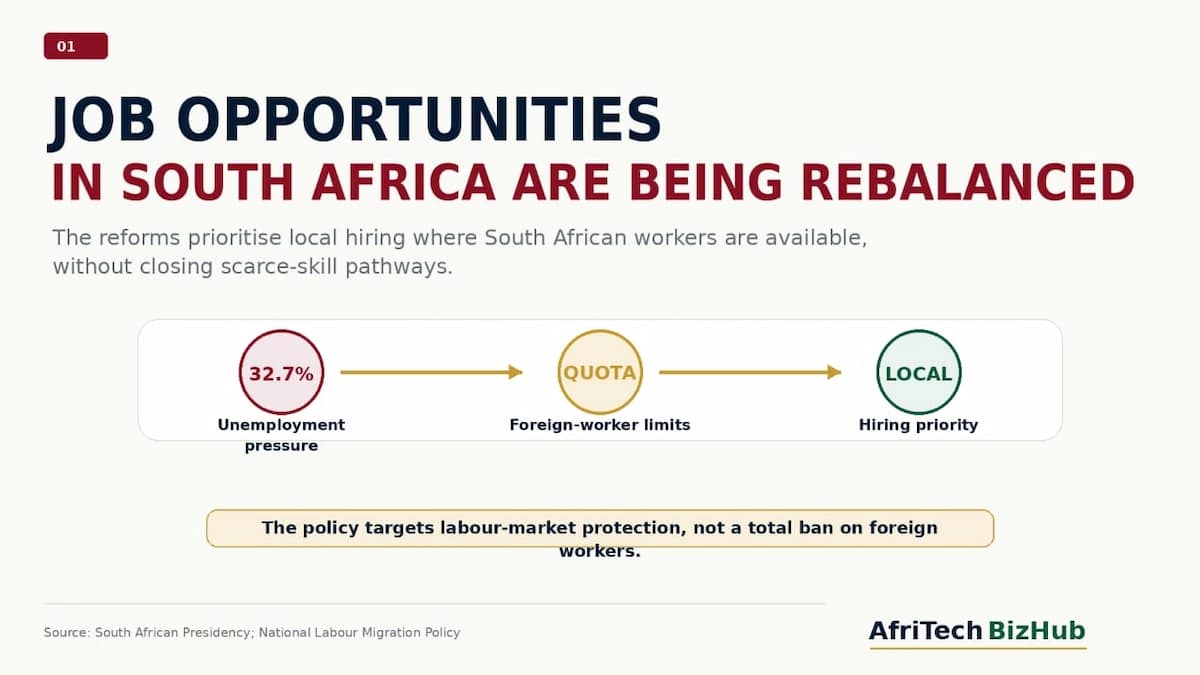
The official unemployment rate reached 32.7% in the first quarter of 2026, while unemployment among people aged 15 to 34 stood at 45.8%.
The government has finalised its National Labour Migration Policy, and the Employment Services Amendment Bill before Parliament would empower the Employment and Labour Minister to introduce maximum foreign-worker quotas in specified sectors, occupations or regions.
The reforms are often described as a “locals first” policy, although that is not the formal title of a single law.
South Africa is pursuing a two-track strategy: protect job opportunities in South Africa where suitable domestic labour is available, while preserving immigration routes for scarce skills and investment capable of increasing productive capacity.
The policy question is therefore not whether foreigners can work in the country, but which forms of foreign participation support rather than displace domestic employment.
Why Are South African Workers Getting Hiring Priority?
South African workers are receiving greater policy priority because the government wants foreign recruitment to occur where an identifiable labour or skills shortage exists.
If enacted, the Employment Services Amendment Bill would allow the Minister to set maximum quotas through notices published in the Government Gazette.
Any quota would have to consider the availability of relevant skills among South Africans, permanent residents, refugees and asylum seekers before limiting foreign employment within a sector or occupational category.
The Bill would also place clearer duties on employers. Businesses recruiting a foreign national would need to verify the person’s legal right to work, establish through a prescribed process that no suitably skilled local candidate is available, prepare a skills-transfer plan where required and provide employment conditions no less favourable than those offered to South Africans.
These provisions are designed to prevent foreign recruitment from being used to bypass labour protections or reduce employment costs.
The policy does not create an automatic citizen-only hiring system.
Quotas would still require consultation, publication and sector-specific evidence, while exemptions may apply where business or skills conditions justify them.
Local priority is therefore being built through recruitment tests, employer accountability and future quotas rather than a blanket prohibition on foreign workers.
How Will Job Opportunities in South Africa Change Now?
Job opportunities in South Africa will not change immediately because the Employment Services Amendment Bill has not yet completed the parliamentary process and sectoral quotas have not been gazetted.
The first practical effect is greater scrutiny of employers that recruit undocumented workers or cannot show that foreign employees are legally authorised to work.
If the Bill becomes law, companies covered by future quotas may need to widen domestic recruitment, strengthen vacancy records and invest more deliberately in training and skills transfer.
The effect would be strongest in sectors where the government finds that South African workers are available but recruitment practices continue to favour foreign labour.
Positions involving verified shortages would remain open to international recruitment through the relevant work-visa routes.
Quotas can influence who receives access to existing vacancies, but they cannot create sufficient employment on their own.
Job opportunities in South Africa ultimately depend on business formation, investment, economic demand and whether training systems prepare workers for available roles.
Poorly calibrated restrictions could leave specialist positions unfilled or delay projects, making reliable labour-market data central to implementation.
Who Can Qualify for the Critical Skills Visa?
The Critical Skills Visa remains a targeted route for applicants whose occupations appear on South Africa’s official Critical Skills List.
The current points-based system awards the required 100 points to a listed critical occupation, provided the applicant also meets the other prescribed immigration conditions.
The route covers selected specialist roles across engineering, information technology, healthcare, science, agriculture, finance, research and other fields where government has identified shortages.
Applicants must identify the specific listed occupation for which they are applying and provide supporting evidence of their qualifications and experience.
Current requirements include an employment offer, confirmation from the relevant professional body or recognised authority, a South African Qualifications Authority evaluation of foreign qualifications and professional registration where required by law.
A Critical Skills Visa may be issued for up to five years at a time.
Its continued availability shows that local hiring priority is not intended to close the labour market to international expertise.
Foreign recruitment remains justified where an unfilled specialist role would restrict infrastructure delivery, healthcare, research, industrial production or technological development.
Why Is South Africa Targeting Strategic Investors Now?
South Africa is facilitating immigration for strategic investors because productive capital can enlarge the employment base rather than compete only for existing vacancies.
Home Affairs launched the second phase of its Trusted Employer Scheme in July 2026, extending eligibility to businesses involved in strategic infrastructure, companies establishing regional or global headquarters and qualifying financial-sector entities.
The scheme uses advance accreditation and a risk-based process to simplify visa applications for qualifying employers that need international expertise.
Companies must demonstrate meaningful investment in South Africa, employ predominantly South African citizens or permanent residents, invest in skills development and operate within priority sectors.
The scheme therefore connects faster mobility with domestic economic commitments rather than granting unrestricted access to foreign personnel.
The commercial logic is that major investments may require senior managers, engineers or technical specialists during establishment and expansion.
Their entry can support new facilities, technology transfer and local training where the wider operation creates sustainable employment.
Strategic immigration carries economic value when foreign expertise helps build a larger South African workforce rather than replacing it.
How Will Immigration Reforms Shape South Africa’s Economic Competitiveness?
South Africa’s immigration reforms will strengthen competitiveness only if they distinguish accurately between labour substitution and genuine capability shortages.
Protecting local access to work can improve confidence in the labour system, but rigid or outdated quotas could raise operating costs and prevent companies from securing skills required for investment, production and public services.
The stronger model combines evidence-based limits with efficient routes for scarce expertise and productive capital.
Employers should recruit and train South Africans where suitable labour exists, while foreign specialists should remain available for roles that cannot be filled at the required level or within a commercially workable period.
Strategic investors should receive faster support where their projects create employment, deepen supply chains and transfer skills.
The decisive test will not be the number of foreign workers restricted or visas approved.
Job opportunities in South Africa will improve when immigration enforcement is paired with business growth, workforce development and investment capable of creating additional demand for labour.
A selective system can protect access to employment today, but its long-term success depends on whether it also expands the economy’s capacity to create work tomorrow.


Recent Comments