


Featured Summary:
- South African firms are buying established British companies rather than entering the market from scratch.
- International acquisitions provide immediate access to customers, expertise and revenue in pounds.
- African multinationals are using Britain as an operating market, financial centre and platform for wider growth.
- Long-term success rests on disciplined integration rather than the number of assets acquired.
Britain’s commercial relationship with South Africa no longer runs in one direction.
UK investors remain important to the South African economy, but South African firms now own businesses, manage assets and compete for customers inside Britain.
Acquisitions across services, healthcare supplies, facilities management and financial services show African capital securing a larger role within a mature global market.
These transactions challenge the assumption that corporate expansion always carries capital from developed economies into Africa.
Strong South African groups are using skills and earnings built at home to acquire operating platforms abroad, diversify revenue and reduce exposure to domestic constraints.
Britain offers them more than prestige: it provides customers, regulated industries, specialist talent and a route into wider international markets.
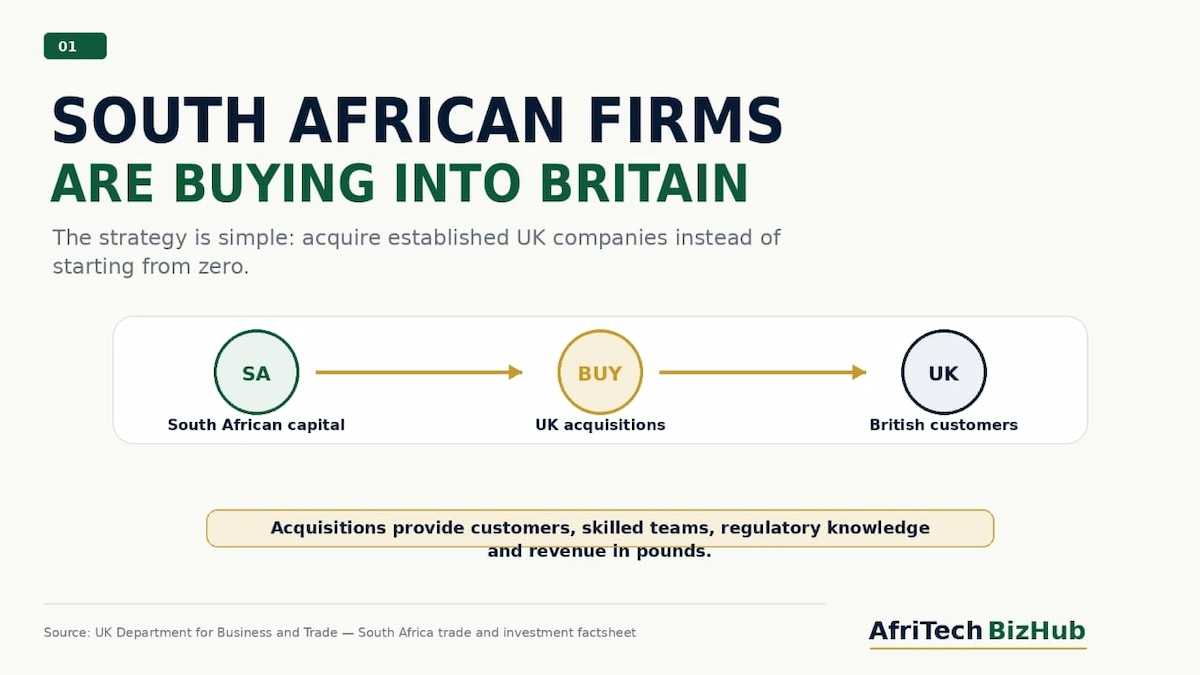
Why Are South African Firms Expanding Through International Acquisitions?
International acquisitions shorten the distance between ambition and market access.
Buying an established British company gives South African firms an existing customer base, trained employees, regulatory knowledge, supplier relationships and proven revenue.
Organic entry would require years of brand development and local recruitment, while an acquisition provides a functioning platform from the first day.
The strategy also protects stronger groups from excessive dependence on South Africa’s economic cycle and the rand.
Sterling income adds geographic and currency diversity, while ownership of specialised British businesses gives the parent company capabilities it can use elsewhere.
The acquisition only creates value, however, when the buyer understands the sector, pays a disciplined price and preserves the strengths of the business it purchased.
How Are African Multinationals Driving Corporate Expansion in Britain?
African multinationals now participate in Britain as employers, service providers, asset managers and business owners rather than occasional foreign investors.
Their operations reach customers directly, place African-led companies inside regulated sectors and give them experience managing complex businesses beyond the continent.
This marks a deeper form of corporate expansion than exporting goods or maintaining a representative office.
South African groups carry experience from a market shaped by tight margins, infrastructure pressure and diverse customer needs.
That background supports strong cost control, decentralised management and careful capital allocation inside British service industries.
Their presence shows that African corporate strength can travel outward, with companies from the continent acquiring and operating assets inside developed economies.
What Makes South African Companies UK Expansion So Successful?
South African companies UK operations perform best when the acquired business fits an existing area of expertise.
Buyers with experience in banking, facilities management, distribution or business services can evaluate operating risks more accurately and improve performance without dismantling the local knowledge that made the target valuable.
Sector familiarity matters more than the symbolic appeal of owning a British company.
Management discipline provides the second advantage.
South African executives often operate under tighter capital constraints than competitors in larger economies, encouraging close attention to cash flow, margins and return on investment.
That discipline can support successful integration, but it also sets a clear warning: expansion loses value when acquisitions serve geographic ambition rather than a coherent commercial strategy.
Why Are UK Investments Attracting Africa’s Global Acquisitions?
Britain offers clear corporate rules, deep financial markets, skilled labour and established companies with access to domestic and international customers.
Acquiring a British business can provide revenue in a major currency, recognised operating standards and a platform for further growth.
These characteristics make UK investments attractive to African groups seeking scale without building every capability internally.
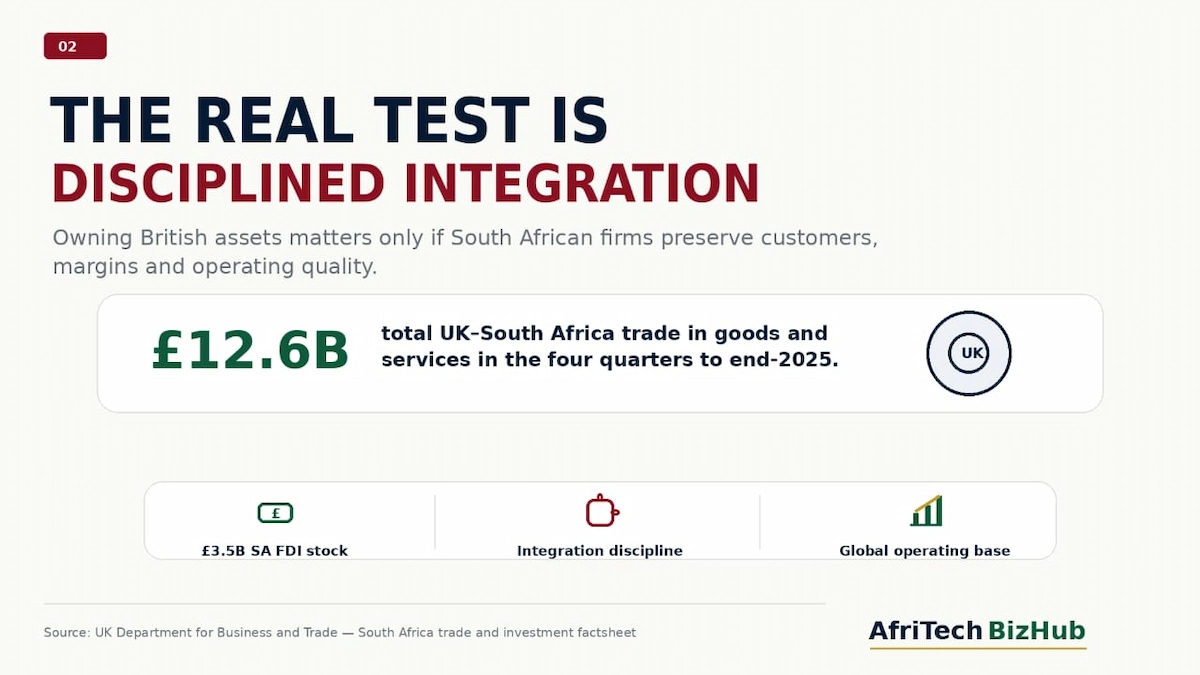
The latest UK Department for Business and Trade factsheet records a substantial two-way commercial relationship between the countries.
Total trade in goods and services reached £12.6 billion in the four quarters to the end of 2025, while South African foreign direct investment stock in the UK stood at £3.5 billion at the end of 2024.
South African acquisitions therefore sit within an established investment relationship rather than a temporary sequence of isolated deals.
What Is the Connection Between the UK and South Africa?
The UK and South Africa share commercial links across trade, financial services, mining, education, professional services and investment.
Britain remains a significant source of capital and expertise for South Africa, while London gives South African companies access to finance, global investors and corporate networks.
South African ownership of British businesses adds a stronger outward-investment dimension to that relationship.
The durability of this shift rests on performance after each acquisition.
South African firms must retain customers, integrate operations and generate returns without weakening the businesses they bought.
Companies that achieve that balance can use Britain as a permanent base for international growth, while poorly matched deals will expose the limits of expansion driven by scale alone.
The decisive measure is no longer whether African capital can enter Britain, but whether it can build institutions that remain competitive there.


Recent Comments