

Featured Summary:
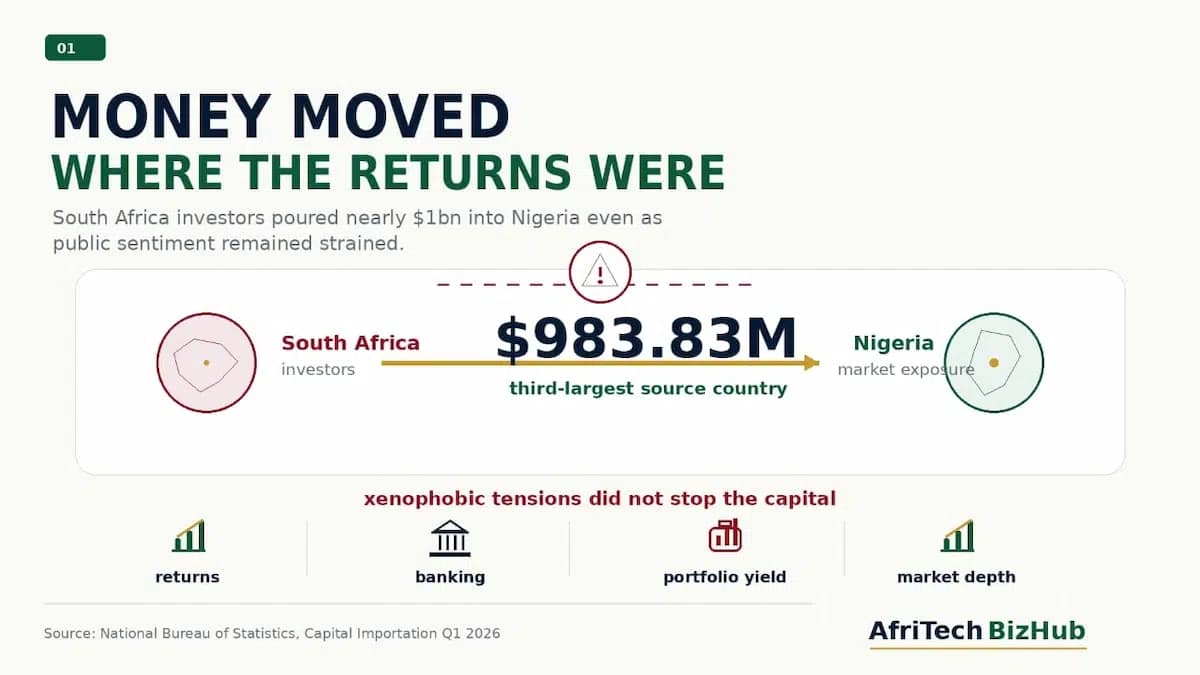
- Capital importation into Nigeria reached $10.37 billion in Q1 2026, with South Africa contributing $983.83 million as the third-largest source country.
- Portfolio investment dominated Nigeria’s inflows, showing that foreign investors are mainly entering through financial assets rather than long-term direct projects.
- South Africa investors are increasing Nigeria exposure because market size, banking returns, financial yields, and reform signals remain commercially attractive.
- Xenophobia South Africa tensions can affect diplomacy and public sentiment, but the latest data shows capital decisions are still being shaped by returns and market access.
Nigeria and South Africa are moving through two different realities at the same time.
On the political and social side, xenophobic tensions have strained public trust and raised fresh questions about how Nigerians are treated in South Africa.
On the financial side, South Africa investors are still sending large volumes of capital into Nigeria, showing that markets often move on returns even when diplomacy is under pressure.
That contrast is what makes the latest capital importation data important.
Nearly $1 billion from South Africa did not enter Nigeria because relations were calm.
It entered because Nigeria remains one of Africa’s largest financial markets, with banking assets, portfolio yields, currency-adjusted opportunities, and reform signals that investors cannot easily ignore.
The deeper story is not that xenophobia South Africa has no effect.
It is that Nigeria investment is being pulled by commercial logic strong enough to keep capital moving through political discomfort.
Is Nigeria-South Africa Capital War Fueling Record $1bn Investment Surge?
The phrase “capital war” captures the tension, but the data points more toward a hard commercial calculation.
South Africa investors are not simply reacting to politics.
They are allocating capital into a Nigerian market where returns, liquidity, bank channels, and financial instruments remain attractive compared with many alternatives on the continent.
Nigeria and South Africa have long been economic rivals and partners at the same time.
Their relationship carries competition in banking, telecoms, retail, energy, trade, and regional influence. That makes the latest inflow more significant.
Capital is entering Nigeria at a moment when public sentiment between both countries is strained, yet investors appear focused on yield, scale, and exposure to Africa’s largest consumer market.
The surge is therefore less about sentiment and more about where capital sees opportunity.
How does Capital Importation Drive Nigeria Growth?
Foreign capital supports Nigeria’s growth when it strengthens liquidity, deepens financial markets, and gives companies access to funding.
Capital importation can help stabilize foreign exchange supply, support banking-sector activity, finance government and corporate instruments, and improve investor confidence when inflows are sustained.
In an economy where dollar liquidity matters, fresh capital can ease pressure across markets.
The quality of that capital still matters. Portfolio investment can move quickly and support market activity, but it is less stable than foreign direct investment.
Nigeria benefits most when capital inflows support production, infrastructure, manufacturing, technology, agriculture, and long-term business expansion.
The latest data shows strong investor appetite, but the growth question is whether these inflows can move beyond financial positioning into deeper economic activity.
Is Portfolio Investment Boosting Nigeria Financial Inflows?
Nigeria’s capital rebound is being driven overwhelmingly by portfolio investment.
This means foreign investors are mainly entering through financial assets such as money-market instruments, bonds, and equities rather than committing heavily to factories, infrastructure, or long-term operating businesses.
That structure explains why the headline inflow is large but still needs careful interpretation.
Portfolio investment can boost Nigeria’s financial inflows by bringing liquidity into banks, markets, and government securities.
It can also signal renewed investor confidence after reforms or changing interest-rate conditions.
The risk is that portfolio capital can reverse quickly if yields fall, currency risk rises, or global investors become more cautious.
For Nigeria, the immediate benefit is stronger inflow momentum.
The longer-term challenge is converting investor confidence into more durable foreign investment Nigeria can use for jobs, productivity, and industrial growth.
Why are South Africa Investors Increasing Nigeria Exposure?
Nigeria’s scale is difficult for regional investors to ignore.
The country offers a large banking market, a deep consumer base, active financial institutions, and reform-linked opportunities that can attract investors seeking higher returns.
South Africa investors also understand African market risk better than many offshore investors, which can make Nigeria exposure more acceptable when the return profile is strong.
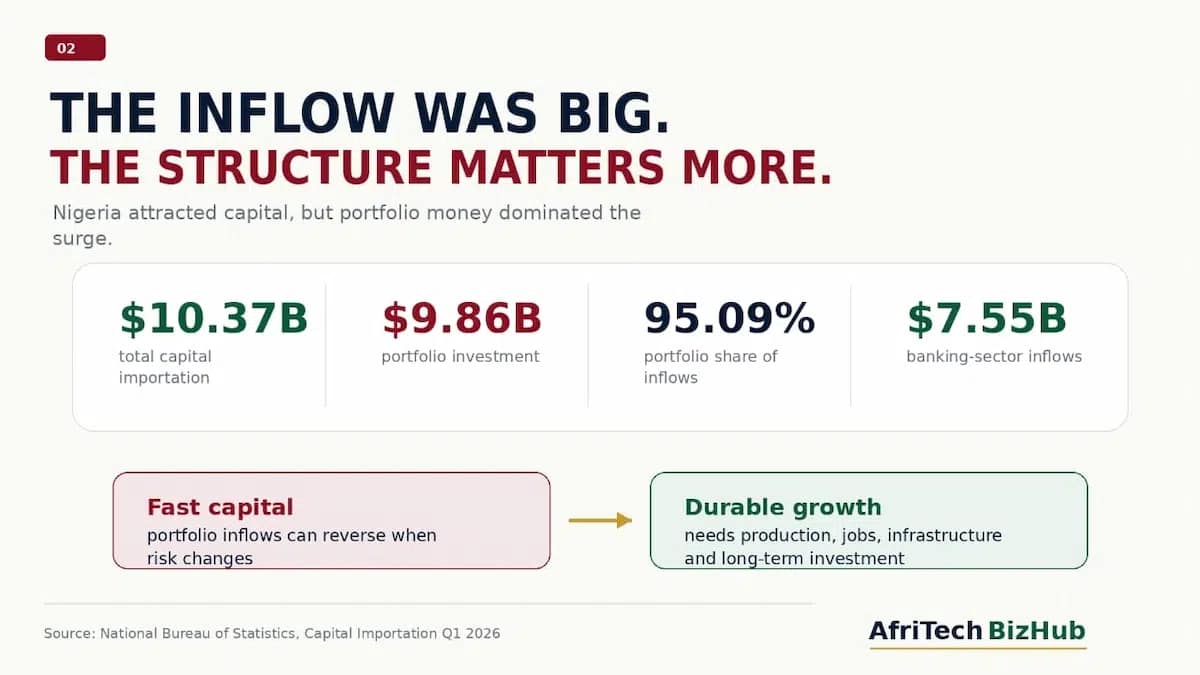
The National Bureau of Statistics reported that Nigeria received $10.37 billion in capital importation in Q1 2026, up 83.83% from Q1 2025 and 60.97% from Q4 2025.
Portfolio investment accounted for $9.86 billion, or 95.09% of total inflows, while South Africa contributed $983.83 million, representing 9.49% of total capital importation and ranking third after the United Kingdom and the United States.
The banking sector received the largest share of inflows at $7.55 billion, or 72.79%, which helps explain why financial-sector exposure remains central to the Nigeria-South Africa investment story.
What Drives Nigeria Investment Amid Global Uncertainty Trends?
Nigeria investment is being shaped by a mix of domestic reform signals and global capital behavior.
Investors are looking for markets where returns can compensate for risk, especially when global conditions remain uncertain.
Nigeria’s large population, financial market depth, oil-linked economy, banking sector, and policy reforms make it difficult to exclude from African investment strategies.
The inflows also reflect how global investors separate risk types.
Political tension, currency uncertainty, and social concerns matter, but they do not always stop capital if yields, liquidity, and market access remain attractive.
That is why Nigeria can attract portfolio investment even while long-term direct investment remains weaker.
The country is drawing capital, but much of it is still return-sensitive and mobile.
That creates opportunity for the financial system, while also reminding policymakers that deeper confidence requires stability, transparency, and stronger productive sectors.
Does Xenophobia South Africa Affect Nigeria Capital Inflows?
Xenophobia South Africa affects the political environment, public trust, and bilateral mood between both countries.
It can lead to diplomatic pressure, consumer boycotts, retaliation debates, and public anger toward South African-linked businesses.
These tensions matter because investment does not happen in a vacuum. Perception, safety, and diplomatic trust all shape the wider climate around capital flows.
The latest capital importation data, however, shows that financial decisions are not moving in the same direction as public sentiment.
South Africa investors still increased exposure to Nigeria because the commercial case remained strong.
That does not mean xenophobia has no economic cost.
It means the immediate capital-flow story is being shaped more by returns, banking-sector opportunities, portfolio investment channels, and Nigeria’s market size than by political discomfort alone.
The sharper lesson is that Nigeria-South Africa tensions can strain relations, but capital will continue to follow credible opportunities where investors believe the numbers still work.


Recent Comments