


Featured Summary:
- South Africa AI cooperation with China is expanding beyond technical exchanges into joint research, cybersecurity, quantum computing, and scientific collaboration.
- China’s experience deploying AI across major industries provides South Africa with opportunities to strengthen productivity, research capability, and innovation.
- Secure digital infrastructure and cybersecurity are becoming as important as AI models themselves in building national technological capability.
- The long-term value of the partnership will depend on South Africa’s ability to translate international cooperation into domestic research capacity, skilled talent, and commercial innovation.
Artificial intelligence has become a strategic national capability built through research institutions, advanced computing, secure data systems and skilled scientific talent.
Governments are no longer competing only to adopt AI applications.
They are building the institutions required to develop, govern and commercialise the technology across entire economies.
The latest South Africa AI engagement with China reflects that shift.
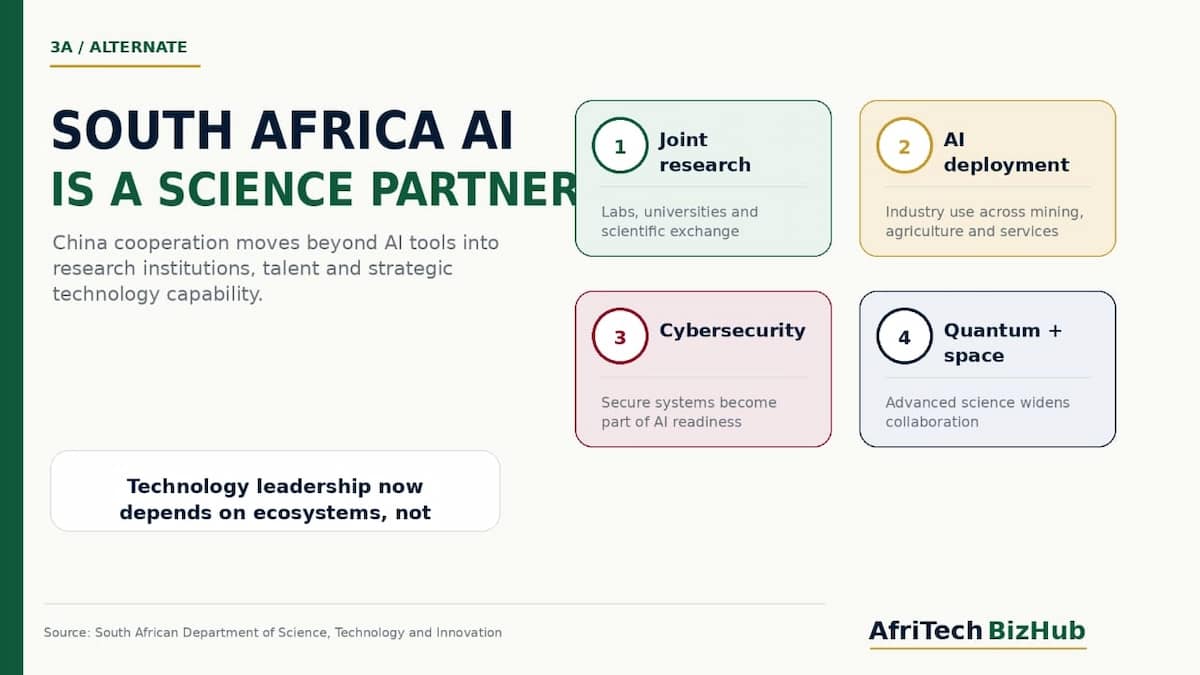
During the 2026 World Artificial Intelligence Conference in Shanghai, both governments identified artificial intelligence, joint research centres, quantum computing, cybersecurity, astronomy, space science and researcher exchanges as priority areas for deeper cooperation.
The talks broaden an existing scientific relationship rather than establishing a single AI project, placing long-term institutional capability at the centre of the partnership.
How will Technology Collaboration Transform South Africa AI Future?
The South Africa AI partnership can shorten the time required to build scientific capability by connecting local universities, public research institutions and technology agencies with larger international research networks.
The bilateral discussions focused on joint research centres and laboratories, public engagement, youth development and scientific exchange, showing that the cooperation is aimed at strengthening the system around AI rather than transferring isolated products.
That institutional focus matters because sustained AI development depends on the ability to produce new knowledge continuously.
Laboratories require skilled researchers, computing resources, dependable datasets and long-term funding.
International collaboration can widen access to expertise and research methods, but domestic institutions must retain the capacity to absorb that knowledge and apply it independently.
South Africa gains the greatest advantage where local researchers participate in defining projects, developing intellectual property and converting scientific work into commercial applications.
Technology collaboration strengthens national capability when it develops institutions that can continue innovating after individual partnerships or programmes end.
Why is China’s AI Partnership Expanding Across Strategic Sectors?
Artificial intelligence carries greater economic weight when it improves industries that already shape production, employment and public services.
Manufacturing can use intelligent systems to reduce downtime and improve quality control, while mining can apply data analysis to equipment management, geological modelling and operational safety.
Agriculture, healthcare, logistics and public administration present different use cases tied to productivity and service delivery.
For South Africa, the commercial question is not whether AI applications can be imported, but whether they can be adapted to domestic industrial conditions.
Mining operations, manufacturers and agricultural businesses require systems trained around local data, infrastructure and regulatory requirements.
The South Africa AI opportunity therefore depends on connecting technical research with sector knowledge and measurable operating needs.
China AI collaboration can provide exposure to large-scale deployment experience, but South Africa must determine where adoption can deliver clear economic returns.
Strategic value will come from stronger industrial output, lower operating costs and locally developed products rather than the number of pilot projects announced.
How Does the South Africa–China Alliance Strengthen Scientific Research?
Scientific collaboration gives AI development a wider foundation than software engineering alone.
South Africa and China identified space science, astronomy, quantum computing, artificial intelligence and joint laboratories as areas for deeper engagement.
Researcher exchanges and youth programmes can also widen the pipeline of scientists capable of working across those disciplines.
The relationship builds on established cooperation between the two countries rather than beginning with the Shanghai meeting.
Its next phase places greater emphasis on research institutions and emerging technologies that require long development cycles, specialised equipment and collaboration across scientific fields.
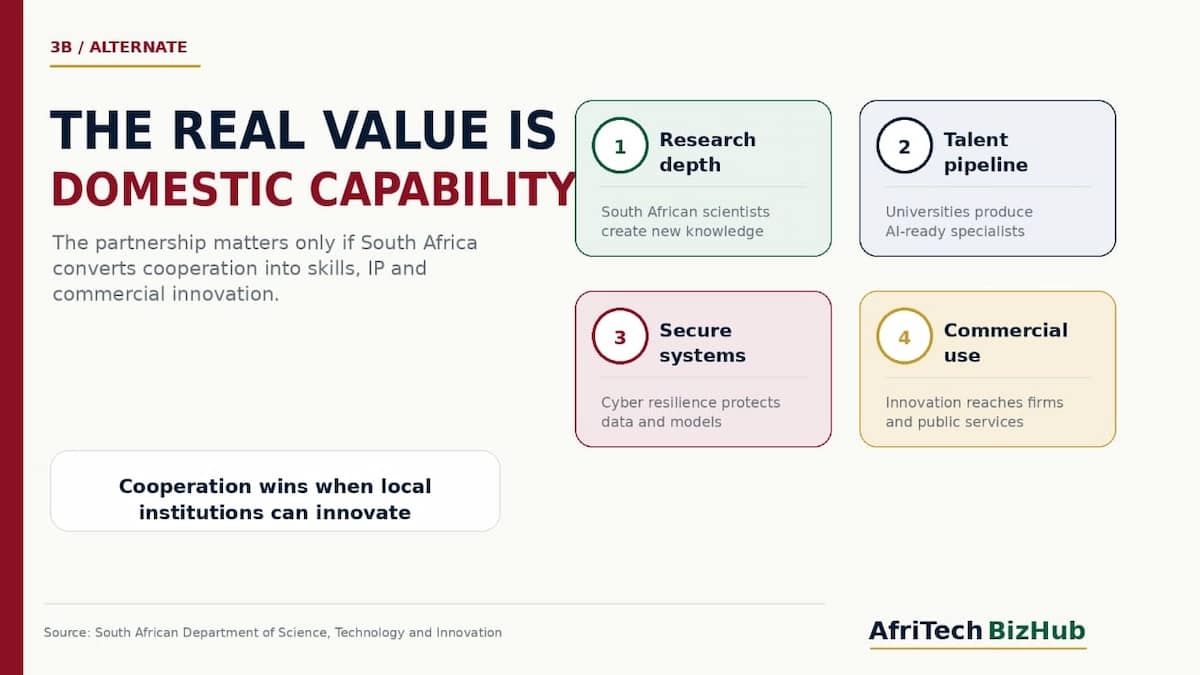
The economic value will depend on whether joint research produces stronger domestic expertise, publishable science, intellectual property and technologies that can move into commercial use.
Scientific partnerships become strategic when they expand what local institutions can discover and develop, not only the international networks in which they participate.
Why is Cybersecurity Collaboration Becoming Essential for AI Development?
South Africa and China identified cybersecurity as a priority area alongside artificial intelligence and quantum computing during their bilateral engagement at the 2026 World Artificial Intelligence Conference.
Its inclusion reflects the operational reality that national AI capability depends on secure data systems, computing infrastructure and digital networks capable of resisting disruption and unauthorised access.
The risk grows as AI is deployed across sectors that manage sensitive information and essential services.
A compromised system can expose confidential data, distort automated decisions or interrupt operations in finance, healthcare, energy and public administration.
Cybersecurity collaboration can strengthen technical expertise, threat awareness and institutional readiness as South Africa expands the use of AI across the economy.
Secure infrastructure will therefore determine how confidently governments, businesses and research institutions can adopt artificial intelligence at scale.
Cybersecurity is not separate from AI development; it is part of the foundation that makes advanced digital systems reliable.
Secure digital infrastructure is becoming as important as AI models themselves in building national technological capability.
How Could South Africa’s AI Cooperation Influence Global Research Networks?
South Africa’s participation in international AI cooperation can give its researchers a stronger position within the institutions where technical standards, research priorities and governance principles are shaped.
The country was identified as a founding member of the World Artificial Intelligence Cooperation Organisation launched around the Shanghai conference, extending the partnership beyond bilateral research into wider discussions on AI capacity, safety and access.
Membership alone will not create technological influence.
South Africa will need domestic computing infrastructure, research funding and companies capable of commercialising discoveries if international access is to produce independent economic capability.
Without that foundation, scientific cooperation may expand participation without changing the country’s position in the global technology value chain.
The South Africa AI partnership changes the strategic calculation because it links artificial intelligence with cybersecurity, quantum research, astronomy, laboratories and scientific talent.
Its long-term value will not be measured by the breadth of the diplomatic agenda, but by the research capacity, intellectual property and competitive businesses created inside South Africa.
International cooperation becomes transformative only when it strengthens a country’s ability to innovate on its own.


Recent Comments