


Featured Summary:
- Stablecoin Africa adoption is being driven less by cryptocurrency speculation than by demand for digital dollars, faster cross-border settlement, and protection against local-currency instability.
- Businesses, freelancers, importers, and remittance users can move value through digital wallets without relying on every institution in the conventional correspondent-banking chain.
- Dollar-backed stablecoins can reduce payment friction, but wider use may divert deposits from banks, deepen currency substitution, and weaken the influence of domestic monetary policy.
- Africa’s monetary authorities can preserve financial stability by regulating access points, improving payment infrastructure, strengthening local currencies, and integrating innovation rather than attempting to eliminate it.
Africa’s stablecoin market is moving beyond cryptocurrency trading into payments, savings and commercial settlement.
Chainalysis estimated that sub-Saharan Africa received more than $205 billion in on-chain value between July 2024 and June 2025, an increase of about 52% from the previous year.
Its earlier regional analysis estimated that stablecoins represented approximately 43% of crypto transaction volume, while the IMF reported that Nigeria received about $59 billion in crypto-asset inflows between July 2023 and June 2024 and has accounted for roughly 60% of sub-Saharan Africa’s stablecoin inflows since 2019.
The figures measure on-chain activity rather than confirmed real-economy payments, but they establish the scale of the shift.
The silent revolution is not the formal replacement of African currencies or commercial banks.
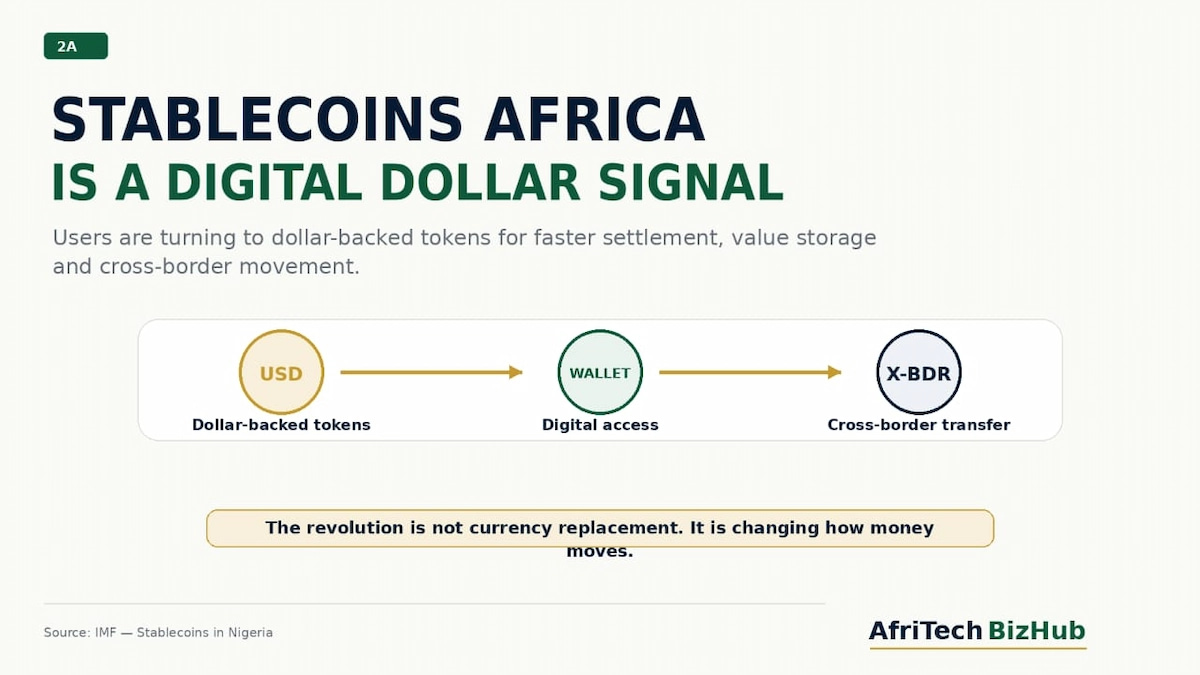
It is the emergence of privately operated networks through which users can hold and transfer dollar-denominated value continuously across borders.
Stablecoins Africa therefore describes a change in financial architecture: national institutions still issue and regulate money, but a larger share of its movement can occur through wallets, exchanges and blockchain-based payment providers operating alongside the banking system.
Why Are Stablecoins in Africa Growing Faster Than Traditional Banking?
Stablecoins are gaining ground where access to foreign currency remains restricted, domestic currencies are unstable or conventional international payments are too slow and costly.
A user with a smartphone, internet access and a supported wallet can receive a dollar-linked token without first opening a foreign-currency bank account.
In Nigeria, the IMF linked adoption to naira depreciation, high inflation and constrained access to foreign exchange, with households and small businesses using stablecoins as both a dollar-linked store of value and a means of paying overseas suppliers.
The shift does not show that stablecoins are replacing the wider banking system.
Banks still provide credit, regulated deposits, consumer protection and domestic financial intermediation at a scale stablecoin networks do not match.
The Stablecoins Africa trend is advancing fastest within specific gaps: access to dollars, round-the-clock settlement and cross-border payments.
Users are adopting an alternative where conventional channels do not provide the required speed, availability or price.
Can Cross-Border Money Transfer Thrive Without Conventional Banking Systems?
Stablecoins can shorten cross-border money transfer chains without removing conventional finance from the transaction.
International bank payments may move through sending banks, correspondent institutions, foreign-exchange providers, clearing systems and receiving banks operating under different schedules and data standards.
A stablecoin can move between digital wallets within minutes, allowing the recipient to retain the token or convert it into local currency.
The IMF notes that this model can compete with remittance channels where sending $200 to sub-Saharan Africa costs about 9% of the amount transferred, compared with a global average of roughly 6%.
The commercial use extends beyond household remittances.
Freelancers can receive international income, importers can settle supplier obligations and businesses can transfer value where access to conventional dollars is constrained.
Stablecoins still require dependable entry and exit points: users obtain and redeem tokens through exchanges, banks, cards, mobile-money services or cash agents.
Their advantage lies in bypassing sections of the correspondent-banking chain, not in operating independently of regulated liquidity, identity checks and local-currency conversion.
How Do Dollar-Backed Stablecoins Change Domestic Financial Systems?
Dollar-backed stablecoins begin to affect domestic finance when users retain them as savings or use them to price and settle local commercial activity.
The Bank for International Settlements reported that 99.4% of fiat-backed stablecoins by market value were pegged to the US dollar in 2026.
Wider adoption can therefore extend dollar use into economies where households and companies previously faced greater barriers to holding or transferring foreign currency.
At sufficient scale, that shift can weaken demand for domestic money and reduce the influence of local interest-rate decisions over financial behaviour.
The effect on banks depends on how funds move into the tokens and where issuers hold their reserves.
A sustained migration from local deposits into foreign stablecoins could reduce the low-cost funding available to domestic lenders, raise funding costs and constrain credit creation.
Stablecoins can transfer existing value, but their issuers generally do not perform the same role as banks in financing households and businesses.
At scale, the Stablecoins Africa market could therefore divide financial functions: digital-dollar networks capture more payments and savings activity while regulated banks remain responsible for much of the credit and liquidity supporting the economy.
Why Is the African Financial System Responding to Stablecoin Growth?
African regulators are responding because stablecoin activity reaches monetary policy, consumer protection, financial integrity and cross-border capital flows.
Dollar-linked tokens can move through exchanges and self-hosted wallets beyond monitoring systems designed around supervised banks.
Regulators must therefore consider the treatment of issuers and payment providers, the quality and location of reserve assets, redemption rights, transaction reporting and the controls applied when users convert between stablecoins and domestic currency.
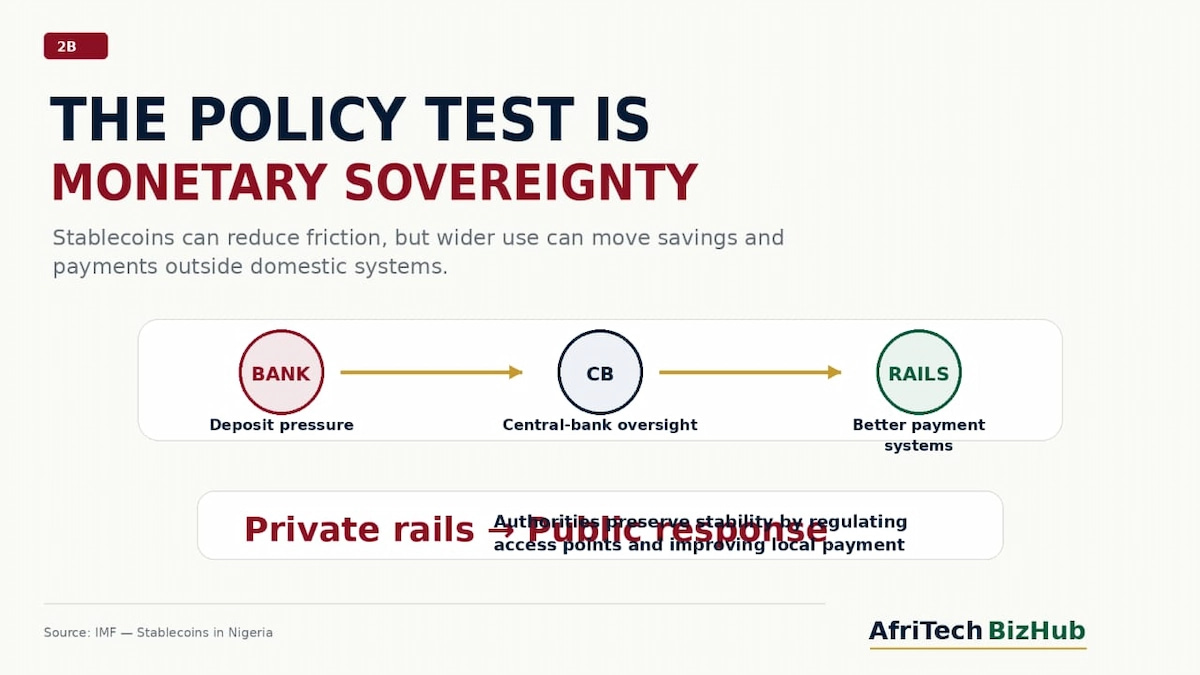
The IMF recommends a pragmatic response built around four priorities: protecting monetary stability, strengthening oversight, improving transaction data and upgrading domestic and regional payment infrastructure.
For Stablecoins Africa, the policy contest is not between unrestricted adoption and prohibition.
Authorities must regulate the points where digital tokens connect with the formal economy while improving the payment delays, foreign-exchange constraints and interoperability gaps that created demand for alternative channels.
Can Monetary Sovereignty Adapt to Africa’s Digital Currency Shift?
A silent currency revolution is already underway, but it is occurring through payment behaviour rather than the formal surrender of national currencies.
Monetary sovereignty becomes harder to exercise when residents can move savings and commercial settlement into dollar-linked instruments at the first sign of inflation or exchange-rate pressure.
The central bank may continue issuing the national currency, yet its policy influence weakens where businesses and households prefer another unit for storing value and completing transactions.
The durable response is to make domestic money and regulated payment systems competitive enough to remain central to economic life.
Stablecoins Africa signals that users have identified genuine weaknesses in cross-border settlement and access to reliable stores of value.
Sovereignty will not be preserved by controlling currency issuance alone.
It will depend on whether public institutions can maintain confidence in local money while building financial infrastructure that moves value with the speed, affordability and reliability users now expect.


Recent Comments