


Featured Summary:
- Flutterwave Tempo is deploying stablecoin payments to reduce costs in Africa’s most expensive remittance flows.
- Cross-border payments remain complex due to fragmented settlement rails and multiple intermediaries.
- Fintech partnerships are evolving into infrastructure strategies rather than simple expansion models.
- Future Crypto remittance adoption will hinge on settlement capacity, liquidity availability, and regulatory execution.
Cross-border payments into Africa remain among the most expensive in the world, even as digital finance grows.
Money moves through multiple intermediaries before reaching recipients, adding delays, fees, and operational complexity.
Flutterwave and Tempo are attempting to reduce friction with Stablecoin payments, entering a market where the technology is proven but the supporting infrastructure remains fragmented.
Observed activity shows that the real test is not simply moving funds digitally, but creating networks capable of handling global-scale remittances efficiently and reliably.
How will Stablecoin Payments Transform African Remittances?
International remittances have historically relied on correspondent banking networks. Payments from Europe or North America to Africa pass through several financial institutions, each adding fees, compliance checks, and operational delays.
These layers help explain why remittance costs remain high despite digital innovation.
Stablecoin payments aim to simplify this chain.
Blockchain-based settlement networks can move value continuously, reducing the number of intermediaries and settlement costs.
Observed patterns show that faster transfers and lower fees, rather than the technology itself, are the primary attraction for users.
If adoption grows, competition may shift from customer acquisition to settlement efficiency.
Institutions capable of moving value more effectively could gain advantage over those tied to traditional payment models, changing the competitive landscape.
Can Flutterwave Tempo Handle Global Settlement Scale?
Executing cross-border transfers is feasible; the challenge is settlement at scale.
Each corridor requires liquidity, local payout infrastructure, compliance systems, and operational resilience.
Larger networks amplify complexity.
Tempo contributes remittance expertise and established corridors, while Flutterwave brings African distribution networks and payment infrastructure.
Observed patterns indicate that integrating these capabilities is critical to scaling Stablecoin payments across multiple jurisdictions.
Even with thousands of transactions processed efficiently, liquidity constraints at scale can create bottlenecks.
Patterns suggest the real constraint is infrastructure capacity, not transaction technology.
Is Flutterwave Building Next-gen Payment Infrastructure?
Payment companies often compete through networks, not products.
The largest players derive value from the infrastructure that underpins transactions.
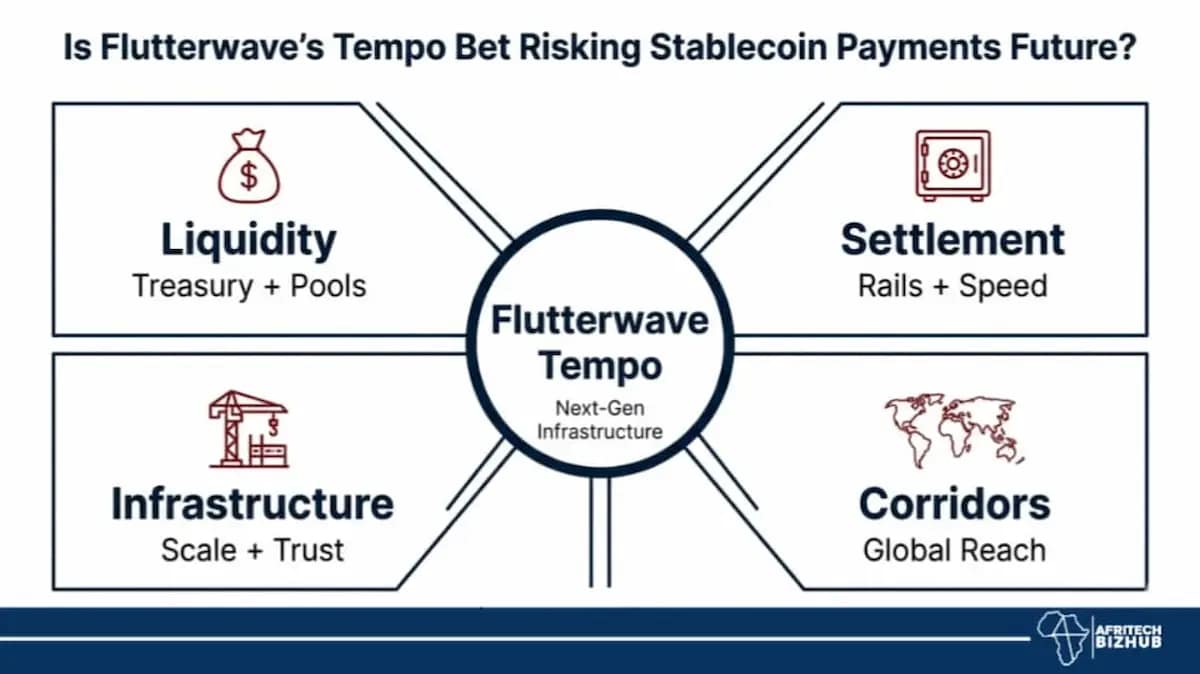
Settlement rails, liquidity systems, treasury management, compliance frameworks, and payout networks define long-term advantage.
Flutterwave’s Tempo strategy moves beyond remittance execution to infrastructure ownership.
Observed deployment patterns show that capturing control of these layers could generate value far exceeding individual Stablecoin transactions.
Cross-border payment efficiency depends on operational and settlement layers.
Patterns indicate that institutions controlling the network may dominate the market, independent of customer-facing features.
Are Fintech Partnerships Driving Stablecoin Adoption Surge?
Stablecoin payments expand through partnerships because no single company owns all components of a global remittance network.
Regulatory access, banking relationships, settlement infrastructure, and local payout networks are distributed across institutions.
Partnerships assemble infrastructure instead of simply expanding customers.
Observed patterns show that collaboration allows combining strengths, covering gaps, and scaling services more rapidly than single-entity approaches.
Flutterwave’s partnership with Tempo combines remittance expertise with African payment infrastructure and market reach, reflecting the broader industry shift.
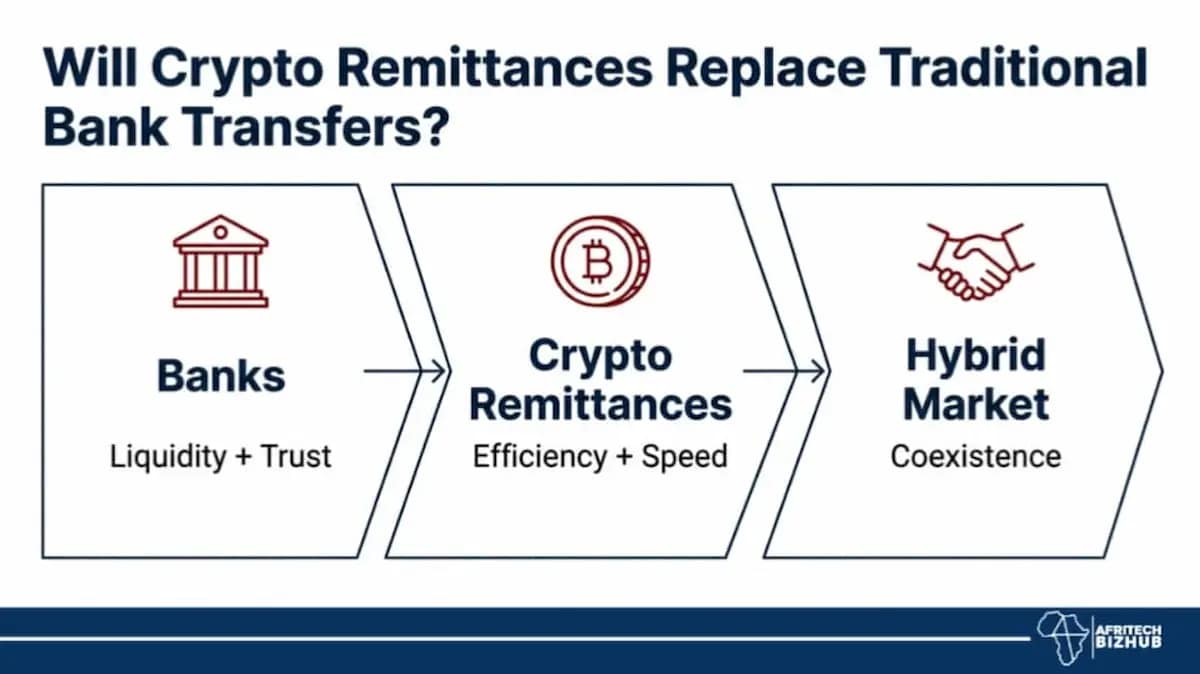
Will Crypto Remittances Replace Traditional Bank Transfers?
Stablecoin payments increase efficiency but do not supplant traditional banking.
Banks retain liquidity, regulatory relationships, and trust built over decades.
Observed trends suggest a hybrid market where traditional institutions and digital networks operate side by side.
Competition may reduce costs, speed transfers, and expand access.
Patterns indicate that the greater risk is infrastructure failure: liquidity shortages, bottlenecks, and fragmented compliance can hinder adoption regardless of technological capability.
Flutterwave’s Tempo strategy is therefore a bet on the infrastructure layer itself, not just the digital payment technology.
Observed market behavior shows that success depends on scaling settlement, managing liquidity, and navigating regulatory environments.


Recent Comments