


Featured Summary:
- Safaricom internet launches pay-as-you-go broadband, directly targeting households with limited budgets.
- Kenya’s smaller ISPs face competition from a provider leveraging scale, brand, and payment flexibility.
- Consumer adoption patterns are shifting toward incremental payments and lower upfront costs.
- Early market signals suggest pressure on previously stable segments and a potential reordering of the broadband landscape.
Safaricom internet is expanding aggressively into Kenya’s budget broadband segment with pay-as-you-go access.
On the surface, it appears as a product update.
Beneath that simplicity, tension is building.
Small ISPs operate on narrow margins, serving price-sensitive households.
Safaricom’s reach, brand, and flexible payment model introduce a competitive strain few providers are equipped to counter.
The market is starting to move.
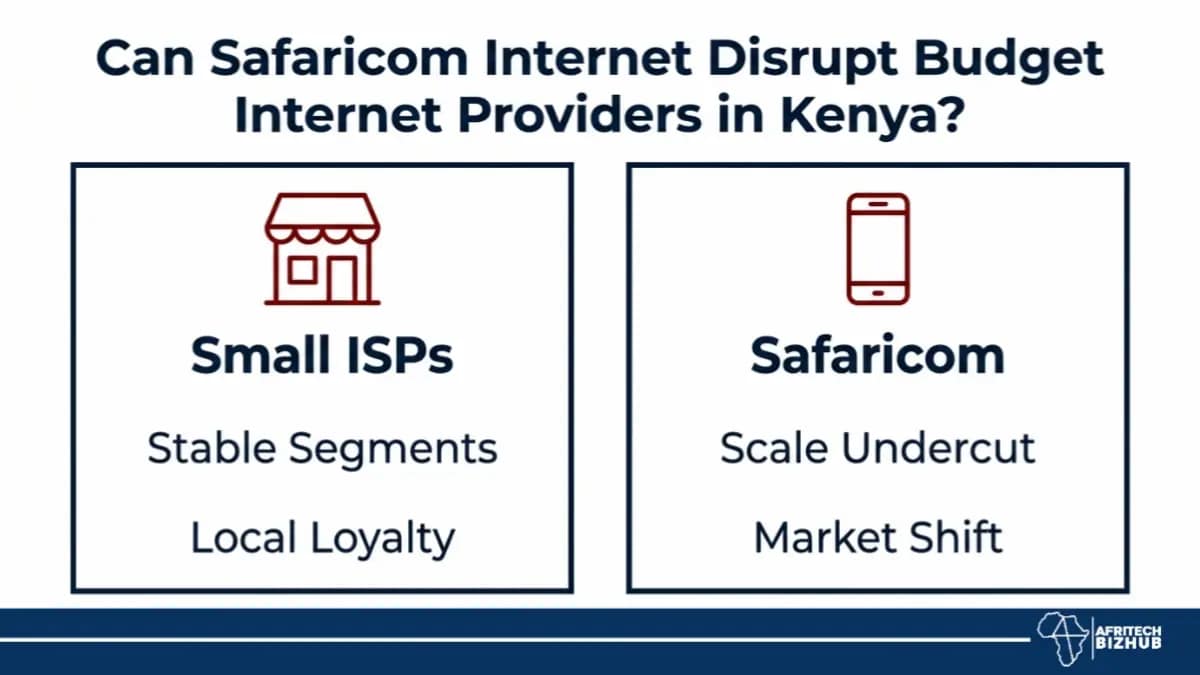
Can Safaricom Internet Disrupt Budget Internet Providers in Kenya?
Safaricom internet is entering a segment historically held by small ISPs.
These providers rely on predictable revenue streams and local customer loyalty.
Safaricom’s scale allows it to undercut pricing while bundling services, creating tension for budget operators.
Segments that once offered stability are now contested.
Early adoption of Safaricom internet pay-as-you-go broadband indicates that household subscribers are re-evaluating which providers meet affordability and access needs.
Market behavior is beginning to shift.
Why Is Safaricom Expanding Pay-As-You-Go Internet?
Pay-as-you-go broadband lowers the barrier for households that cannot commit to monthly fees.
Safaricom internet integrates with M-PESA to enable incremental payments aligned with Kenyan household budgeting practices.
The rollout expands reach and tests new segments previously served by smaller providers.
Areas once considered reliably held by local ISPs are experiencing early signs of churn, not because of service quality but due to flexibility and accessibility advantages offered by Safaricom internet.
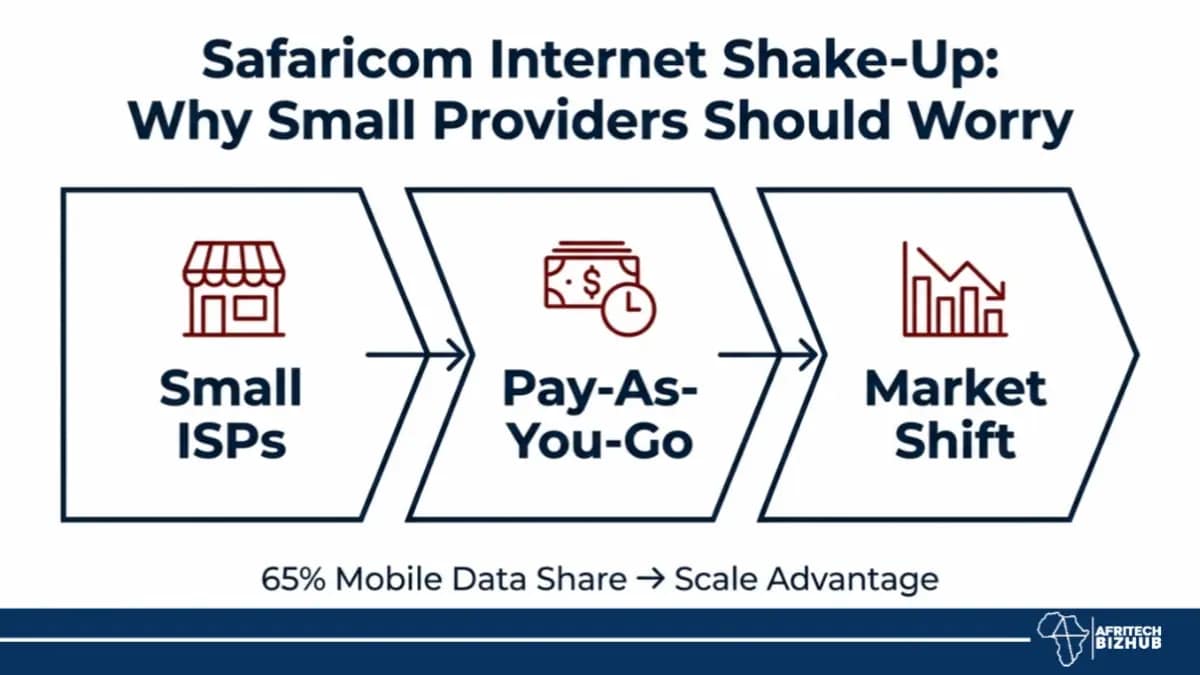
How Does Safaricom Internet Target Price-Sensitive Households?
Packages focus on incremental access and low upfront costs rather than flat monthly subscriptions.
Safaricom internet leverages consumer familiarity with M-PESA, allowing incremental data consumption and payments.
Customer behavior is beginning to shift.
Households previously subscribing to low-cost monthly bundles from smaller ISPs are moving toward more flexible pay-as-you-go models.
Flexibility, once a small ISP advantage, is now amplified by Safaricom’s scale, putting budget providers under early pressure.
Can Internet Providers Survive Safaricom’s Low-Cost Broadband Push?
The Communications Authority of Kenya (CAK) monitors broadband competition and pricing.
According to the CAK 2026 Market Report Safaricom internet accounts for more than 65% of mobile data subscribers, while smaller ISPs operate in fragmented segments with higher unit costs.
CAK highlights that dominant operators offering flexible payment models can shift adoption patterns and compress revenue potential for smaller providers.
Safaricom internet leverages scale, distribution, and brand recognition, structural advantages that smaller ISPs cannot match.
Early indicators confirm pressure on budget ISPs and suggest that adaptation, partnerships, or consolidation will become necessary.
Will Pay-As-You-Go Internet Transform Kenya’s Broadband Market?
Pay-as-you-go broadband is reaching households previously excluded from monthly subscriptions.
Adoption is accelerating, and consumer behavior is adapting rapidly to lower-cost, flexible payment models.
Small ISPs’ footholds are under strain as expectations evolve.
Safaricom internet continues to expand into previously stable market segments, reshaping competitive benchmarks for pricing, accessibility, and payment flexibility.
The rollout signals a moving landscape, where survival depends on responsiveness and innovation rather than historical market positioning.


Recent Comments