


Featured Summary:
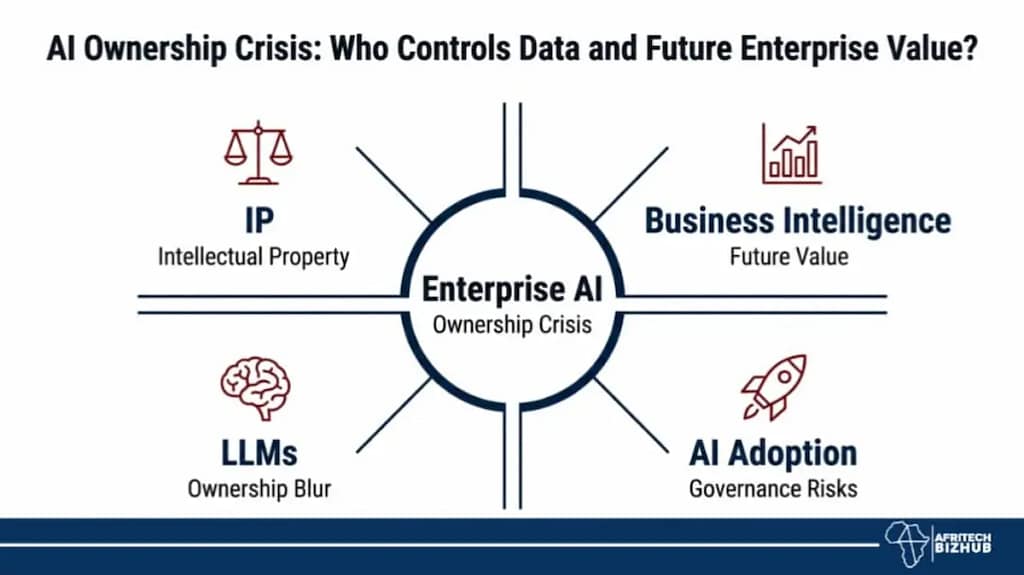
- Enterprise AI is generating valuable digital assets, yet ownership frameworks lag behind creation.
- Business Intelligence produced by Enterprise AI may exceed the value of raw data.
- AI Adoption introduces governance, IP, and legal exposure that many organizations are unprepared for.
- Large Language Models blur traditional ownership boundaries, creating systemic implications for enterprise value.
Enterprise AI adoption is accelerating across organizations seeking competitive advantage, producing outputs ranging from software code to operational recommendations and strategic insights.
Observed patterns show that these AI-generated assets increasingly influence enterprise value, yet ownership frameworks struggle to keep pace.
As companies integrate AI systems, the tension between asset creation, control, and legal clarity grows, with implications for intellectual property, Business Intelligence, and the allocation of strategic value across organizations and AI providers.
Who Owns Intellectual Property in AI Systems?
When AI generates outputs, ownership depends on multiple factors: who provides the data, who designs the model, and who directs the AI’s operation.
Observed patterns show that enterprise assets often involve overlapping claims between AI providers, cloud hosts, and internal teams.
Enterprise AI outputs include software, product designs, marketing content, and research reports.
While organizations often assume ownership because employees initiate the processes, the underlying AI model and training datasets remain external.
This interplay creates observable ambiguity in asset control and rights.
Instances of outputs resembling copyrighted material highlight the complexity: responsibility is often distributed across multiple stakeholders, and legal frameworks are still evolving to manage AI-generated Intellectual Property at scale.
How Does Business Intelligence Transform AI Data Ownership?
Enterprise AI shifts attention from owning raw data to controlling the intelligence derived from it.
Observed usage patterns show that AI transforms identical datasets into distinct insights, generating business value beyond the original data.
Predictions, operational recommendations, and trend forecasts created by Enterprise AI create strategic assets that may outperform the inherent value of the underlying datasets.
Organizations increasingly focus on access and control over the AI-produced knowledge rather than the raw inputs.
Patterns indicate that future competitive advantage may reside less in data possession and more in managing and leveraging AI-generated Business Intelligence, with implications for governance and ownership frameworks.
Is Enterprise AI Creating Hidden IP Risks?
Enterprise AI often ingests sensitive documents, contracts, source code, and proprietary information without clearly defined rights.
Observed adoption patterns reveal that organizations may inadvertently expose valuable assets while believing data remains private.
Outputs generated by AI may resemble existing Intellectual Property, creating potential liability or disputes.
AI-generated content can include software code, marketing material, or research findings that overlap with copyrighted works, raising complex ownership and risk questions.
These patterns demonstrate that Enterprise AI introduces latent IP risks that can surface over time, particularly when organizations build enterprise value on outputs whose ownership is ambiguous.
What Are AI Adoption Risks for Data Ownership?
Enterprise AI adoption introduces governance challenges around access, storage, control, and future ownership of generated insights.
Observed deployments show that internal users uploading operational documents or customer data can create overlapping claims with vendors or cloud providers.
Reports from OECD, 2025, note that AI-generated outputs often lack clear ownership under current Intellectual Property frameworks, exposing organizations to legal and operational risks.
Evidence highlights that adoption without clarified rights may lead to disputes and reduce control over emerging enterprise value.
Patterns suggest that the absence of formal governance amplifies risk exposure, making ownership questions central to AI strategy rather than peripheral concerns.
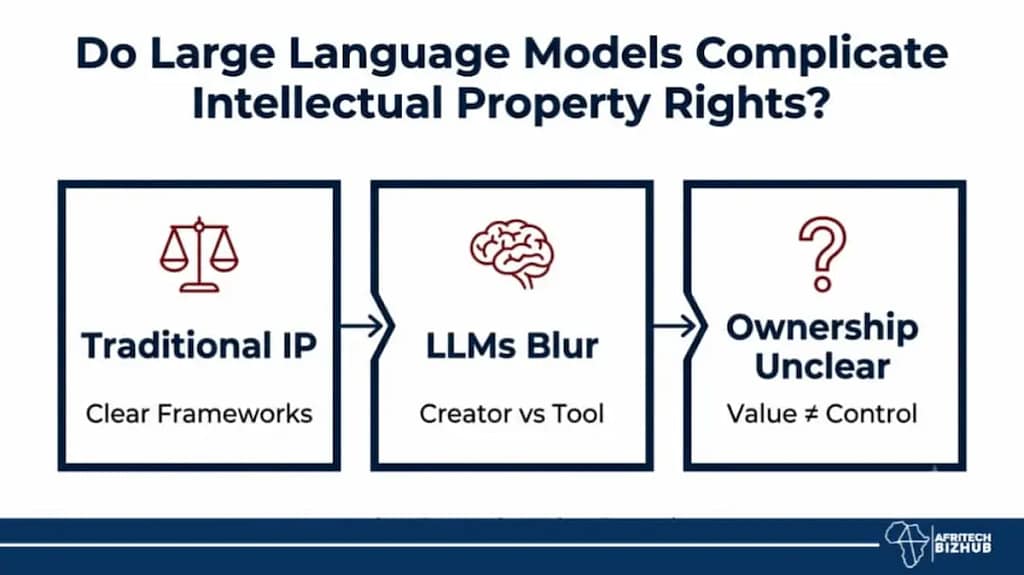
Do Large Language Models Complicate Intellectual Property Rights?
Large Language Models (LLMs) generate outputs that blur lines between creator, tool, and asset. Observed usage shows they can produce original-looking content, research insights, or operational recommendations without established authorship.
LLMs complicate Intellectual Property frameworks because outputs can influence strategic decisions and generate commercial value while ownership remains legally unresolved.
Observed market behavior indicates that organizations must consider control over AI-generated insights as integral to enterprise strategy.
Patterns suggest that future enterprise value increasingly depends on AI-produced outputs, Business Intelligence, and decision-making tools.
The most prepared organizations may not simply operate the most advanced AI systems, but those that implicitly control and manage the assets their AI creates, without needing to state the corrective lesson outright.


Recent Comments