


Featured Summary:
- Nigeria oil licensing produced mixed results after 13 of the 50 blocks offered failed to attract investor bids.
- The outcome does not by itself establish a broad retreat from Nigeria’s petroleum sector; it shows that investors ranked individual assets selectively.
- Capital continues to return to producing assets and lower-risk developments where geology, infrastructure and project economics are more certain.
- Nigeria’s long-term production growth will depend on making future exploration opportunities commercially competitive enough to replace declining reserves.
Global upstream investment has entered a period of tighter capital discipline.
Higher financing costs, shareholder demands for stronger returns and competition from lower-risk developments have pushed oil companies towards projects with clearer geological evidence, shorter development timelines and more predictable commercial outcomes.
Nigeria’s latest licensing round illustrates that selectivity.
Bidders submitted offers for 37 of the 50 blocks made available by the Nigerian Upstream Petroleum Regulatory Commission, leaving 13 without bids.
The Nigeria oil result does not establish that investors have rejected the wider petroleum sector.
It shows that available acreage must compete for capital against producing fields, brownfield developments and exploration opportunities across other global basins.
Why Did Nigerian Oil Blocks Receive No Bids?
The 13 Nigerian oil blocks received no offers during the commercial bidding process, but the result does not reveal why each asset was passed over.
NUPRC has not published block-by-block explanations from prospective investors, making it impossible to attribute the outcome conclusively to geology, fiscal terms, security conditions or infrastructure limitations.
The result instead establishes a clear market boundary: investors concentrated their bids on 37 blocks and left the remaining acreage outside their current capital plans.
Nigeria oil licensing is therefore being judged asset by asset, not through a single view of the country.
The absence of bids signals weaker commercial interest under the terms and information available during this round, without proving that the blocks lack recoverable resources.
Why Is Nigeria Oil Recovering Despite Investor Caution?
Nigeria oil production can rise while companies remain cautious about frontier exploration because the two activities carry different levels of uncertainty.
NUPRC reported that crude production reached 1.56 million barrels per day in June 2026, its highest level since April 2020, while combined crude and condensate output averaged about 1.735 million barrels per day.
The recovery came from assets already connected to established operating systems rather than discoveries from the latest licensing round.
Producing fields allow operators to work with known reservoirs, existing facilities and established evacuation routes.
New exploration begins before commercial reserves have been confirmed and can require seismic work, exploratory drilling, appraisal and years of development spending before first production.
Stronger output from existing assets therefore demonstrates improved operating performance; it does not remove the higher technical and financial risk attached to undeveloped acreage.
What Makes an Oil Block Investable Today?
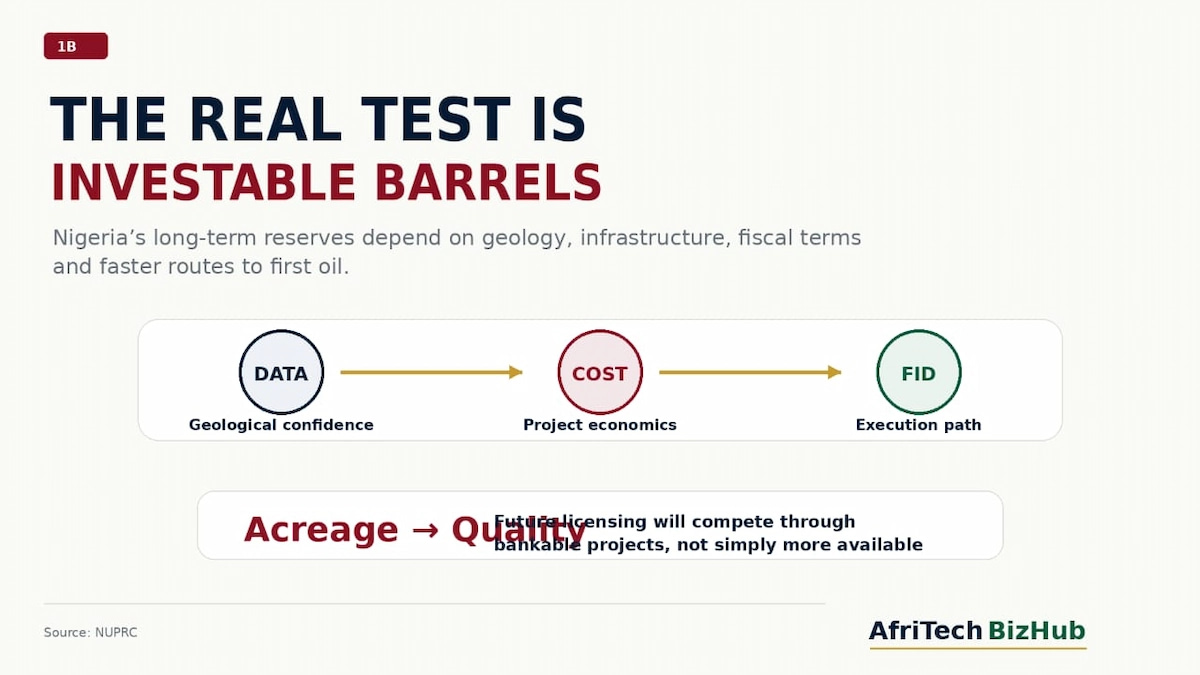
An oil block becomes investable when its expected returns justify the capital, time and execution risk required to move from licence award to commercial production.
Investors assess the quality of available subsurface data, the probability of a recoverable discovery, drilling complexity, development costs, fiscal obligations, infrastructure access and the regulatory process that governs approvals and operations.
Opportunity cost is equally decisive.
A frontier block that may require years of data acquisition and appraisal must compete with producing assets and tie-back projects capable of using existing infrastructure and generating cash flow sooner.
NUPRC’s licensing framework evaluates technical and commercial capacity, but investor participation ultimately depends on whether an asset can compete within a global portfolio for limited exploration capital.
Why Is Upstream Investment Returning to Nigeria?
Upstream investment is returning where companies can connect new capital with established reserves, infrastructure and clearer development pathways.
Shell reached a final investment decision on Bonga North in December 2024, approving a subsea project that will connect new wells to the existing Bonga production facility.
The project is expected to produce as much as 110,000 barrels per day at peak, with first oil anticipated before the end of the decade.
Other opportunities remain at earlier stages.
ExxonMobil has described possible additional drilling at Usan as a potential investment, not a completed final investment decision, while it continues to assess larger deepwater developments.
The distinction shows where Nigeria oil capital is moving: approved spending is concentrating around projects with proven resources and existing operating systems, while less-developed opportunities must still pass further commercial and technical tests.
How Can Oil Exploration Investment Strengthen Nigeria’s Long-Term Reserves?
Oil exploration investment remains necessary because higher production from existing fields cannot replace depleted reserves indefinitely.
Brownfield spending can improve recovery and extend asset life, but long-term output requires new discoveries to progress through appraisal, development approval and construction before mature fields decline further.
The 13 unbid blocks remain outside that future production pipeline until they are restructured, reoffered or supported by information that changes their investment case.
Nigeria oil competitiveness will depend on improving subsurface data, matching work programmes to asset maturity and ensuring successful licence awards move into drilling rather than remaining dormant.
The licensing result is therefore not only a verdict on the latest auction; it is a warning that current production recovery must be matched by a stronger reserve-replacement pipeline.


Recent Comments