


Featured Summary:
- Russian crude oil exports are moving through changing maritime networks as sanctions restrict access to Western shipping, insurance, and financial services.
- African ship registries have gained attention after tankers linked to Russian oil appeared under African flags, including registrations that national authorities later said were fraudulent.
- Russian oil tankers frequently change flags, ownership structures, and service providers to remain active within a more restrictive global shipping market.
- Africa’s greater visibility in international shipping creates commercial opportunities, but weak registry supervision can expose governments to sanctions and environmental and reputational risks.
A tanker carrying Russian oil no longer needs to be owned, insured, and registered through the same maritime system that handled the trade before Western sanctions.
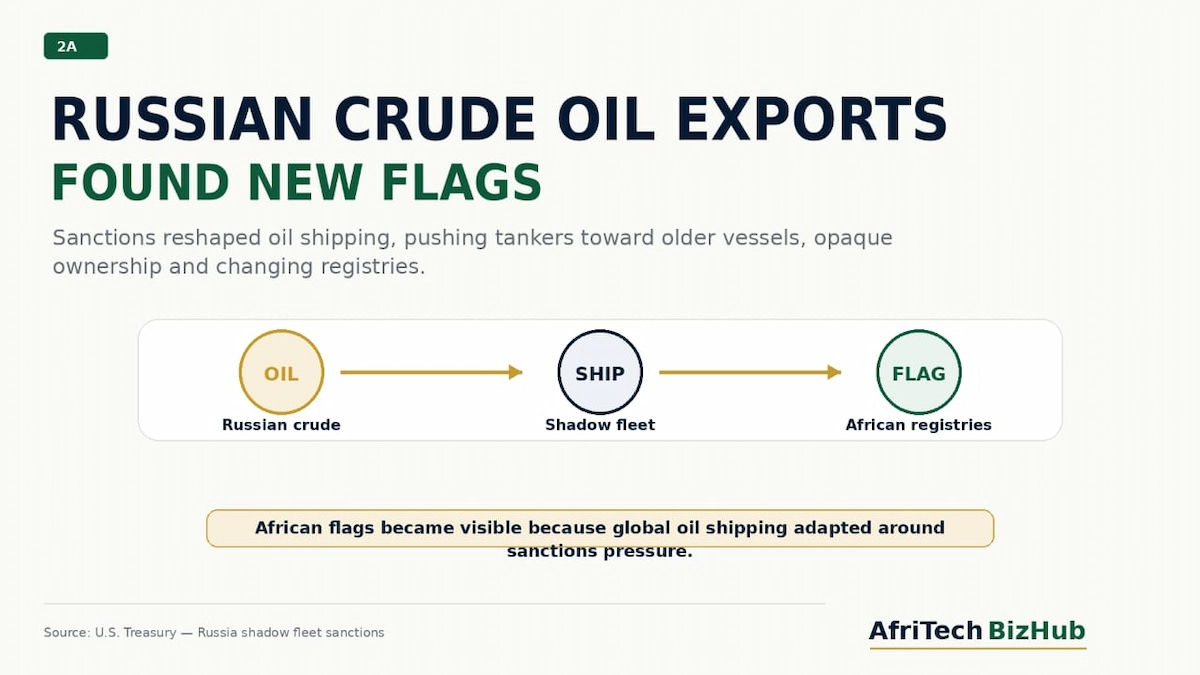
Restrictions on Russian energy have encouraged operators to use older vessels, opaque corporate structures, alternative insurers, and rapidly changing flags to keep crude moving towards buyers outside Europe.
African registrations have become more visible within that restructuring, placing countries with relatively small maritime administrations inside one of the world’s most heavily scrutinized shipping networks.
The clearest evidence emerged in Cameroon, where the government told the International Maritime Organization that vessels had been operating unlawfully under its flag and that fraudulent websites had been assigning Cameroonian registration without state authorization.
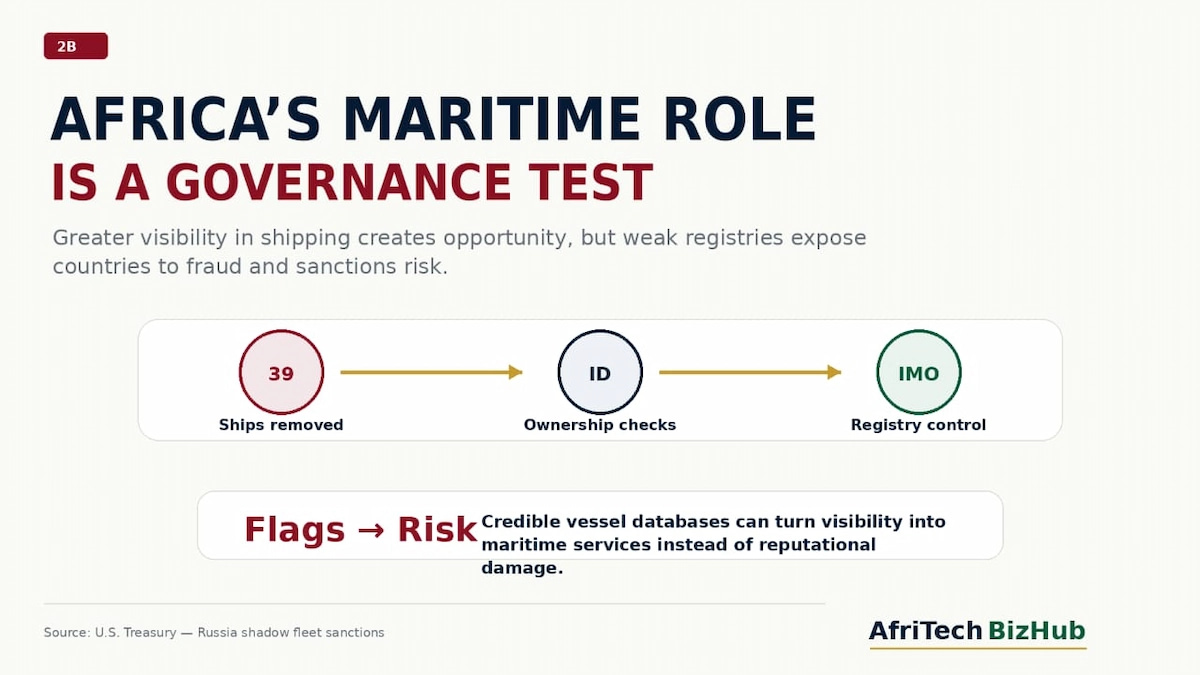
Cameroon subsequently removed 39 ships from its registry after several tankers linked to Russian crude were found using the country’s flag.
The episode did not prove that African governments had collectively agreed to facilitate Russian crude oil exports; it showed how geopolitical disruption can exploit weak, outsourced, or impersonated maritime systems.
Why Are Russian Crude Oil Exports Using African Flags?
Tankers carrying Russian crude have appeared under African flags as ship operators search for registries outside the jurisdictions enforcing Western oil sanctions and the price cap.
A foreign flag does not itself establish a sanctions violation, and many vessels are legally registered outside their owners’ home countries.
The concern arises when tankers combine frequent flag changes with opaque ownership, limited insurance disclosure, manipulated tracking data, or registrations that the purported flag state does not recognize.
Cameroon’s experience revealed how far that adaptation can extend.
European authorities identified tankers transporting Russian oil while claiming Cameroonian nationality, but Cameroon’s investigation found that several were not lawfully registered and that fraudulent online registries had issued documents in the country’s name.
African flags therefore became part of the route not only through legitimate commercial registration but also through false-flag activity that allowed vessels to present an apparent nationality while continuing international operations.
How Do Ship Registries Shape Global Oil Shipping?
Every commercial vessel must operate under the flag of a state, which gives that state responsibility for registration, safety oversight, documentation, and compliance with international maritime rules.
Shipowners are not required to register vessels in the country where they live or conduct business, creating a global market in which registries compete through fees, administrative speed, tax treatment, and regulatory requirements.
UN Trade and Development data show that a large share of the world fleet operates under foreign flags rather than the nationality of its beneficial owners.
That separation allows shipping companies to choose commercially attractive jurisdictions, but it also places substantial responsibilities on states that may have limited capacity to inspect vessels or verify ownership.
Registry credibility affects whether ships can obtain insurance, enter ports, and access financial or technical services.
When registration records are weak or fraudulent websites impersonate official authorities, the flag becomes more than an administrative label: it can conceal the relationship between the vessel, its commercial operator, and the cargo it transports.
Why Are African Ship Registries Becoming More Prominent?
Some African registries have become more visible because the sanctions environment has increased demand for flags available to aging or commercially restricted vessels.
Registries can generate foreign currency and expand a country’s formal maritime presence without requiring the ships to operate from its ports.
For administrations seeking to develop shipping services, registration may appear to offer revenue, employment, and a larger role in international trade.
The same model becomes dangerous when registry growth exceeds regulatory capacity.
States must verify vessel identities, beneficial ownership, insurance, safety certification, and compliance history before granting their flags.
Cameroon’s removal of 39 ships demonstrates that growing fleet numbers may not represent genuine maritime development when registrations are issued without proper state control.
Africa’s prominence in the Russia-linked tanker network is therefore uneven: some registrations may be lawful commercial arrangements, while others reflect identity fraud, regulatory arbitrage, or weak oversight rather than a coordinated Africa-Russia shipping policy.
How Does International Shipping Adapt to Geopolitical Sanctions?
Sanctions reshape shipping by changing which banks, insurers, ports, brokers, and technical service providers can support a voyage.
The Western price-cap system allows participating service providers to handle Russian oil only when it is sold within prescribed limits.
Operators seeking to trade outside that framework have responded by purchasing older tankers, moving ownership through newly created companies, using non-Western insurance, and changing flags or vessel names.
The United States described many of these ships as part of a high-risk shadow fleet when it sanctioned 183 vessels in January 2025.
Compliance pressure has since extended beyond cargo ownership to the commercial infrastructure surrounding each vessel.
The European Union has restricted port access and maritime services for hundreds of ships linked to Russia’s shadow fleet, including vessels associated with ship-to-ship transfers, sanctions circumvention, and interference with automatic identification systems.
These measures increase operating costs and push tankers towards less established registries, insurers, and service networks, making due diligence on ownership, flag status, and voyage history central to modern oil shipping.
What Does Africa’s Expanding Maritime Role Mean for Global Shipping?
Africa became part of Russia’s alternative crude route because sanctions reorganized the commercial systems surrounding oil transportation.
Tankers did not need African ports to make the continent relevant; they needed flags, documentation, administrative recognition, and service relationships that could support continued access to global waters.
Countries such as Cameroon gained attention because their maritime identity appeared on vessels operating between Russian ports and international buyers, even where the government later disputed the registrations.
The long-term consequence will depend on how African states respond.
Stronger digital registries, public vessel databases, beneficial-ownership checks, and cooperation with the International Maritime Organization could convert greater visibility into credible maritime services and better trade monitoring.
Weak supervision would produce the opposite outcome, exposing countries to fraudulent flag use, unsafe vessels, environmental liabilities, and reputational damage.
Africa’s expanding role in international shipping is therefore not simply evidence of closer Africa-Russia trade; it is a test of whether African maritime governance can keep pace with global networks that adapt rapidly when geopolitics closes established routes.


Recent Comments