

Featured Summary:
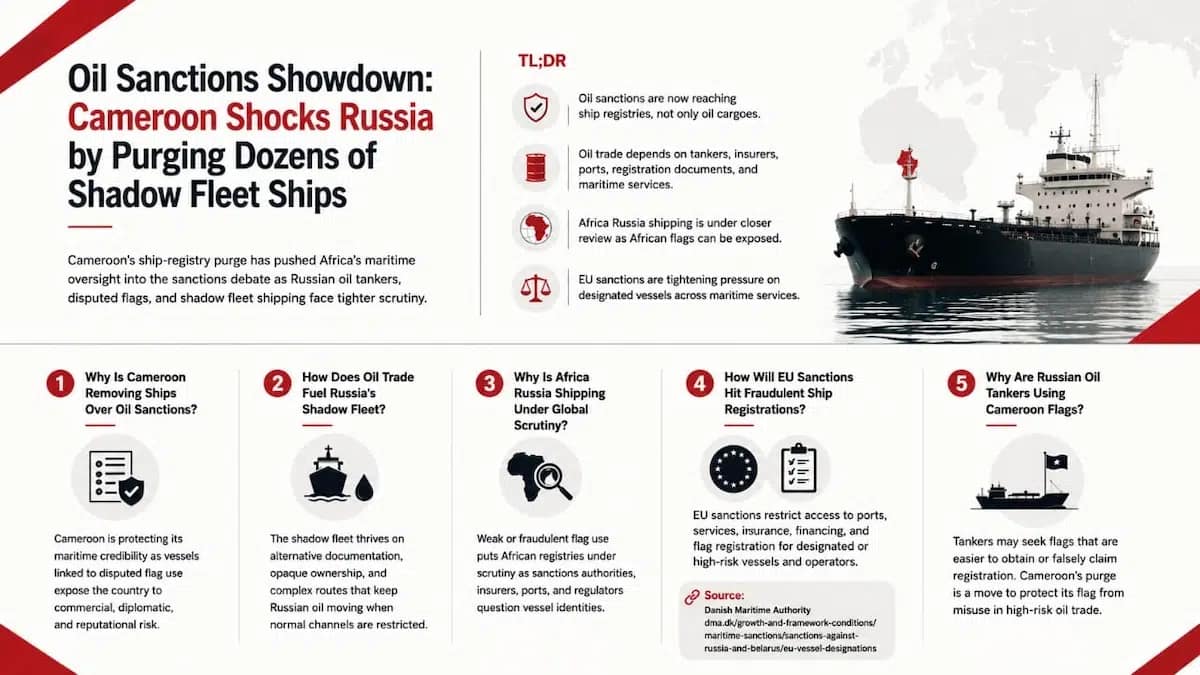
- Oil sanctions are now reaching ship registries, not only oil cargoes, as Cameroon removes vessels linked to disputed flag use.
- Oil trade depends on tankers, insurers, ports, registration documents, and maritime services, which is why shadow fleet activity has drawn wider attention.
- Africa Russia shipping is under closer review because African flags can be exposed when vessels use weak or fraudulent registration channels.
- EU sanctions are increasing pressure on designated vessels by restricting port access, flag registration, financing, insurance, and maritime services.
Cameroon is facing a maritime problem with consequences far beyond its ports.
Vessels tied to Russia’s shadow fleet have been linked to the country’s flag at a time when oil sanctions are becoming harder to avoid and easier to trace.
For Cameroon, the issue is not only whether Russian oil tankers moved under its name.
It is whether its ship registry can remain credible when disputed vessels use national flags to stay active in global oil trade.
The pressure is now landing on a sensitive part of Africa business: trust.
A flag is supposed to show legal registration, oversight, and responsibility.
When that flag is used by vessels connected to sanctions-sensitive oil trade, the risk moves from shipping paperwork into diplomacy, insurance, port access, safety standards, and national reputation.
Cameroon’s purge is therefore not just a registry clean-up.
It is a signal that African maritime systems are being pulled into the enforcement architecture around Russia, oil trade, and EU sanctions.
Why Is Cameroon Removing Ships Over Oil Sanctions?
Cameroon’s registry action reflects the growing cost of weak maritime verification.
A ship registry can create revenue and international visibility, but it also exposes a country to scrutiny when vessels linked to high-risk oil trade claim its flag.
Once Russian oil tankers are associated with disputed registration, the flag state must show that it can separate legitimate vessels from ships using its identity improperly.
That is the immediate reason Cameroon’s decision matters.
The country is trying to protect the credibility of its maritime flag before the issue becomes a wider commercial and diplomatic liability.
Ports, insurers, banks, charterers, and regulators all rely on vessel identity.
If Cameroon’s flag is seen as easy to misuse, the effect could reach beyond one group of ships and create friction for legitimate Africa business activity tied to shipping, insurance, trade finance, and port services.
How Does Oil Trade Fuel Russia’s Shadow Fleet?
The shadow fleet is built around the systems that keep oil moving when normal channels become restricted.
Crude and petroleum products still require vessels, flags, insurers, certificates, ports, financing, traders, and buyers.
When sanctions narrow access to formal Western maritime services, higher-risk trade can shift toward older tankers, opaque ownership, changing flags, ship-to-ship transfers, and complex routing.
This is why oil trade sits at the center of the sanctions debate.
Restrictions on cargo alone do not stop trade if the transport network remains available.
The shadow fleet exists because the value of Russian oil creates incentives to keep vessels moving through alternative documentation and service channels.
Cameroon’s case shows how flag registration can become part of that system. A vessel does not only need a destination.
It needs a legal identity that allows it to move through ports, waters, and commercial checks.
Why Is Africa Russia Shipping Under Global Scrutiny?
African registries are receiving more attention because sanctions enforcement is now examining the identities behind ships, not only the oil inside them.
A vessel flying an African flag is not automatically in breach of any rule.
The concern begins when the flag is used by tankers linked to Russian oil, unclear ownership, weak insurance, or disputed registration.
That puts Africa Russia shipping under a more difficult spotlight.
Smaller registries can be attractive to operators looking for less visible routes through the global maritime system.
African states then face a governance challenge: registry income is useful, but weak controls can damage national credibility.
Cameroon’s experience shows how quickly a shipping issue can become a reputational risk when sanctions authorities, naval missions, ports, and insurers begin questioning whether a flag is valid.
How Will EU Sanctions Hit Fraudulent Ship Registrations?
EU sanctions are tightening the space for tankers that depend on disputed identity, weak documentation and shifting maritime services.
The Council of the European Union’s April 2026 sanctions package added 46 vessels to measures covering port access and maritime transport services, taking the number of designated vessels to 632.
It also introduced mandatory due diligence checks for tanker sales, a move aimed at making it harder for Russia’s shadow fleet to expand through opaque ownership and registration channels.
That places fraudulent ship registrations closer to the centre of enforcement.
A tanker that carries a disputed flag is no longer dealing only with registry paperwork.
It can face questions from ports, insurers, financiers, brokers, charterers and service providers before it moves cargo.
For Cameroon, the risk is clear without needing to be overstated: once a national flag is linked to sanctioned oil trade, the damage can move from vessel lists into reputation, compliance checks and wider Africa business exposure.
Why Are Russian Oil Tankers Using Cameroon Flags?
Cameroon’s flag became attractive because ship identity can shape how a vessel moves through the maritime system.
Tankers under sanctions pressure may seek flags that appear easier to obtain, harder to verify, or available through weak documentation channels.
In some cases, the problem is not legitimate registration but false claims of registration, where a vessel broadcasts a flag that the state does not properly recognise.
That creates a serious problem for Cameroon.
If Russian oil tankers use its flag without proper authority, the country carries the reputational burden without controlling the trade. The registry purge is therefore a credibility measure.
It tells ports, insurers, regulators, and shipping companies that Cameroon wants its flag treated as a regulated maritime identity, not as a convenient cover for disputed oil trade.
The wider message is also important for Africa business: as oil sanctions tighten, African maritime systems will need stronger verification to protect legitimate trade from being pulled into sanctions risk.


Recent Comments