


Featured Summary:
- Moroccan aviation received a further institutional boost as the European Union advanced a protocol updating its aviation agreement with Morocco to include Croatia.
- The wider EU–Morocco aviation framework gives airlines broad market access while aligning rules on safety, security, competition, passenger protection, and air traffic management.
- Morocco’s location, airport investment, and airline network allow it to connect European cities with destinations across West, Central, and North Africa.
- Stronger air connectivity could support tourism, cargo, business travel, conferences, investment, and Morocco’s ambition to become a leading regional aviation hub.
Morocco’s latest aviation development is not a new open-skies agreement but an update to a much larger framework already reshaping travel between Morocco and Europe.
In July 2026, the European Parliament backed a protocol extending the existing Euro-Mediterranean Aviation Agreement to Croatia, clearing another institutional step in the integration of all EU member states into the Morocco–EU air transport market.
The original agreement was signed in 2006 and entered into force in 2018, opening market access for Moroccan and European airlines while aligning aviation rules across safety, security, competition, passenger rights, air traffic management, and environmental standards.
The amendment itself is narrow, but its strategic value is broader.
It reinforces an aviation relationship that gives Morocco access to one of the world’s largest air travel markets while the country invests in airports, airline capacity, and passenger infrastructure ahead of the 2030 FIFA World Cup.
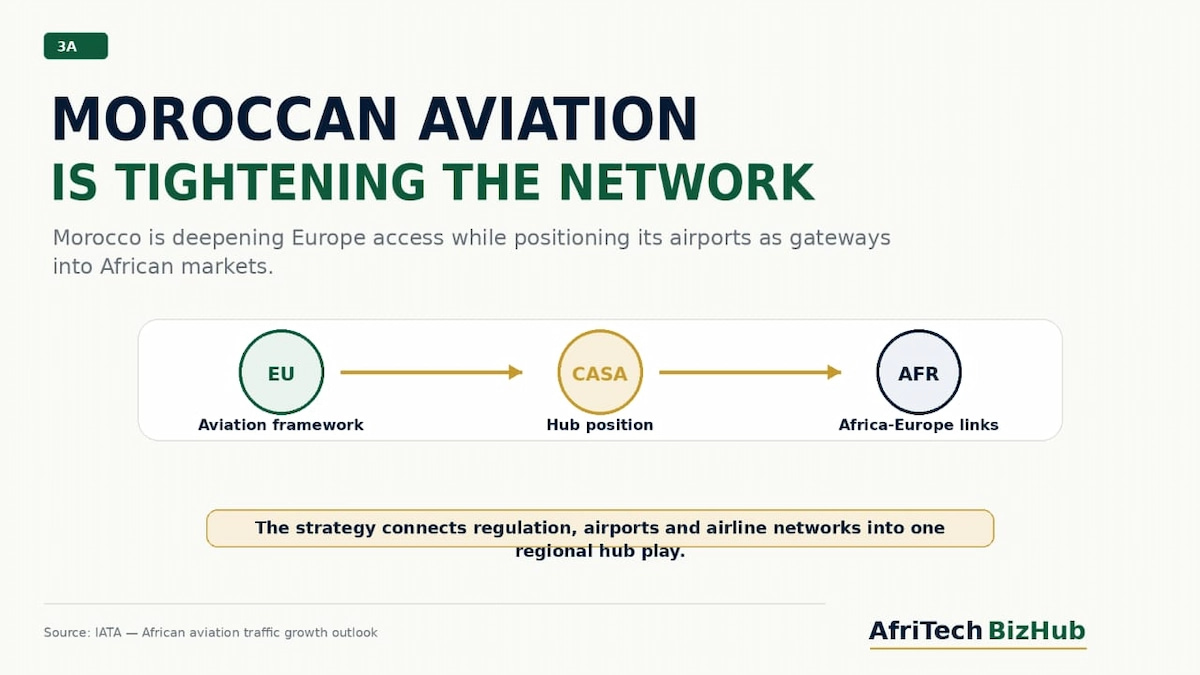
Moroccan aviation is therefore advancing through two connected tracks: deeper integration with Europe and stronger positioning as a transfer point for passengers traveling between European and African markets.
How Will the EU Aviation Deal Expand Morocco’s International Air Network?
The updated protocol brings Croatia fully into the EU–Morocco aviation framework, ensuring that airlines and authorities from the country operate under the same market-access and regulatory structure already applied across the wider European Union.
The change does not create Morocco’s European aviation access from scratch; it completes the legal coverage of an agreement that already allows European and Moroccan carriers to operate under a progressively liberalized air transport market.
For airlines, the wider framework reduces the administrative fragmentation that can limit route development between separate national markets.
Carriers can assess routes, partnerships, schedules, and connecting traffic within a more predictable regulatory environment, while passengers gain from broader network competition and more travel options.
Morocco benefits because each additional European market strengthens the pool of passengers that can enter its airports directly or connect onwards to destinations across Africa.
Why Is Africa-Europe Air Travel Becoming More Hub-Centered?
Africa-Europe air travel is becoming more hub-centered because airlines cannot serve every city pair profitably with direct flights.
Passenger demand between many African and European cities remains too dispersed to support frequent nonstop services, leading carriers to concentrate traffic through airports where several routes can be combined.
A strong hub allows an airline to collect passengers from smaller markets, transfer them through one airport, and place them on higher-capacity flights to major destinations.
This structure gives an advantage to countries with airlines capable of coordinating arrival and departure schedules across several regions.
Morocco sits between European markets and large parts of West and Central Africa, allowing Casablanca to compete for passengers who might otherwise connect through Paris, Istanbul, Lisbon, Madrid, Addis Ababa, or Gulf hubs.
Africa’s aviation market is also expected to record stronger traffic growth than several mature regions, increasing the strategic value of hubs that can capture connecting demand.
IATA projected African traffic growth of 5.4% in 2026, supported by improving connectivity and gradual trade diversification.
Why Are Airlines and Businesses Gaining From the Morocco-Europe Air Pact?
Airlines gain from the Morocco-Europe framework because liberalized market access creates more freedom to add frequencies, test routes, form commercial partnerships, and compete for passengers across a larger market.
Royal Air Maroc can use European cities as sources of connecting passengers for its African network, while European airlines can expand access to Morocco’s tourism and business markets.
The agreement also supports common rules, which can lower regulatory uncertainty for carriers operating across several jurisdictions.
Businesses benefit because aviation shortens the time required to move executives, specialist workers, urgent goods, documents, and high-value cargo between markets.
Better connections can support foreign investment, regional headquarters, professional services, automotive and aerospace supply chains, agricultural exports, and conference travel.
The commercial value is therefore not limited to ticket sales: reliable air links help companies coordinate operations across Morocco, Europe, and African markets without depending on long or poorly connected journeys.
Why Is Morocco Aviation Emerging as Africa’s Strategic Gateway?
Moroccan aviation is emerging as a strategic gateway because the country is combining international agreements with airport investment and airline network development.
Its Airports 2030 strategy is intended to modernize infrastructure, improve passenger experience, and strengthen Morocco’s position as a regional and global aviation hub.
ONDA has also started major capacity projects, including a new terminal at Casablanca Mohammed V Airport designed to handle 20 million passengers.
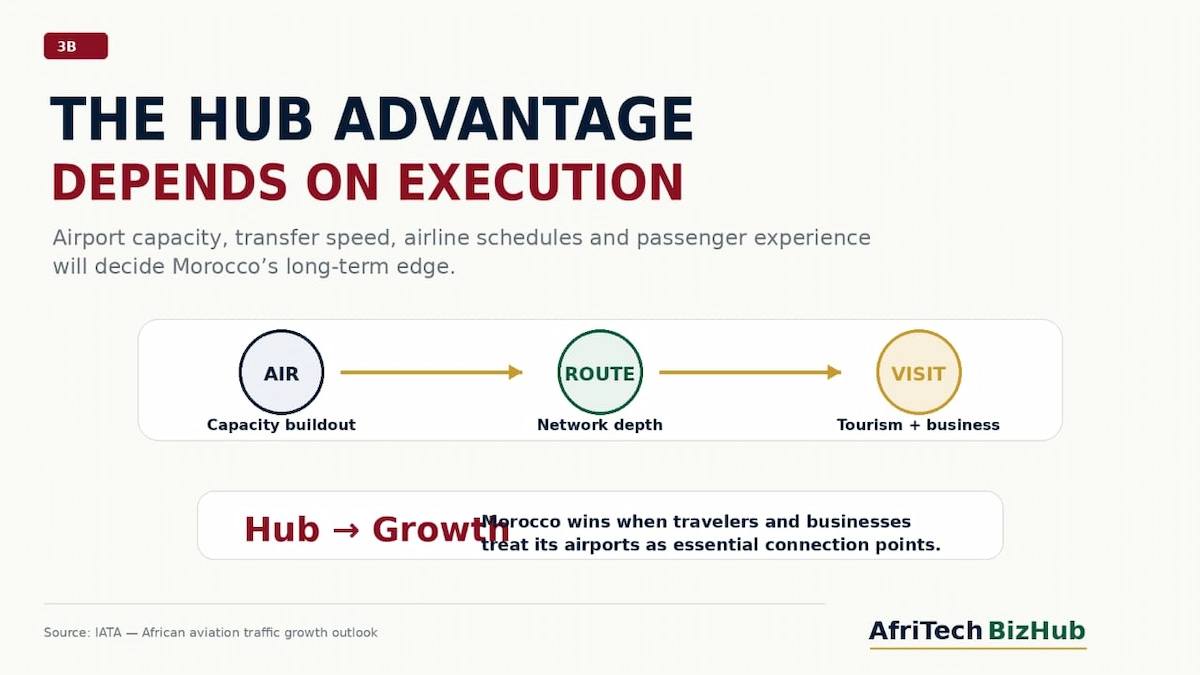
Geography supports the strategy, but policy and execution determine whether passengers actually choose a hub.
Morocco needs sufficient runway and terminal capacity, fast transfers, competitive airport charges, reliable baggage handling, strong digital systems, and an airline schedule that connects European arrivals efficiently with African departures.
The country’s advantage rests on building all of these elements together rather than relying on its location alone.
How Could Stronger Air Connectivity Transform Morocco’s Visitor Economy?
Stronger air connectivity can expand Morocco tourism by making the country easier to reach from more European cities and by supporting higher flight frequency throughout the year.
More routes can distribute visitors beyond traditional gateways such as Marrakech and Casablanca, increasing demand for hotels, restaurants, domestic transport, cultural attractions, and local services in secondary destinations.
Aviation capacity will be especially important as Morocco prepares to co-host the 2030 FIFA World Cup and seeks to accommodate larger international visitor flows.
The wider opportunity extends beyond leisure travel.
Better air links can attract conferences, exhibitions, regional offices, investors, consultants, and multinational companies that need dependable access to both Europe and Africa.
Morocco tightens its grip on the Africa-Europe aviation network when travelers and businesses begin treating its airports not merely as destinations but as essential connection points.
Its long-term influence will depend on whether airport capacity, airline service, pricing, and passenger experience improve quickly enough to convert geographic advantage into sustained commercial leadership.


Recent Comments