

Featured Summary:
- Russian sanctions are making Africa more important to Moscow’s foreign trade policy as Russia seeks diplomatic, commercial, and strategic partners outside Western markets.
- Russia Africa ties are widening through diplomatic missions, trade talks, fuel trade, security cooperation, education links, and commodity partnerships.
- Western sanctions are likely to make the US and EU monitor Russia’s Africa partnerships more closely, especially around finance, shipping, fuel, defence, and sanctions compliance.
- Russia’s sanctions losses are difficult to measure fully, but the EU says around €210 billion of Russian Central Bank assets are immobilised in the bloc.
Russia is not opening more African embassies for ceremony alone.
Each new mission gives Moscow a direct channel into trade negotiations, fuel discussions, mining interests, security partnerships, education links, and political relationships in markets where Western pressure has less direct reach.
At a time when sanctions have narrowed Russia’s access to European finance, technology, energy services, and key markets, Africa is becoming more useful to Moscow’s external strategy.
New diplomatic missions can look routine on paper, but they also help Russia build commercial routes, political support, and alternative partnerships while sanctions remain in place.
Fuel shortages at home add pressure, but the larger issue is strategic: Moscow is trying to keep international trade active by deepening ties in regions that still prefer flexible diplomacy.
Russia Africa ties are therefore becoming part of a wider contest over sanctions, trade access, and global influence.
How are Russia Africa Ties Expanding Now?
Moscow is widening its African footprint through embassies, trade diplomacy, security cooperation, commodity links, and political engagement.
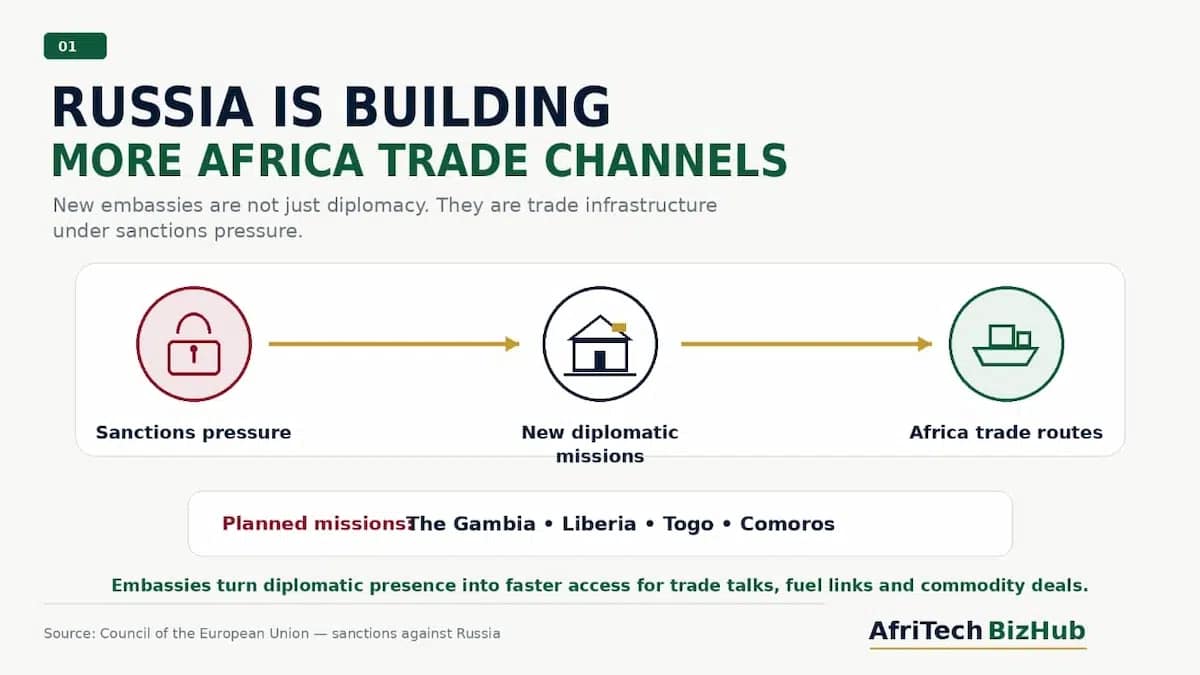
The planned missions in The Gambia, Liberia, Togo, and Comoros show that Russia is looking beyond Africa’s largest economies and long-standing security partners.
Smaller states can still matter through ports, regional access, voting influence, mining prospects, fuel trade, agriculture, and diplomatic alignment.
This expansion also gives Russia more permanent infrastructure for deal-making. Embassies help governments move faster on visas, business delegations, trade agreements, education exchanges, defence discussions, and cultural diplomacy.
For African governments, Russia can present itself as another partner in energy, grain, fertiliser, mining, security, and infrastructure talks.
For Moscow, the value is clear: deeper diplomatic missions can support foreign trade policy at a time when Western sanctions have made traditional routes harder to use.
What is Russia’s Relationship with Africa?
Russia’s relationship with Africa is built on history, diplomacy, security ties, commodities, and strategic positioning.
During the Cold War, Moscow developed strong relationships with several African states through education, military support, and anti-colonial political backing.
That influence weakened after the Soviet Union collapsed, but Russia has been rebuilding it through summits, trade forums, arms links, energy deals, media influence, scholarships, and embassy expansion.
The relationship is not the same across the continent.
Some countries see Russia mainly as a defence partner.
Others engage Moscow through grain, fertiliser, oil, mining, nuclear energy, education, or diplomatic cooperation.
A few also view Russia as a counterweight to Western pressure.
That variety explains why Russia Africa ties cannot be reduced to one sector.
They are shaped by what each African government needs and what Russia can still offer while its Western access remains restricted.
Do Western Sanctions Reshape Russia Strategy Abroad?
Sanctions have pushed Russia to treat diplomacy, trade, finance, and logistics as connected parts of the same strategy.
When access to Western finance, technology, shipping services, energy markets, and high-value imports becomes restricted, Moscow has a stronger reason to build commercial routes through countries that are not fully aligned with Western sanctions.
Africa fits into that approach because many governments continue to maintain non-aligned positions and prefer to keep multiple foreign partnerships open.
That makes Russia’s African embassy expansion more important to Western policymakers.
New diplomatic missions can support trade, payments, logistics, fuel links, military relationships, and political influence.
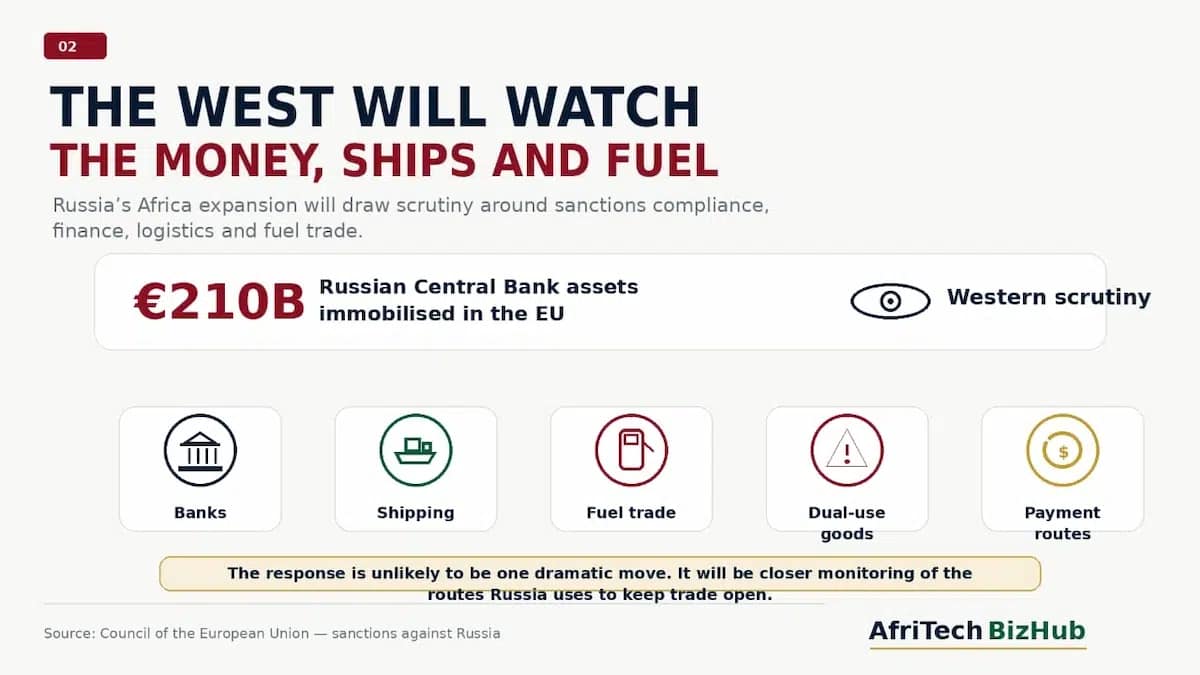
The likely Western response will be closer monitoring of banks, shipping, dual-use goods, defence links, fuel trade, payment channels, and any commercial routes that could reduce the effect of Western sanctions.
Are Fuel Shortages Pushing Global Expansion Efforts?
Fuel shortages add pressure to Russia’s economic environment, but they do not fully explain Moscow’s Africa strategy.
Russia’s diplomatic expansion in Africa is part of a longer push to rebuild influence, widen trade links, and strengthen partnerships outside the Western system.
The fuel issue matters because it reinforces a broader vulnerability: energy power depends not only on crude production, but also on refining, distribution, trade routes, and market access.
The Council of the European Union says its sanctions are designed to weaken Russia’s economic base, deprive it of critical technologies and markets, and reduce its ability to continue the war against Ukraine.
It also says around €210 billion of the Central Bank of Russia’s assets are immobilised in the EU.
That sanctions pressure helps explain why Russia is widening diplomatic and trade channels outside the West, including in Africa.
Fuel shortages may sharpen the urgency, but the broader driver is Russia’s need to keep international trade and diplomatic access open under tighter Western restrictions.
How Much did Russia Lose due to Sanctions?
The cost of Russian sanctions cannot be captured by one figure because the impact reaches across blocked assets, lost market access, trade restrictions, technology limits, higher transaction costs, weaker investment flows, and long-term productivity pressure.
Some losses are immediate and visible. Others build slowly as companies lose access to advanced equipment, Western finance, global partnerships, and efficient supply chains.
The clearest official figure is the immobilisation of Russian state assets.
The EU’s €210 billion figure does not represent the full cost of Western sanctions, but it shows the scale of financial pressure Moscow is trying to work around.
Russia’s embassy expansion in Africa should be read against that background.
It is part of a wider effort to keep international trade active, deepen political support, and build partnerships in markets where Western restrictions have less direct reach.


Recent Comments