


Featured Summary:
- Kenya investment is attracting Saudi capital because Nairobi offers urban growth, regional access, infrastructure demand, and a more organised Special Economic Zone model.
- Saudi foreign investment in Tatu City gives Gulf investors exposure to African real estate through a planned urban project with existing infrastructure.
- Gulf investment is moving deeper into Kenya’s property market as investors search for long-term assets beyond energy, logistics, and infrastructure.
- African real estate is gaining Saudi attention because cities need housing, offices, retail, schools, and mixed-use development tied to fast-growing populations.
Saudi Arabia’s entry into Kenya’s property market is not just a real estate deal.
It is a test of whether African cities can turn population growth, land demand, and infrastructure planning into assets that global capital can trust.
For years, Gulf money has been more visible in energy, ports, logistics, and government-backed infrastructure.
Kenya is now trying to prove that its urban development pipeline can attract the same level of confidence.
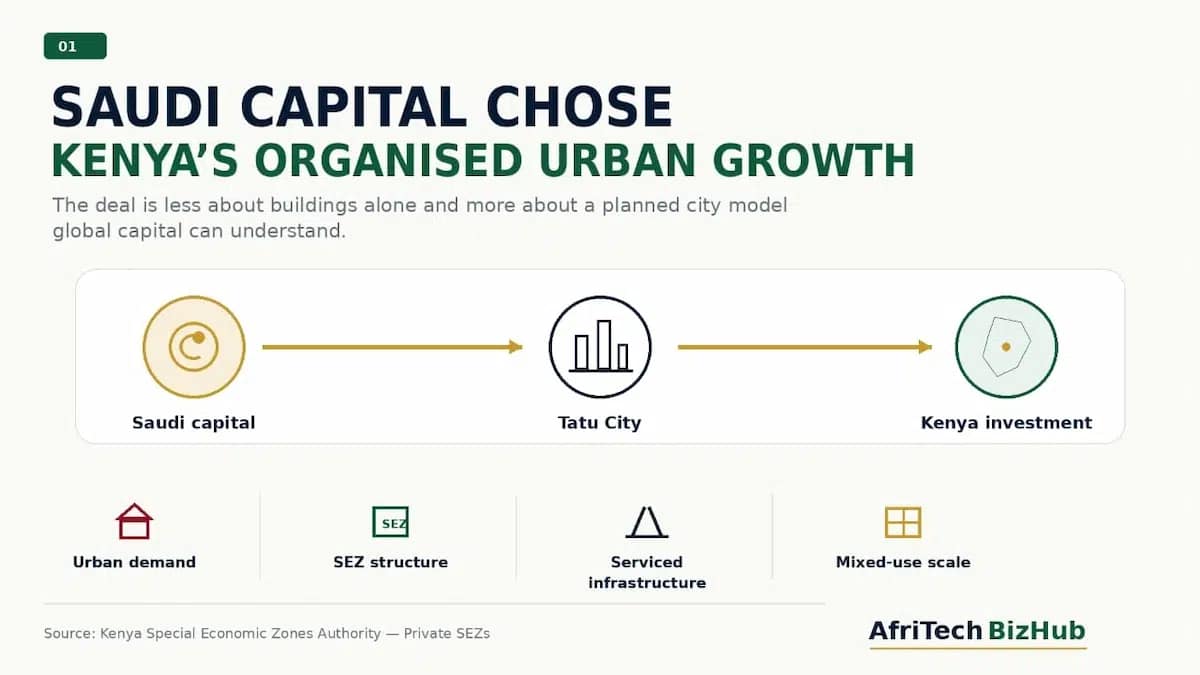
Tatu City gives Saudi investors what many African property markets still struggle to package clearly: serviced land, roads, utilities, schools, businesses, housing demand, and a Special Economic Zone structure in one place.
That makes the deal more than a Saudi bet on buildings.
It is a bet on Kenya’s ability to organise growth before congestion, weak planning, and infrastructure gaps reduce the value of that growth.
The wider question is whether this becomes a single property move or the beginning of deeper Saudi Arabia investment in Africa’s real estate market.
What is the Relationship between Kenya and Saudi Arabia?
Kenya and Saudi Arabia are moving from traditional diplomatic ties into a more investment-driven relationship.
Their connection has long included trade, oil imports, labour migration, religious travel, aviation, and bilateral cooperation.
Kenya sends workers to the Gulf, while Saudi Arabia remains an important partner for energy, capital, and construction-linked opportunities.
The Tatu City deal adds a new layer to that relationship because it places Saudi capital inside Kenya’s urban economy.
Instead of remaining focused only on fuel, labour, or state-level agreements, the relationship is now extending into private-sector property development.
That shift matters for Kenya investment because it shows Saudi investors are looking at Kenya as a market where long-term urban assets can be built, held, and scaled.
Why Is Kenya Investment Attracting Saudi Construction Giants?
Kenya offers a growth story that construction investors can understand without overcomplication.
Nairobi is expanding, housing demand remains strong, companies need modern space, and East Africa’s services economy continues to pull people and businesses toward the capital region.
For a Saudi construction group entering Africa, that combination creates a practical reason to look at Kenya before less structured property markets.
The stronger attraction is that Tatu City reduces some of the uncertainty that usually comes with large African real estate projects.
Investors are not starting with empty land and unclear infrastructure.
They are entering a planned mixed-use development with roads, utilities, schools, homes, businesses, and an operating Special Economic Zone framework.
That makes Kenya investment more credible because the project already has the basic conditions needed for long-term property value.
How Will Saudi Foreign Investment Transform Tatu City?
Saudi capital can strengthen Tatu City by adding funding, construction experience, external confidence, and wider Gulf visibility to one of Kenya’s most prominent private urban developments.
Jabali Towers is positioned as a large mixed-use development, not a standalone apartment project.
Its value depends on how well residential, retail, hospitality, leisure, and business activity can work together inside the wider Tatu City environment.
The transformation will come if the investment helps Tatu City move from a planned-city concept into a stronger urban destination.
More capital can speed up construction, attract additional partners, and make the project more visible to international investors looking for African real estate exposure.
If the development performs well, it could make Tatu City a stronger reference point for Saudi foreign investment in Africa’s property sector.
Why Is Gulf Investment Targeting Kenya’s Property Market?
Gulf investors are paying attention to Kenya because the market offers growth with a clearer structure than many frontier property destinations.
Nairobi has regional business importance, a growing urban population, demand for better housing, and a need for modern mixed-use development.
Those factors create opportunity, but they become more attractive when they are supported by infrastructure and a regulated investment environment.
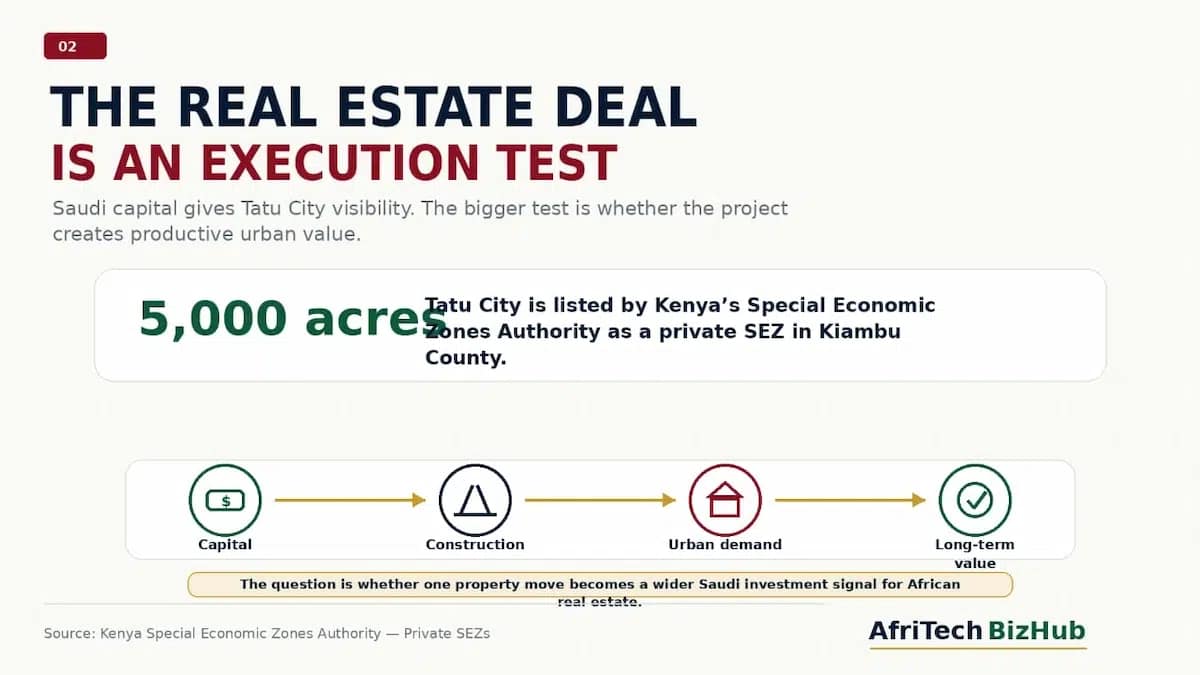
Kenya’s Special Economic Zones Authority lists Tatu City as a 5,000-acre private Special Economic Zone in Kiambu County.
SEZA also says its role is to create an enabling environment for investors through integrated infrastructure facilities and incentives that reduce barriers to doing business.
That institutional structure helps explain why Gulf investment is targeting Kenya’s property market. Investors are not only looking at buildings.
They are looking at a zone model designed to make capital deployment easier, more organised, and more scalable.
How is African Real Estate Winning Saudi Capital?
African real estate is becoming more attractive to Saudi capital because the continent’s cities need long-term urban infrastructure, not just isolated buildings.
Fast-growing populations are creating demand for housing, offices, retail centres, schools, hospitals, logistics hubs, and planned communities.
Gulf investors understand this kind of development because their own markets have used real estate as part of economic diversification.
Kenya’s advantage is that it gives Saudi investors a clearer entry point into that wider African opportunity.
Tatu City offers a visible model where land, infrastructure, regulation, and demand are already connected.
The deal can help show that African real estate is not only a high-risk frontier market.
It can become a serious investment destination when projects are well planned, commercially grounded, and supported by credible institutions.
The next test is whether Saudi capital helps create productive urban value, not only premium property headlines.


Recent Comments