


Featured Summary:
- Ethiopia Golden Visa proposes one of the continent’s most selective residency-by-investment programmes through a very high investment threshold.
- Residency by investment is being positioned as an exchange for substantial long-term economic contribution rather than passive capital.
- Local job creation plays a central role in determining the programme’s economic value.
- The programme’s long-term success will depend on whether its selectivity attracts sufficient high-impact investment.
Countries are redesigning investment migration programmes to compete for long-term capital, productive industries and investors capable of supporting national economic priorities.
Residency is shifting from a standalone immigration benefit towards a policy tool that can reduce administrative uncertainty for investors expected to build businesses, employ workers and remain economically active.
Ethiopia officially introduced a 10-year residence permit for high-impact foreign investors in March 2026.
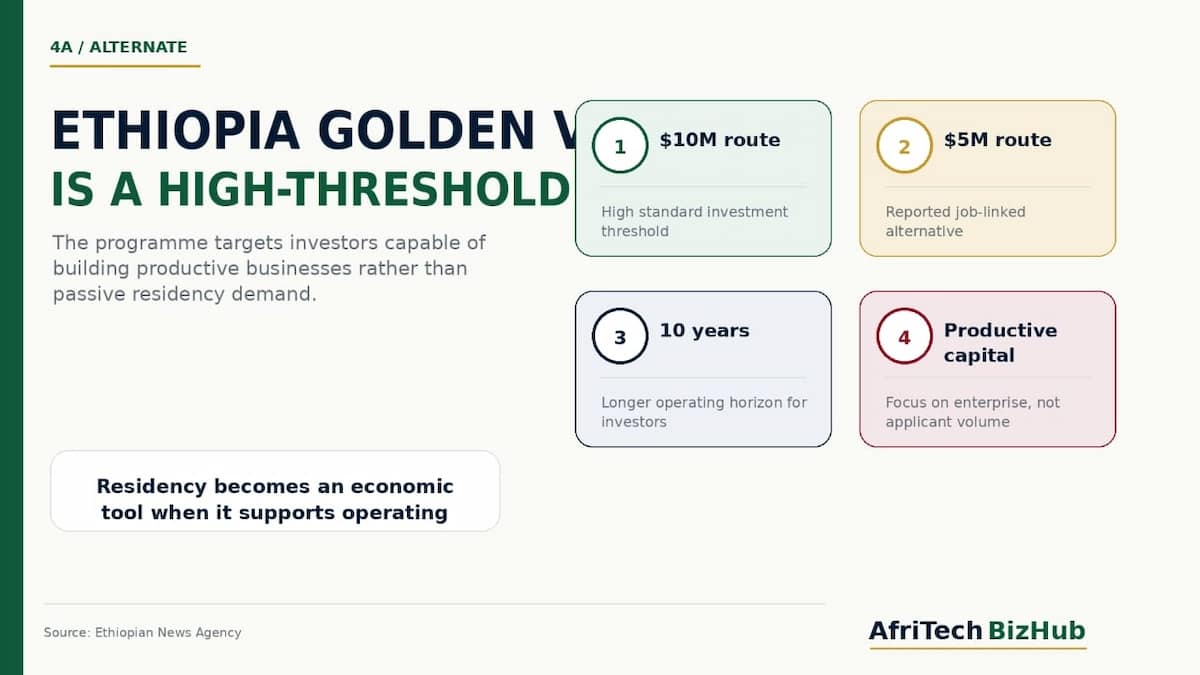
The Ethiopia Golden Visa has since been reported to include a $10 million standard investment route and a $5 million alternative linked to substantial local job creation, although the operational directive setting exact employment quotas and sector conditions has not yet been published.
The distinction places economic contribution, rather than applicant volume, at the centre of the programme.
Why Is the Ethiopia Golden Visa So Expensive?
The Ethiopia Golden Visa is reported to set a $10 million entry threshold for its principal investment route.
A second route would reduce the required capital to $5 million where an investor creates substantial local employment, but the government has not yet released the final directive defining the number, duration or category of jobs required.
The high threshold signals a deliberate preference for concentrated productive capital.
Ethiopia is seeking investors with the financial capacity to establish operating businesses, finance equipment, build supply networks and sustain projects through the period between initial investment and commercial production.
The policy is therefore structured around the scale of economic activity an applicant can support rather than the number of residence permits issued.
The threshold also gives the programme a clear policy identity.
It separates the 10-year permit from lower-cost residency models based primarily on property ownership or passive financial commitments.
The programme’s high investment threshold signals an emphasis on attracting large-scale productive capital rather than maximising applicant numbers.
What Does Residency by Investment Offer Foreign Applicants?
Residency by investment gives qualifying applicants a longer operating horizon inside Ethiopia.
The official programme provides a standardised electronic permit valid for 10 years, reducing the need for repeated residence applications and giving investors greater certainty over their ability to remain in the country while managing long-term projects.
That certainty matters for businesses that require several years to secure approvals, develop facilities, recruit employees and establish commercial relationships.
Investors overseeing factories, technology platforms or other capital-intensive operations need a predictable residence framework that allows them to manage the enterprise beyond its launch phase.
The permit does not remove commercial risks involving regulation, foreign exchange or investment returns.
It addresses one administrative uncertainty by allowing approved investors to reside and operate in Ethiopia with fewer repetitive procedures.
Residency becomes economically valuable when it provides investors with greater certainty to build and expand long-term business operations.
What Kind of Wealthy Investors Is Ethiopia Trying to Attract?
The reported threshold points towards investors capable of financing productive enterprises rather than individuals seeking residence through passive asset ownership.
Ethiopia’s investment priorities include manufacturing, agro-processing, mining, technology, energy, transport and logistics, giving the programme potential relevance to sectors that require substantial upfront capital.
Manufacturing investors can fund production facilities, equipment and supplier networks that support domestic output and exports.
Commercial agriculture and agro-processing can connect raw production with higher-value goods, while technology and logistics investment can strengthen the infrastructure required by businesses across the wider economy.
Capital size alone will not determine whether an investor creates long-term value.
Ethiopia is seeking wealthy investors with the operational experience, financing capacity and commercial commitment required to move projects from approval into sustained production.
The programme is designed to attract investors capable of creating productive businesses rather than making passive financial commitments.
How Will Local Job Creation Shape Ethiopia Golden Visa Eligibility?
Local job creation is expected to distinguish the reported $5 million route from the programme’s higher standard threshold.
The employment-linked option has been reported as part of the planned eligibility structure, but no final official directive currently specifies how many jobs must be created, how long they must remain in place or which sectors will qualify.
The officially confirmed policy objective is broader.
Ethiopia’s Immigration and Citizenship Service said the 10-year permit targets investors making significant contributions to the national economy and is intended to support industrial growth, foreign direct investment and foreign-currency inflows.
Employment generation would give authorities a measurable way to assess whether a lower capital commitment is producing sufficient domestic value.
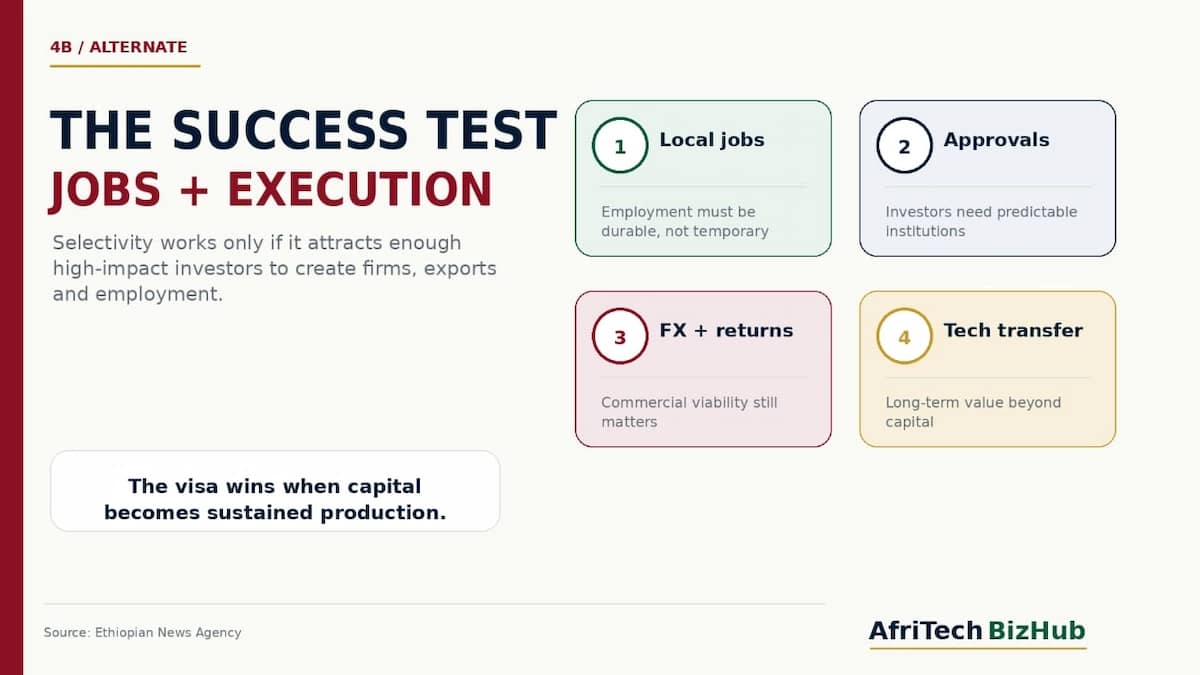
The final rules will need to distinguish durable employment from temporary hiring used only to obtain residence.
Eligibility could carry greater economic credibility where it measures permanent jobs, skills development, operating activity and continued investment after approval.
The Ethiopia Golden Visa seeks to reward investment that generates measurable economic activity rather than capital alone.
Can Ethiopia’s Investment Threshold Attract Capital Without Limiting Demand?
A $10 million threshold can improve capital quality by restricting eligibility to investors capable of financing projects at meaningful scale.
It can also reduce the potential applicant pool because investors with that level of capital have several countries, industries and asset classes competing for the same funds.
Ethiopia’s challenge is therefore not simply to maintain a selective entry requirement.
The wider investment environment must give qualifying applicants credible commercial opportunities, predictable regulation, efficient approvals and workable routes for managing foreign currency and investment returns.
A long residence permit strengthens the offer, but it cannot replace the fundamentals that determine whether a project is financially viable.
The Ethiopia Golden Visa answers the headline by targeting a narrow class of investors with enough capital to build large enterprises and remain committed through long development cycles.
Its success will be measured by whether that selectivity produces operating companies, exports, employment and technology transfer without reducing participation below commercially useful levels.
The success of selective residency programmes depends on balancing investment quality with sufficient market demand.


Recent Comments