


Last updated: July 31, 2026
Featured Summary:
- Kenya golden visa proposals reflect a broader shift as countries compete for globally mobile entrepreneurs and investors.
- Nairobi’s position as an investment hub will depend on converting investor access into company formation, venture investment, and innovation.
- Venture capital firms benefit most when founders, investors, and businesses can build long-term commercial relationships with fewer barriers.
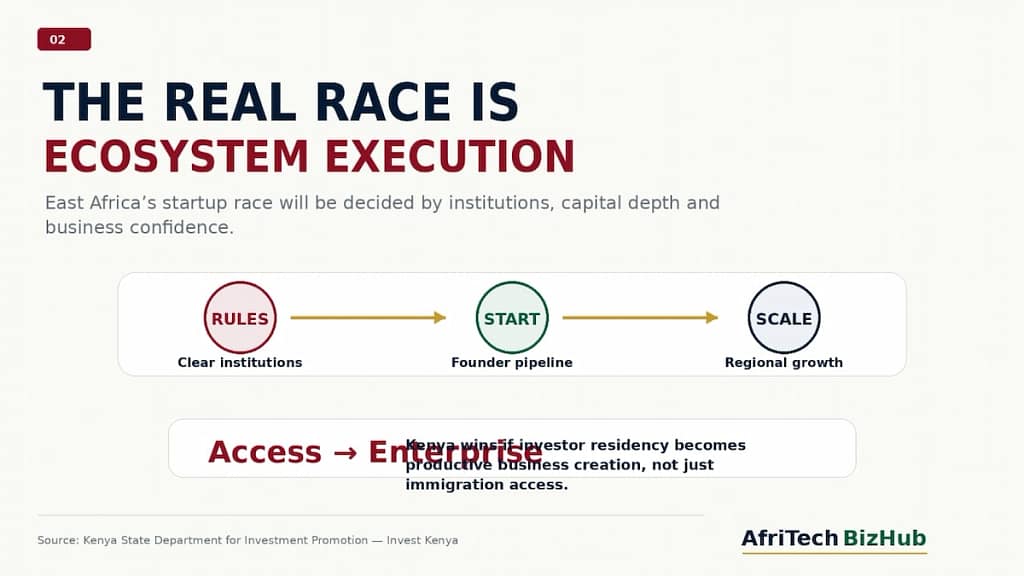
- East Africa’s investment race will be shaped by ecosystem quality, institutional execution and market confidence rather than incentives alone.
Governments are expanding the competition for global capital beyond tax incentives, infrastructure, and investment promotion.
As founders, venture investors, and internationally mobile businesses gain greater flexibility over where they establish companies, investor mobility is becoming part of national economic strategy rather than simply an immigration function.
Kenya’s proposed golden visa reflects that transition.
The initiative seeks to strengthen Nairobi’s position as a regional investment hub by giving qualifying foreign investors a more permanent base from which to build businesses.
Its long-term significance, however, will not be measured by residency approvals but by whether easier investor access leads to stronger venture funding, new enterprises, and sustained commercial activity across the Kenyan economy.

How Will Kenya Golden Visa Attract Global Investors?
The Kenya golden visa proposal reflects a wider shift in how countries compete for investment.
Governments once focused primarily on tax incentives, industrial parks and infrastructure.
Those tools remain important, but globally mobile entrepreneurs now evaluate another factor before committing long-term capital: whether they can establish themselves, their families and their businesses without repeated immigration uncertainty.
Investor residency has therefore become another form of economic infrastructure.
Kenya’s proposal remains under development and should not be confused with existing immigration rules.
Officials have indicated that qualifying investors could receive permanent residency based on investment, employment creation and broader economic contribution, but detailed eligibility requirements and enabling legislation have not yet been published.
The programme will create economic value only if it attracts entrepreneurs who establish productive businesses rather than investors seeking residency without sustained commercial engagement.
Why is Investment Hub Status Crucial for Nairobi?
Investor residency delivers stronger economic outcomes only when businesses already have compelling reasons to operate in the host economy.
Nairobi has established itself as one of Africa’s leading commercial centres through its concentration of financial institutions, technology companies, professional services, development finance organisations and regional headquarters.
Those networks allow founders to recruit talent, access finance and expand across East Africa from organizations.
The city’s competitive position rests on ecosystem quality rather than infrastructure alone. Venture investors are drawn to active founder communities, accelerators, legal and financial expertise, regional market access and a growing pipeline of scalable businesses.
Residency reform can reinforce these strengths, but it cannot substitute for regulatory certainty, efficient institutions or commercial opportunities that ultimately determine where companies choose to build.
How Could Venture Capital Firms Benefit From Investor Residency?
Venture capital depends as much on relationships as finance.
Investors regularly meet founders, conduct due diligence, mentor management teams, attend board meetings and build networks before committing capital.
Easier long-term residency can reduce administrative barriers that limit how deeply international investors participate in local markets, making it easier to establish offices, support portfolio companies and remain engaged with emerging startups.
Residency alone, however, does not increase venture investment.
Fund managers deploy capital where they find scalable businesses, predictable regulation, realistic valuations and credible exit opportunities.
The Kenya golden visa therefore becomes commercially significant only when investor access is matched by a pipeline of investable companies, stronger founder networks and institutions capable of supporting sustained capital deployment.
Why Is East Africa Investment Becoming More Competitive?
East Africa’s investment landscape has become more competitive as governments strengthen the conditions that attract globally mobile businesses.
Kenya continues expanding its innovation ecosystem, Rwanda has focused on administrative efficiency and digital government, Tanzania has pursued investment reforms across strategic sectors;Ethiopia has gradually opened parts of its economy to greatergovernment;rticipation.
The competition now extends beyond attracting foreign direct investment to attracting founders, venture funds and regional headquarters capable of generating long-term economic activity.
The quality of the business ecosystem increasingly shapes where that capital settles.
Kenya’s State Department for Investment Promotion identifies the country’s strategic location, access to regional markets, modern infrastructure, skilled workforce, financial services and growing innovation ecosystem as core advantages for investors.
Those strengths create a stronger foundation for investor residency, but they also demonstrate that long-term investment depends on the wider commercial environment rather than residency access alone.
Can Kenya Investment Authority Turn Investor Residency Into Long-Term Investment?
The Kenya Investment Authority will ultimately determine whether investor residency functions as an administrative benefit or a catalyst for enterprise growth.
The strongest outcome would connect residency approval with investment facilitation, business registration, investor aftercare, regulatory coordination and continued support as companies expand.
Investors generate lasting value not because they receive permanent residency but because they establish businesses, employ workers, introduce technology and reinvest capital over time.
Investor residency becomes a competitive advantage only when it functions as an extension of investment policy.
Countries that simply issue residency permits gain additional residents.
Countries that connect investor access with venture creation, supplier development, innovation and export industries build stronger economic ecosystems that continue creating value long after residency has been granted.
Kenya’s proposed golden visa could redefine East Africa’s startup investment race, but only if institutional execution transforms policy access into productive enterprise, sustained capital deployment and long-term business growth.


Recent Comments