


Featured Summary:
- Guinea bauxite policy has returned Arrow Minerals’ Niagara project to active development after more than a year of regulatory uncertainty.
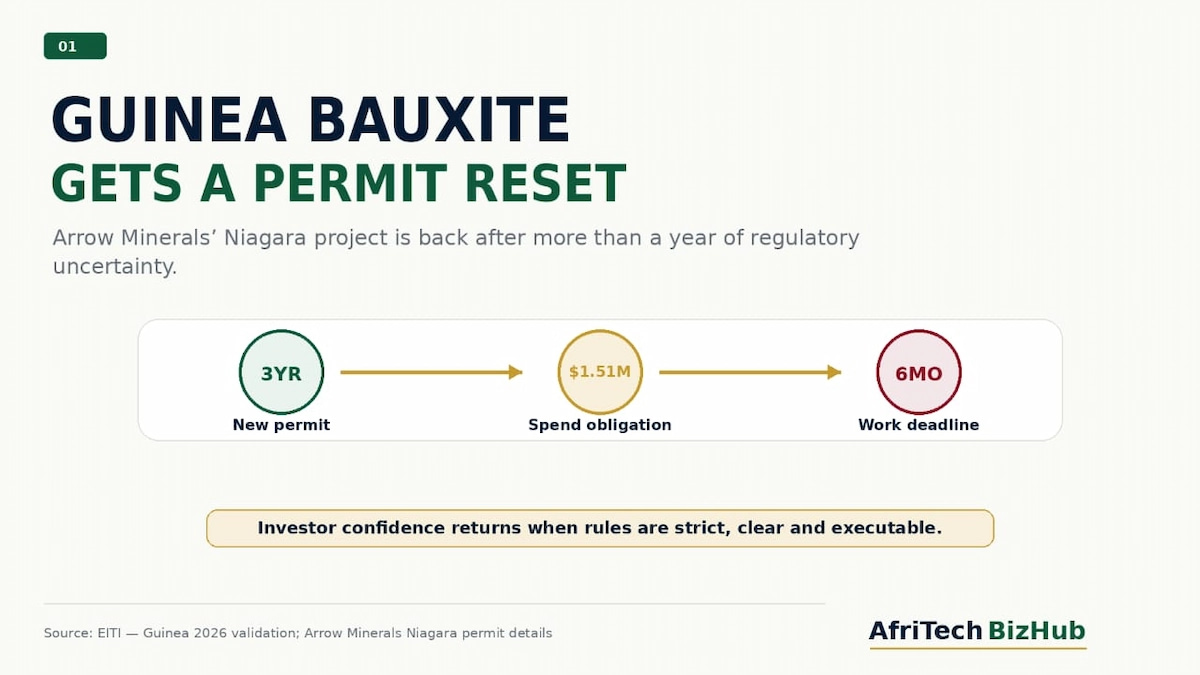
- The new three-year permit requires the Australian mining company to begin work within six months and spend at least $1.51 million.
- Rising aluminum demand strengthens Guinea’s position, but mineral abundance alone will not secure long-term investment.
- Mining sector reforms will succeed when stronger state control is matched by transparent rules, credible enforcement, and greater domestic value creation.
Guinea has awarded Australian-listed Arrow Minerals a new three-year industrial exploration permit covering the Niagara Bauxite Project, ending more than a year of uncertainty over the company’s rights to the asset.
The permit was issued on July 15, 2026, after the government reviewed Arrow’s previous exploration work, technical capacity, and ability to advance the project under Guinea’s Mining Code.
The decision is more significant than the return of one project.
Guinea has tightened control over mining licenses, reclaimed underused concessions, and pressed operators to deliver more domestic processing and economic value.
By approving a new permit with defined investment obligations, the government is testing whether stronger resource governance can coexist with the commercial certainty required to attract long-term mining capital.
Why Is Guinea Bauxite Reopening Investor Confidence So Quickly?
Arrow Minerals’ Niagara project had been caught in regulatory uncertainty since May 2025, when Guinean government statements identified its exploration permit among licenses under review.
Arrow suspended project activity, reduced expenditure, and kept its shares in voluntary suspension while seeking clarification from the Ministry of Mines and Geology.
Guinea’s award of a new three-year permit removed the immediate threat that the company could lose access to the project.
The market response reflected the removal of that regulatory overhang rather than proof that all sovereign risk had disappeared.
Arrow’s shares rose sharply after trading resumed, but its separate Simandou North iron ore permit remains unresolved.
The decision therefore sends a limited but important signal: Guinea is prepared to return projects to active development where companies demonstrate technical capacity, regulatory compliance, and a credible plan for investment.
How Will Global Aluminum Demand Benefit From Guinea’s Policy Shift?
Guinea occupies a central position in the global aluminum supply chain because bauxite is the principal raw material used to produce alumina and primary aluminum.
The country holds the world’s largest known bauxite reserves and has become the leading exporter of the ore, making regulatory decisions in Conakry commercially significant for refiners, manufacturers, and infrastructure investors far beyond West Africa.
The International Aluminium Institute forecasts that global aluminium demand could rise by almost 40% between 2020 and 2030, led by transport, electrical infrastructure, packaging, and construction.
Electric grids, renewable-energy systems, and lightweight transport technologies require substantial volumes of the metal.
That demand increases the strategic value of Guinea bauxite, but it also makes predictable mine development, transport infrastructure, and export policy more important to global supply security.
Why Did the Australian Mining Company Regain Its Guinea Permit?
Guinea did not technically reinstate Arrow Minerals’ previous license.
It awarded the company a new industrial exploration permit through Ministerial Decree No. A/2026/255/MMG/SGG.
The permit covers 499.61 square kilometers with the same boundaries and coordinates as the former permit, preserving Arrow’s access to the mineralized plateaux containing its previously reported 185-million-tonne mineral resource.
The government completed a review of Arrow’s historical work, operational capacity, and ability to dplateaushe project in accordance with the Mining Code.
The new permit also imposes measurable obligations. Arrow must spend at least $1.513 million over the three-year term and begin work and expenditures within six months.
These conditions show that Guinea’s approval was not an unconditional reversal but a regulatory decision tied to project execution.
Arrow paid approximately $14,000 in fees and taxes before receiving the permit and has started planning new fieldwork.
The company can also apply for two additional renewal periods of up to two years each.
Its commercial opportunity now depends on converting regulatory access into exploration progress, project studies, and a viable development plan.
How Are Mining Sector Reforms Reshaping Guinea’s Investment Climate?
Guinea’s mining reforms have combined stronger license enforcement with measures intended to capture more public revenue and improve sector transparency.
The government has reviewed concessions, withdrawn rights from some operators, and introduced a reference price mechanism designed to reduce the risk of undervaluing bauxite exports.
These policies reflect an attempt to move beyond an extract-and-export model that generates large volumes without always delivering equivalent fiscal or industrial value.
The Extractive Industries Transparency Initiative awarded Guinea a score of 73.5 points in its 2026 validation, identifying strong performance in contract, license, and production transparency.
It also found remaining weaknesses in data quality, revenue management, and the operating environment for civil society.
That assessment captures the investment tension facing Guinea: stronger oversight can improve confidence when decisions follow transparent procedures, but inconsistent enforcement or limited public disclosure can raise the risk premium attached to new projects.
Long-term capital will respond not simply to whether the government approves or cancels a license but to whether investors can understand the rules, demonstrate compliance, and receive decisions through a consistent legal process.
Arrow’s new permit supports that case, though one approval cannot by itself resolve the uncertainty created by Guinea’s wider license review.
Why is Guinea Protecting Mining Wealth While Attracting Investors?
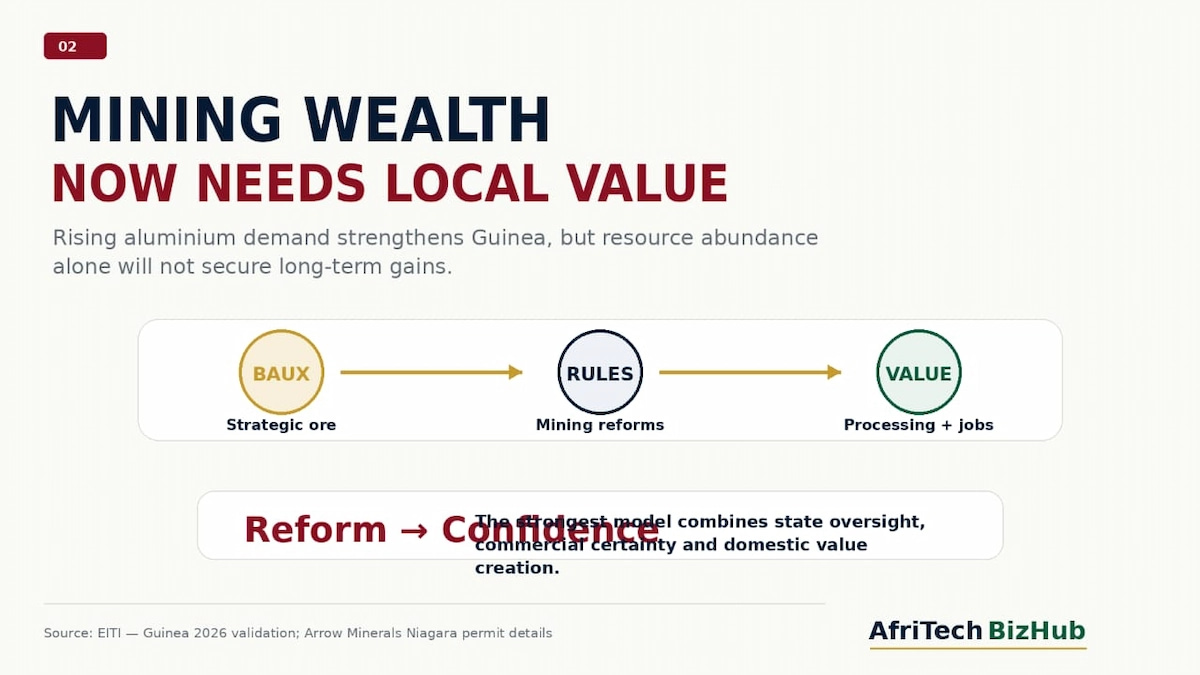
Guinea’s policy direction reflects a structural weakness common across resource-rich economies: exporting more mineral ore does not automatically produce broad economic transformation.
The World Bank reported that mining activity supported Guinea’s recent growth, but high poverty and limited job creation outside the sector show that production volumes alone have not converted mineral wealth into sufficiently broad development gains.
Greater national value will depend on how Guinea uses mining revenues, infrastructure, and policy leverage to support local processing, suppliers, employment, and public investment.
Alumina refining could retain more value than raw bauxite exports, but refineries require substantial electricity, transport infrastructure, capital, and long-term operational certainty.
Mandating local processing without those foundations could delay projects rather than accelerate industrialization.
The new Arrow Minerals permit demonstrates that resource sovereignty and private investment do not have to operate as opposing forces.
Guinea reviewed the project, imposed new expenditure obligations, and granted a full three-year term once the company met its regulatory assessment.
That framework protects state authority while giving the investor enough tenure to resume work.
Australia’s mining gamble has paid off at the permitting stage, not yet at the mine-development stage.
Guinea bauxite will attract sustainable capital when companies can trust the regulatory process and the state can enforce obligations that produce measurable national value.
The countries best positioned to benefit from strategic minerals will not be those that surrender control to investors or block private capital, but those that combine credible regulation, commercial certainty, and a clear path from extraction to domestic wealth.


Recent Comments