

Featured Summary:
- AfDB-backed transport connections support Morocco’s export industries, including automotive products worth 154.5 billion dirhams in 2025
- Tanger Med handled 11.1 million containers measured in TEUs and 535,203 trucks in 2025, serving established industrial and agricultural trade
- Nador West Med will add port capacity and industrial space, strengthening Morocco’s potential to attract shipping and manufacturing investment
- Competing African economies face different challenges, from Mediterranean port competition to costly inland freight corridors
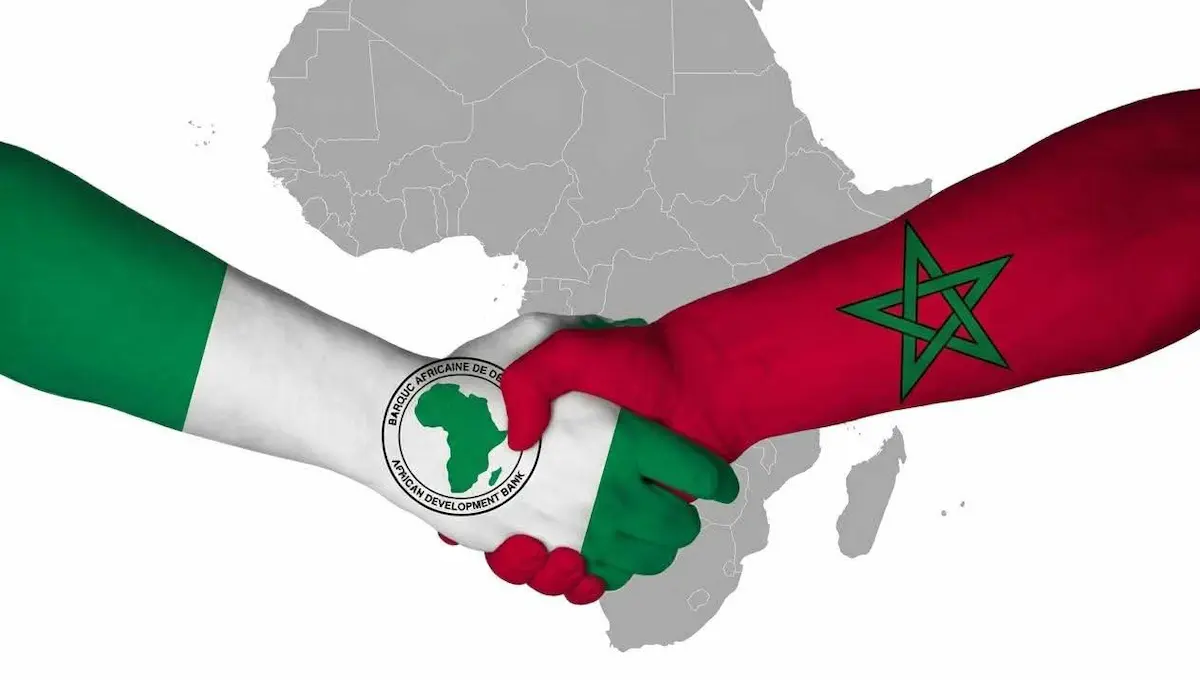
The African Development Bank (AfDB) has provided more than €2 billion for Morocco’s transport infrastructure since 1987, financing roads, railways and ports serving the country’s export industries.
Morocco exported 154.5 billion dirhams in automotive products in 2025, alongside 99.8 billion dirhams in phosphates and derivatives and 86.8 billion dirhams in agricultural and food products. The figures show the scale of industrial and agricultural trade supported by Morocco’s transport network.
Tanger Med handled 11.1 million twenty-foot equivalent units (TEUs) and 535,203 trucks in 2025. Renault and Stellantis export vehicles through the port, which also handles industrial goods and agricultural shipments. Its connections to manufacturing centres give Morocco an established route into European and international markets.
The next expansion is taking shape at Nador West Med, where two container terminals are planned to provide combined capacity of 5.3 million TEUs.
An adjoining industrial zone is intended to attract manufacturing and logistics businesses, while the AfDB’s €229 million financing for the Guercif–Nador motorway will improve road access to the port. The development would give Morocco additional capacity to compete for Mediterranean shipping traffic and export-oriented industrial investment.
Morocco’s Automotive Expansion Reshapes Its Export Transport Network
Morocco’s automotive industry expanded substantially between 2015 and 2025, supported by Renault’s factories in Tangier and Casablanca and Stellantis’ manufacturing plant in Kenitra.
Customs data recorded 22.6 billion dirhams in passenger-car exports in 2015, alongside 22.2 billion dirhams in electrical wires and cables, a category that includes products used in vehicle manufacturing. The industry’s growth increased demand for vehicle terminals, component shipments and freight connections to European manufacturers.
Morocco’s ports handle different parts of its export economy. Tanger Med serves automotive manufacturers through dedicated vehicle terminals and container facilities, while Jorf Lasfar and Safi handle phosphate-related industrial cargo.
Agricultural exporters use refrigerated road transport and maritime services to reach overseas buyers. Tanger Med’s vehicle traffic declined in 2025 despite higher overall container throughput, showing that individual export activities did not follow the same growth pattern.
The African Development Bank provided approximately €300 million for railway improvements along the Tangier–Marrakech corridor. According to the Bank, the investment helped double daily freight train services.
Its €118 million contribution to the Marrakech–Agadir motorway supported a road connection that shortened journeys between the two cities by approximately two hours. In July 2026, the Bank approved another €205 million for railway development, including improvements along the Kenitra–Marrakech corridor.
An April 2026 International Monetary Fund assessment attributed roughly one-fifth of Morocco’s productivity growth since 2005 to improvements in infrastructure quantity and quality, with ports and telecommunications among the principal contributors.
The IMF also examined the country’s wider infrastructure investment programme through 2030, projecting long-term economic gains while identifying additional borrowing and imported construction inputs as costs affecting the programme’s returns.
Morocco’s Port Expansion Challenges Rival Shipping Hubs
Tanger Med ranked sixth globally in the World Bank’s 2025 Container Port Performance Index, which assesses the time container vessels spend in port.
Egypt’s East Port Said handled 4.91 million twenty-foot equivalent units (TEUs) in 2025, including 4.45 million TEUs of transshipment cargo, according to Egypt’s Ministry of Transport.
Tanger Med’s container throughput increased 8.4% during the year, supported by additional capacity at the APM Terminals-operated TC4 terminal.
Morocco handles substantially more containers overall, although East Port Said’s transshipment volumes demonstrate Egypt’s continued importance to Mediterranean shipping networks.
Nador West Med’s first container terminal began initial operations on October 31, 2026, with planned annual capacity of 3.5 million TEUs. A second terminal, developed under a concession involving Marsa Maroc and CMA CGM, is scheduled to open in April 2027, adding another 1.8 million TEUs.
The port complex also includes facilities for bulk cargo and energy shipments. Morocco’s Royal Office reported 54 billion dirhams in public and private investment mobilised for the development, including infrastructure associated with its industrial and logistics zones.
Morocco’s port investments also form part of its competition for industrial production. Renault and Stellantis operate manufacturing facilities supplying export markets, while South Africa hosts established automotive operations serving domestic and international buyers.
Egypt is pursuing additional vehicle manufacturing investment alongside its port and industrial-zone developments. Morocco’s existing production facilities provide potential demand for freight services at its expanding ports, but the volume of business attracted to Nador West Med will depend on shipping contracts and investment commitments.
Morocco also announced plans for Tanger Med 3 in October 2026, extending its port development programme beyond Nador West Med. The additional terminals would increase available capacity for container shipping, while the adjoining industrial developments are intended to attract manufacturers and logistics operators.
Shipping-line commitments and the occupation of industrial sites will determine how much of the planned expansion translates into commercial activity.
Transport Bottlenecks Raise Costs for Africa’s Competing Exporters
Transporting goods between Cameroon’s port of Douala and Bangui in the Central African Republic costs as much as $270 per tonne, according to the World Bank.
Journeys along the 1,400-kilometre corridor take nine to twelve days, with 38 checkpoints on the Cameroonian section, including 17 associated with informal payments.
More than 80% of the Central African Republic’s external trade passes through the route, leaving businesses heavily dependent on its road conditions, freight charges and border procedures.
The African Development Bank’s 2026 Annual Development Effectiveness Review recorded an infrastructure integration score of 0.505 out of 1 for Africa in 2025.
Weak railway connections and inconsistent cross-border transport arrangements continue to affect regional freight services. For manufacturers importing intermediate goods, unreliable delivery schedules increase inventory requirements and production costs. Agricultural exporters face additional losses when lengthy journeys delay shipments of perishable products.
In June 2026, the World Bank approved a $1.12 billion programme to improve the Douala–Bangui corridor, with an initial $525 million covering road rehabilitation, maintenance and trade facilitation.
Cameroon received $425 million in first-phase financing, while $90 million was allocated to the Central African Republic and $10 million to regional institutions. Planned improvements include logistics hubs, feeder roads and measures to reduce delays along the route.
The financing addresses a corridor whose transport costs have constrained trade between Central Africa’s landlocked markets and international ports.
The investment could reduce freight expenses for businesses using Douala to reach the Central African Republic, particularly if road rehabilitation is accompanied by fewer checkpoints and faster clearance procedures.
These improvements would strengthen access to regional markets and overseas shipping services. Morocco’s expanding Mediterranean ports operate in a different market, where competition centres more directly on shipping connections, cargo handling and industrial investment.
Morocco’s Port Expansion Strengthens Its AfCFTA Trade Ambitions
Morocco’s exports to sub-Saharan Africa increased more than fifteenfold between 2000 and 2021, according to the OECD, but the region accounted for just 6% of the country’s total exports.
Fertilisers and food products already serve African markets, while the country’s automotive industry has additional opportunities as trade barriers fall under the African Continental Free Trade Area (AfCFTA).
Morocco’s established manufacturing capacity and Mediterranean shipping connections give its exporters a platform for expanding sales across the continent.
Nador West Med and the Bétoya industrial zone are intended to strengthen trade connections between North and West Africa. Additional shipping services would improve access to African destinations for Moroccan fertilisers, processed foods and manufactured goods, while new industrial operations could broaden the country’s export base.
The next measure of Morocco’s trade advantage will be the volume of goods moving between its ports and African markets, alongside the industrial investment and shipping activity secured by the new facilities.


Recent Comments