


Featured Summary:
- African electric cars are moving from small demonstrations into revenue-generating transport fleets.
- GoCab has added 200 electric vehicles to its Abidjan network, including 100 vehicles handed to drivers in July 2026.
- Lower energy and maintenance costs can improve fleet economics, but vehicle finance, charging downtime, and battery performance will determine profitability.
- Africa’s next mobility leaders will compete through financing, charging, software, and after-sales support rather than ride-hailing platforms alone.
African electric cars are beginning to enter the part of the transport market where operating costs matter most.
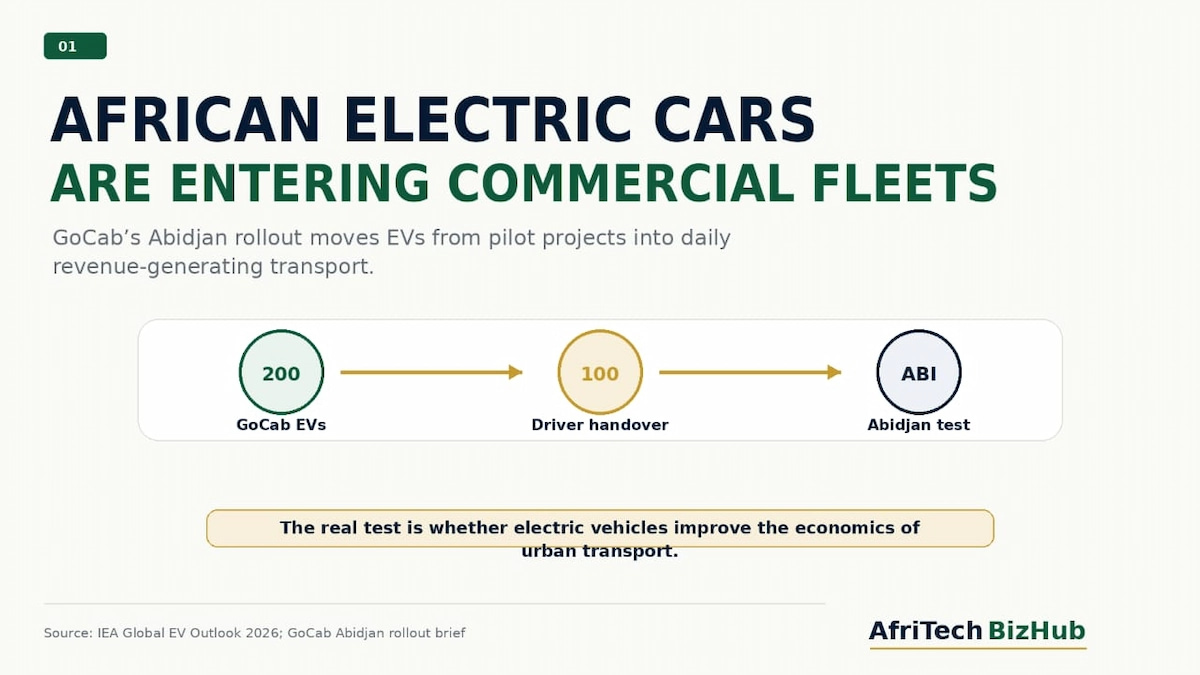
GoCab has integrated 200 fully electric vehicles into its Côte d’Ivoire fleet, with 100 handed to drivers in Abidjan on July 4, 2026, as the mobility-financing company works toward making half of its ride-hailing network electric by 2027.
The rollout places electric vehicles inside daily commercial operations rather than a limited technology trial.
The commercial significance extends beyond GoCab.
African mobility operators now face a competition shaped by vehicle ownership, energy costs, financing structures, charging access, and fleet utilization.
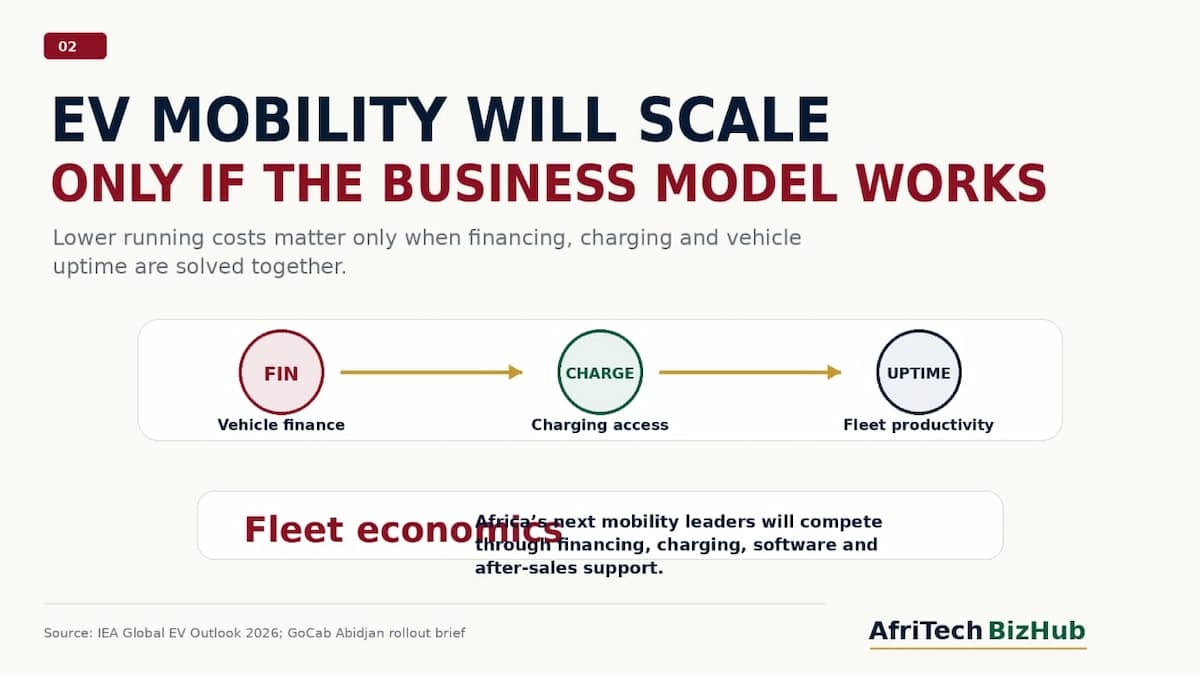
An electric car can cost less to operate, but those savings create value only when drivers can finance the vehicle, find reliable charging, and keep it on the road for enough revenue-generating hours.
Abidjan is therefore testing whether electric mobility can improve the economics of urban transport rather than simply change the type of car used.
Why Are African Electric Cars Gaining Momentum in Abidjan?
GoCab’s latest deployment gives Abidjan one of the clearest commercial tests of African electric cars in ride-hailing.
The company says 200 electric vehicles have entered its fleet, while the July handover placed 100 of them directly into driver operations.
GoCab also works within Côte d’Ivoire’s wider platform market, including as a partner of Yango and an operator connected to the premium Goya service, allowing the vehicles to enter an established passenger-demand network rather than wait for a new market to develop.
Abidjan matters because high daily mileage can make the operating-cost difference between electric and combustion vehicles commercially visible much faster than in private ownership.
Ride-hailing cars consume fuel continuously, require frequent maintenance, and lose revenue whenever they are unavailable.
GoCab’s rollout will show whether lower running costs can offset higher acquisition costs, charging interruptions, and the practical limits of a still-developing support network.
The city’s importance lies not in winning an African EV race but in establishing whether fleet electrification works under real urban transport conditions.
How Will GoCab Electric Vehicles Change Driver Economics?
GoCab electric vehicles could change driver economics by shifting expenditure away from fuel and mechanical servicing toward electricity, financing, and battery-dependent operating decisions.
Electric drivetrains generally contain fewer moving components than combustion engines, which can reduce routine maintenance requirements, while predictable charging costs can protect drivers from some fuel-price volatility.
For a high-mileage ride-hailing vehicle, those savings can improve the amount of revenue left after daily operating expenses.
Profitability, however, depends on the complete financing model.
GoCab operates a drive-to-own platform that allows drivers to use vehicles while working toward ownership, and the company raised $45 million in equity and debt in February 2026 to expand its mobility-financing operations and electric fleet.
Repayment terms, insurance, charging costs, vehicle utilization, and battery performance will determine whether lower operating expenses translate into stronger net income rather than merely covering a more expensive vehicle.
Can EV Mobility Finally Scale Across African Cities?
EV mobility can scale fastest in commercial fleets because operators can centralize charging, monitor vehicle performance, and spread infrastructure costs across vehicles generating daily revenue.
Fleet managers can schedule charging around demand, use software to track energy consumption, and negotiate electricity or maintenance arrangements at a scale that individual buyers cannot easily achieve.
These advantages make taxis, ride-hailing cars, delivery vehicles, and urban buses practical entry points for wider electric vehicle adoption.
The limits are equally commercial.
Charging stations must be located near driver activity, electricity must remain available at predictable prices, and replacement parts must arrive quickly enough to prevent extended downtime.
The IEA reported that electric car sales in Africa more than doubled to almost 11,000 in 2024 but still accounted for less than 1% of new car sales, showing that momentum remains far below mass-market scale.
African electric cars will move beyond isolated fleets only when financing, electricity, maintenance, and charging develop as one operating system.
What Will Determine Africa’s Electric Mobility Future?
Electric mobility becomes bankable when investors can estimate vehicle revenue, charging costs, battery performance, resale value, and regulatory risk over the life of the asset.
Fleet operators need affordable long-term capital, insurers need enough operating data to price risk, and charging investors need confidence that vehicle demand will generate reliable utilization.
Governments can improve capital;stment case through clear vehicle standards, prisk;table import rules, electricity planning, and policies that allow private capital to build charging networks.
The International Energy Agency’s Global EV Outlook 2026 shows that global electric-car sales exceeded 20 million in 2025, representing one-quarter of new-car sales, but Africa remains at an earlier stage where market infrastructure matters more than global momentum.
Its charging analysis also identifies access to charging as a central condition for mass adoption.
Africa’s transition will therefore depend on whether cities create investable ecosystems around vehicles rather than expecting vehicle imports to create the market by themselves.
Will Competition Determine Africa’s Next Mobility Leaders?
Competition is already moving beyond the ride-hailing application.
GoCab combines vehicle finance with fleet operations, while Yango has widened its position in Côte d’Ivoire through Yango Motors, launched in 2025 to distribute vehicles and connect mobility demand with financing, after-sales service, and local market support.
These moves point toward a market where the strongest companies may control several parts of the mobility chain rather than only match passengers with drivers.
The most valuable opportunities will emerge in drive-to-own financing, charging depots, battery diagnostics, fleet-management software, predictive maintenance, insurance, and vehicle remarketing.
Operators that coordinate these services can reduce downtime and make electric fleets easier to finance, while platforms that rely only on passenger commissions risk losing influence over the economics beneath each trip.
African electric cars could change mobility, but leadership will belong to companies that build financially sustainable operating systems around them rather than those that announce the largest vehicle numbers.


Recent Comments