

Featured Summary:
- Gulf IPO activity offers infrastructure companies a route to permanent institutional capital.
- Public listings can support regional expansion without relying solely on project finance or private borrowing.
- Renewable energy projects strengthen Hassan Allam’s investment case goes beyond traditional construction.
- Long-term Gulf leadership will depend on governance, capital discipline, and scalable infrastructure portfolios.
Infrastructure companies once built regional scale by winning larger contracts and moving engineering teams from one project to another.
That model generated revenue, but growth remained tied to contract cycles, project financing and the ability to secure the next major award.
Gulf capital markets now offer another route by connecting infrastructure businesses with investors prepared to fund long-term expansion across construction, utilities and energy.
Hassan Allam Holding’s consideration of listings for selected infrastructure and real estate subsidiaries places the Egypt construction company within that wider commercial transition.
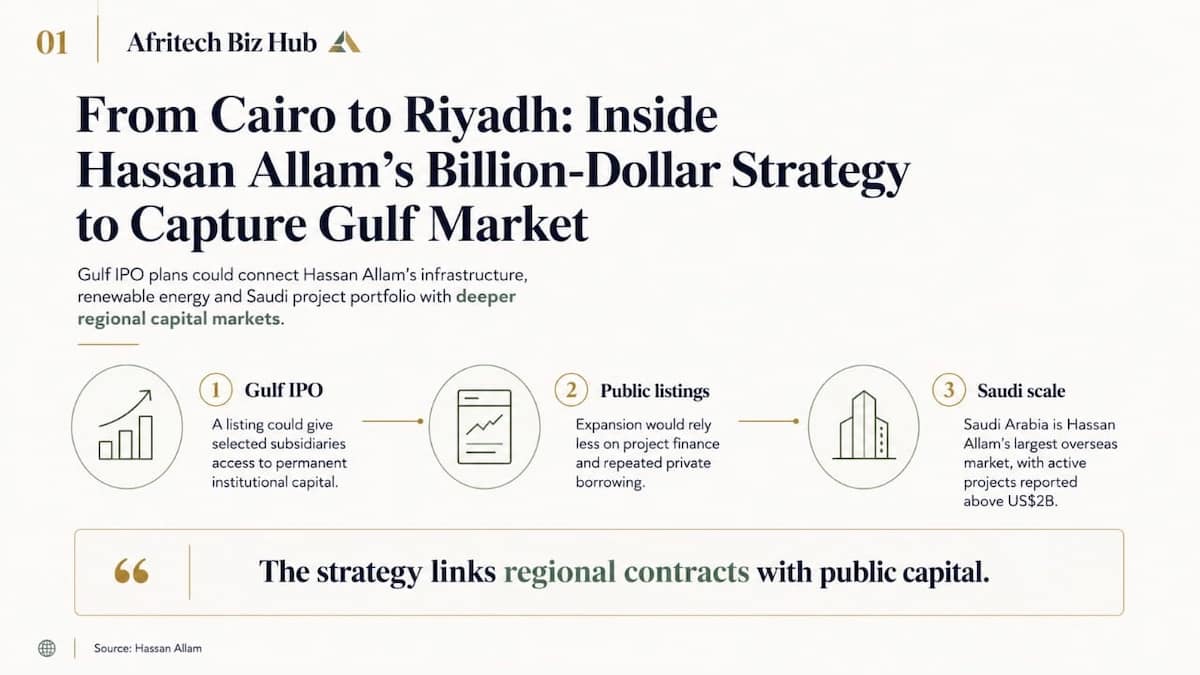
The family-owned parent has not confirmed a Gulf IPO, exchange, valuation or timetable, but Saudi Arabia already ranks as its largest overseas market, with reports placing its active project portfolio above US$2 billion.
The strategy links regional contracts with public capital rather than treating an IPO as a single fundraising event.
How Will Gulf IPO Reshape Hassan Allam?
Infrastructure businesses no longer rely only on contract income and bank financing to support regional growth.
A Gulf IPO could give selected Hassan Allam subsidiaries access to a broader pool of capital that remains available beyond the completion of one project.
Public markets can support acquisitions, equipment investment, project development and entry into new infrastructure sectors while reducing dependence on repeated private funding rounds.
The proposed structure also matters because Hassan Allam has indicated that the parent holding company would remain private while selected operating businesses could access Gulf or Egyptian exchanges.
That approach would allow investors to evaluate specific infrastructure or real estate platforms rather than the entire family-owned group.
A Gulf IPO could therefore move Hassan Allam closer to a capital-backed infrastructure model, although the company has not yet committed to a listing venue or transaction timetable.
Why Are Public Listings Attracting Regional Investors Now?
Infrastructure fits the investment horizons of pension funds, sovereign wealth funds and other institutional investors because essential assets often serve economies for decades.
Transport systems, water facilities, power networks and urban developments respond to long-term demand rather than short consumer cycles.
Listed infrastructure businesses can give investors exposure to those assets while providing financial reporting, governance requirements and a visible route for buying or selling shares.
Public listings also allow investors to assess a company across a portfolio rather than commit capital to one construction contract.
The investment case strengthens when a business combines engineering revenue with operating assets, concessions or development interests capable of producing cash flows after construction ends.
Institutional investors therefore look beyond contract awards to governance quality, project execution, balance-sheet discipline and the durability of future earnings.
How Are Renewable Energy Projects Driving Growth?
Renewable energy projects give infrastructure companies access to longer development cycles and a wider range of commercial roles than traditional construction alone.
Hassan Allam operates across engineering, construction, investment and development, allowing the group to participate in energy projects through project delivery, ownership partnerships and utility infrastructure.
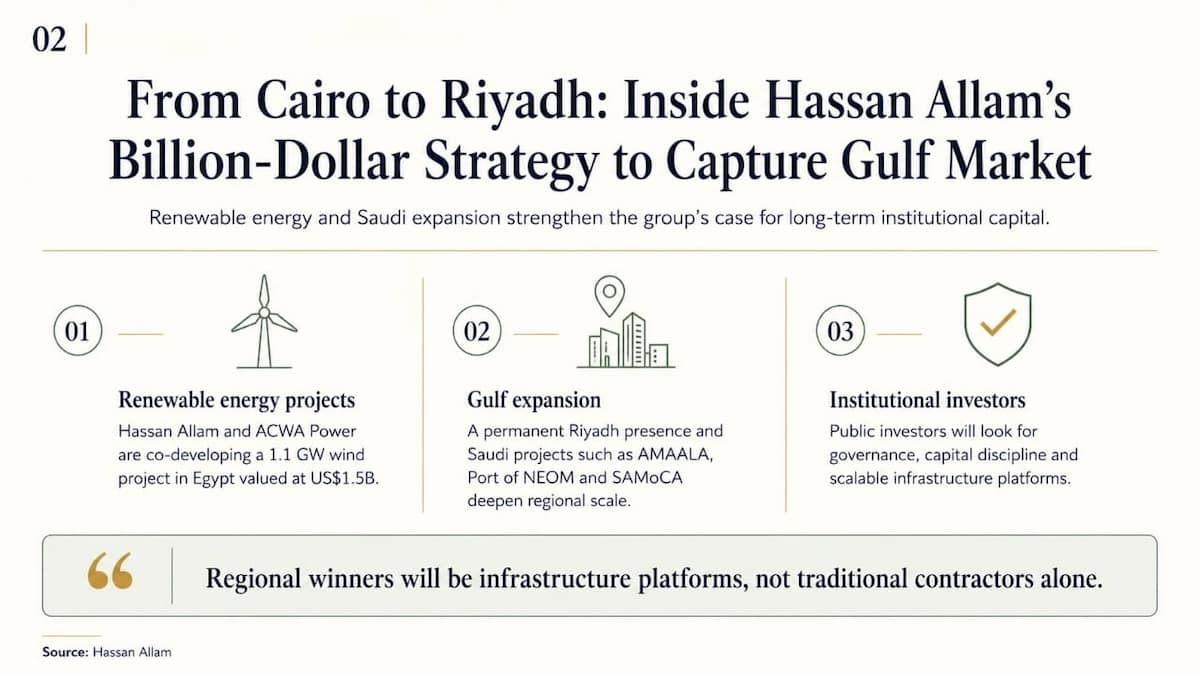
Its agreement with ACWA Power to co-develop a 1.1-gigawatt wind project in Egypt, valued at US$1.5 billion, shows how the group can combine construction capability with long-term energy investment.
That portfolio broadens the case for institutional capital because renewable energy demand extends beyond individual building contracts.
Energy assets can support long-term revenue through development agreements, operating interests, and infrastructure services, while exposure to water, power, and sustainable infrastructure reduces dependence on one construction segment.
Public investors would therefore evaluate Hassan Allam not only as a contractor but also as a diversified infrastructure business with access to projects carrying longer commercial lives.
Why Is the Construction Giant Expanding Across the Gulf?
Gulf markets offer a concentration of public investment, economic diversification programs, and large infrastructure projects that few regions can match.
Saudi Arabia’s development agenda covers transport, tourism, culture, logistics, utilities, and urban infrastructure, creating demand for companies capable of delivering complex projects at scale.
Hassan Allam has responded through a permanent Riyadh presence and contracts connected to destinations such as AMAALA, the Port of NEOM, and the Saudi Arabia Museum of Contemporary Art.
Regional expansion also places the group closer to customers, project pipelines, and Gulf capital.
Saudi contracts give Hassan Allam a commercial base from which selected subsidiaries could present investors with visible operations rather than an untested expansion plan.
The Gulf therefore offers more than construction demand: it connects the group to government-backed development, regional partnerships, and capital markets capable of supporting a larger infrastructure platform.
How Do Institutional Investors View Gulf Expansion?
Institutional investors assess infrastructure companies through the quality and predictability of the platform supporting their projects.
Strong engineering credentials can win contracts, but public-market investors also examine governance, cash flow, debt exposure, capital allocation, and the ability to convert a project pipeline into sustainable returns.
Renewable energy, utilities, and infrastructure development strengthen the portfolio only when management can control costs and protect margins across different markets.
Hassan Allam’s Gulf strategy will therefore carry greater weight when investors can see scalable operations rather than a collection of unrelated contracts.
A successful Gulf IPO would require transparent reporting, disciplined use of capital, and a clear distinction between construction income and longer-term investment returns.
The regional winners will not look like traditional contractors alone; they will operate as infrastructure platforms capable of connecting engineering expertise, public markets and durable assets across the Gulf and Africa.


Recent Comments