


Featured Summary:
- Illegal gold trade is forcing African governments to rethink how mineral wealth contributes to national economies.
- Gold production alone no longer guarantees stronger export earnings or fiscal revenue.
- Governments are tightening oversight to retain more value from existing mineral production.
- Africa’s mining competitiveness will depend on value retention rather than extraction alone.
Africa produces billions of dollars’ worth of gold every year, yet a significant share of that value never reaches national economies.
Informal trading, undeclared exports, and cross-border smuggling divert tax revenue, royalties, and foreign exchange before governments can capture their share.
Higher production has therefore not always translated into stronger public finances or broader economic development.
Tanzania’s latest crackdown reflects a wider change in mining policy across the continent.
Governments now place greater emphasis on protecting the value generated by existing mineral production than simply increasing extraction.
Africa’s mining competitiveness increasingly depends on how effectively countries formalize trade, strengthen oversight, and retain more of the wealth created by their natural resources.
How Is Illegal Gold Trade Fueling Africa’s Revenue Losses?
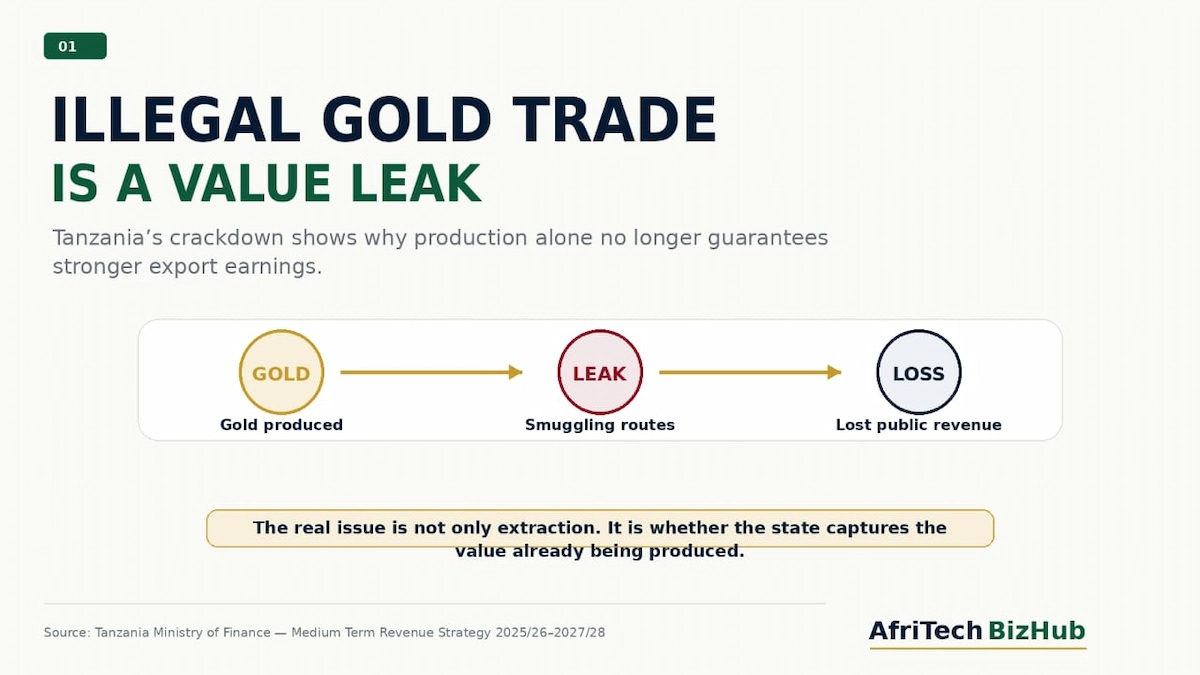
The greatest economic cost of the illegal gold trade appears long before minerals cross international borders.
Gold sold outside official channels bypasses royalty payments, export declarations, corporate taxation, and foreign exchange systems, reducing the public revenue available for infrastructure, education, and industrial development.
Governments therefore lose value from minerals that have already been extracted, even when national production remains strong.
Across Africa, informal gold trading continues to weaken fiscal performance by shifting valuable exports away from regulated markets.
SWISSAID estimated that more than 435 tonnes of African gold worth over US$30 billion left the continent through undeclared channels in 2022, with much of it destined for the United Arab Emirates.
Those losses illustrate why governments increasingly view the illegal gold trade as an economic governance challenge rather than solely a law-enforcement issue.
Why Is Gold Export Growth Accelerating Across Tanzania?
Official gold export growth reflects stronger formalization as much as higher mining activity.
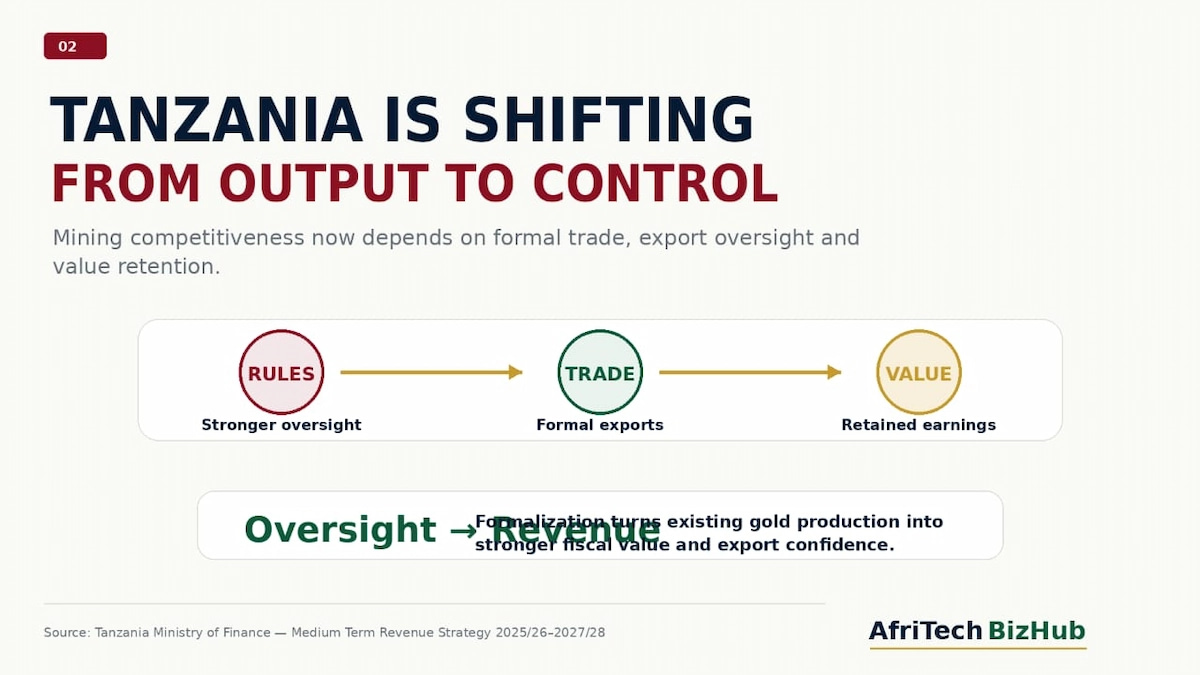
Tanzania has expanded oversight of mineral markets, strengthened export procedures, improved licensing administration, and promoted official trading channels that encourage more gold to move through the formal economy.
Better reporting allows export statistics to capture production that previously escaped official records, strengthening both fiscal revenue and foreign exchange earnings.
The government’s medium-term revenue strategy also outlines measures to strengthen royalty administration, digitize export permit applications, improve benchmark pricing, expand supervision against mineral smuggling, and encourage all minerals to be traded through designated markets.
These reforms focus on retaining more value from existing production rather than relying solely on extracting additional gold.
How Is Gold Smuggling Threatening Tanzania’s Export Earnings?
Gold smuggling weakens export earnings because valuable minerals leave the country without entering official trade statistics or generating foreign exchange through regulated financial systems.
Revenue that would otherwise support public finances, strengthen external reserves, and improve fiscal planning instead circulates through informal markets where governments cannot collect royalties, taxes, or export fees.
Those leakages reduce the economic contribution of gold regardless of production levels.
The consequences also extend to investment confidence.
Investors generally favor mining jurisdictions where export systems are transparent, regulations are consistently enforced, and trade data accurately reflects commercial activity.
Tanzania’s recent enforcement actions, including seizures of smuggled minerals and closer monitoring of illegal trade routes, aim to strengthen confidence in the country’s formal mining economy while reducing the commercial incentives for undeclared exports.
Why Are African Gold Producers Tightening State Control?
African governments increasingly view gold as a strategic economic asset whose value depends on effective governance as much as production.
Tanzania has strengthened regulatory oversight, while countries such as Ghana, Burkina Faso, and Zimbabwe have introduced reforms covering mineral marketing, domestic processing, state participation, and export controls.
Although each country follows a different policy path, they share a common objective of retaining more mineral value within national economies before resources leave the continent.
Stronger state oversight also supports broader economic sovereignty by improving taxation, export monitoring, refining capacity, and transparency across the mining sector.
These measures seek to ensure that African gold contributes more directly to public revenue, industrial development and long-term investment instead of flowing through informal markets that weaken fiscal performance.
The emphasis has shifted from producing more gold to capturing more of the value that production already generates.
How Is Illegal Mining In Africa Driving Mining Business Risks?
Illegal mining creates uncertainty because investors depend on transparent licensing systems, reliable export data and predictable regulatory enforcement before committing long-term capital.
Informal production undermines those conditions by weakening official trade channels, distorting market information and reducing confidence in the governance of mineral resources.
Mining businesses operate more effectively where governments can enforce regulations consistently and protect legitimate commercial activity.
Formalization offers a stronger long-term competitive advantage than higher production alone.
Countries that strengthen export systems, improve regulatory certainty and retain more mineral value create mining sectors capable of attracting sustained investment while supporting stronger public finances.
Africa’s most competitive mining economies will therefore be those that combine efficient production with transparent governance and effective value retention rather than relying solely on expanding extraction.


Recent Comments