


Featured Summary:
- South African Diamonds now operate in a market where controlled supply protects value more effectively than production growth.
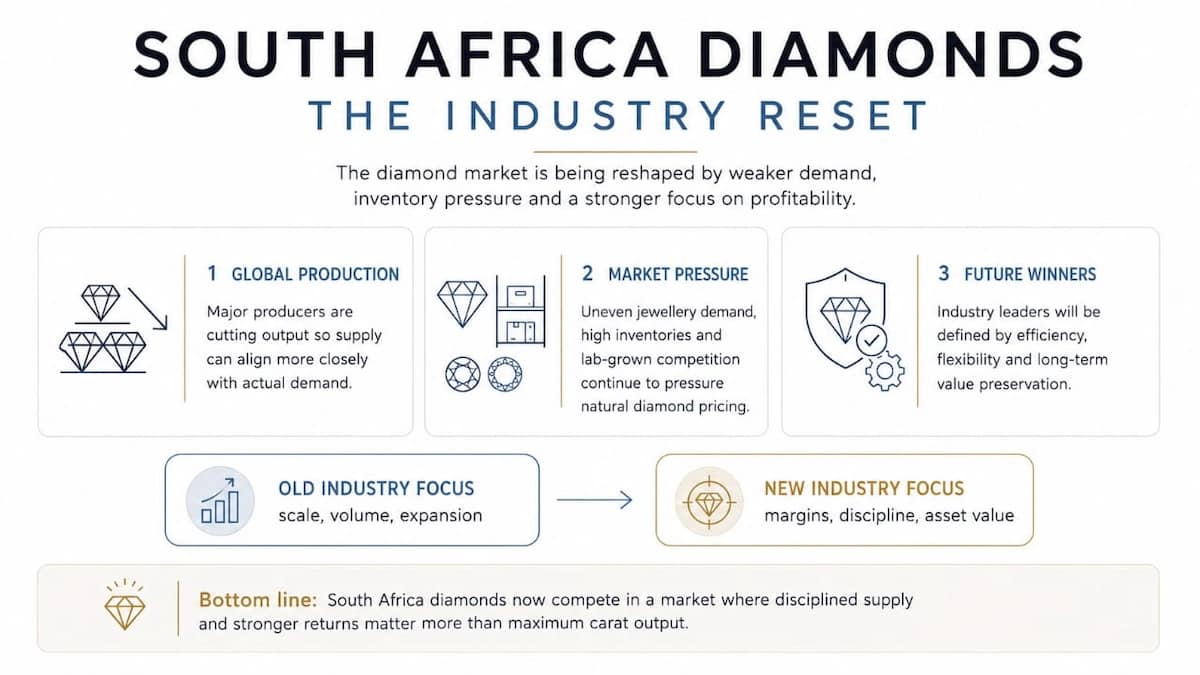
- Global diamond producers are reducing output to ease inventory pressure and support healthier pricing.
- Profitability and operational discipline now carry greater strategic importance than expanding mining volumes.
- Future industry leaders will be defined by efficiency, flexibility and long-term value preservation.
For decades, the diamond industry rewarded companies that discovered larger deposits and increased production.
Higher output supported stronger revenues because global demand could absorb additional supply, allowing mining companies to compete primarily through scale.
Softer consumer demand, elevated inventories and changing buying patterns have altered that commercial equation, placing greater value on protecting prices than increasing production.
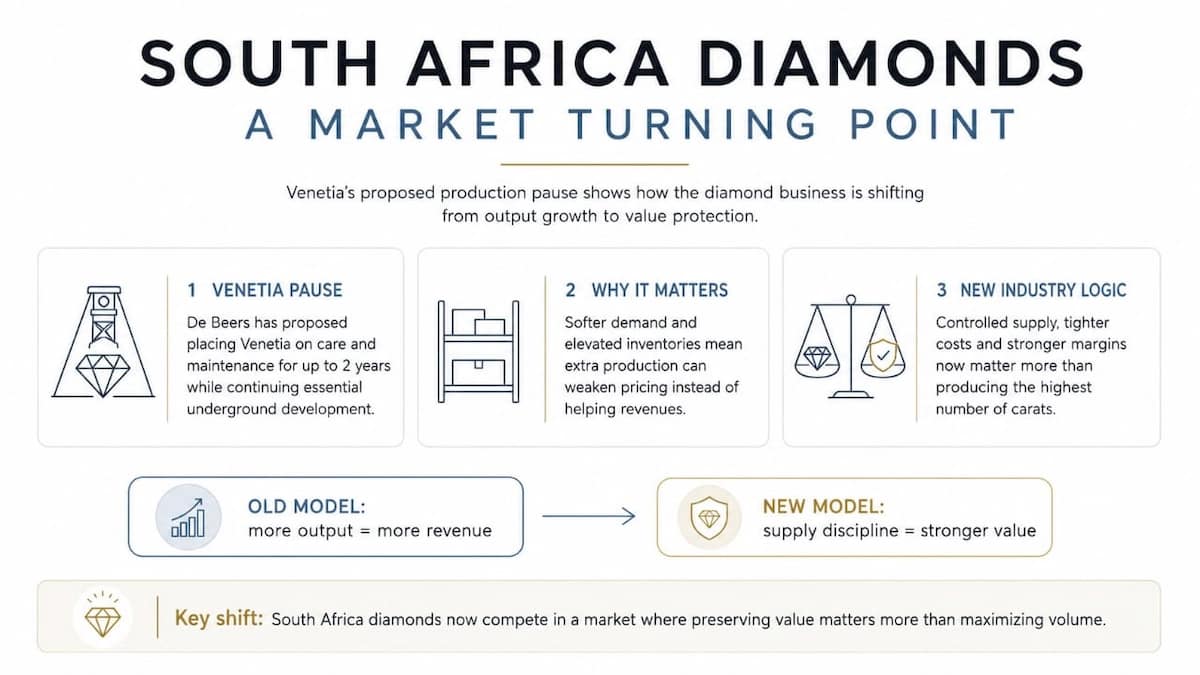
De Beers’ proposal to pause production at South Africa’s Venetia Diamond Mine reflects that wider industry adjustment rather than an isolated operational decision.
The company is responding to a market that rewards disciplined supply, tighter cost control and stronger returns on capital.
South African Diamonds now compete in an environment where preserving value has become more important than producing the highest number of carats.
Why Is Venetia Diamond Mine Halting Operations for Two Years?
Diamond producers now plan output around commercial conditions instead of treating maximum production as the default objective.
De Beers has proposed placing the Venetia Diamond Mine on care and maintenance for up to two years while continuing essential underground development and reducing operating expenditure.
The proposal follows persistent weakness in rough diamond trading, where subdued demand and high inventories have reduced the commercial value of additional production.
Venetia remains one of De Beers’ most significant long-term assets following its US$2.3 billion underground expansion, which extended the mine’s expected operating life beyond 2040.
The temporary suspension protects that investment while preventing unnecessary supply from entering a market already carrying excess inventory.
The Venetia Diamond Mine therefore demonstrates how disciplined production has become part of long-term market management rather than a response to operational failure.
How Will Global Diamond Production Change After This Shutdown?
Global Diamond Production now reflects commercial discipline rather than continuous expansion.
De Beers reduced rough diamond production substantially between 2023 and 2025, while several other major producers delayed projects, reviewed mine plans or lowered output in response to weaker trading conditions.
Production decisions increasingly follow demand trends instead of geological capacity alone.
Lower output gives manufacturers, traders and retailers more time to reduce accumulated inventories before additional rough diamonds reach the market.
Better supply discipline also limits unnecessary pricing pressure by aligning production more closely with actual demand.
Global Diamond Production therefore supports profitability and market stability instead of pursuing higher extraction volumes regardless of commercial conditions.
Why Is the Diamond Market Struggling Despite Rising Demand?
The search question reflects a common misunderstanding because demand has not strengthened uniformly across the natural diamond industry.
Jewelry sales have shown resilience in parts of the United States, particularly for higher-value stones, while demand has remained weaker in China and several other important consumer markets.
Manufacturers and wholesalers have also continued reducing inventories accumulated during previous trading cycles, limiting purchases of newly mined rough diamonds.
Laboratory-grown diamonds have intensified competition in lower-priced jewellery categories, changing buying behaviour and placing additional pressure on natural diamond pricing.
De Beers reported weaker rough diamond prices during 2025 as inventory rebalancing and changing product demand affected sales across the value chain.
The Diamond Market therefore faces pressure from uneven consumer demand, inventory adjustment and structural competition rather than a simple collapse in jewelry demand.
What Does This Mean for the Diamond Mining Industry?
Competitive advantage within the Diamond Mining Industry now depends on protecting value rather than maximizing output.
Mining companies that combine disciplined capital allocation, efficient operations and flexible production planning are better positioned to preserve margins during weaker market cycles while retaining the capacity to increase production when commercial conditions improve.
Investors increasingly assess operational resilience alongside production capacity.
Long-term leadership will favor producers capable of balancing market discipline with operational excellence.
Controlled supply cannot replace healthy consumer demand, but it can reduce unnecessary pricing pressure while protecting the value of high-quality assets.
South African Diamonds therefore illustrate how the industry’s future competitiveness will depend on efficiency, profitability and disciplined production rather than mining volume alone.


Recent Comments