

Featured Summary:
- Burkina Faso Gold sits at the centre of a broader strategy to strengthen economic sovereignty.
- Foreign mining companies now face a commercial model built around greater state participation and stricter domestic obligations.
- The reforms will succeed only if mining wealth supports industrial development, employment and productive investment.
Burkina Faso is changing one of Africa’s oldest mining relationships.
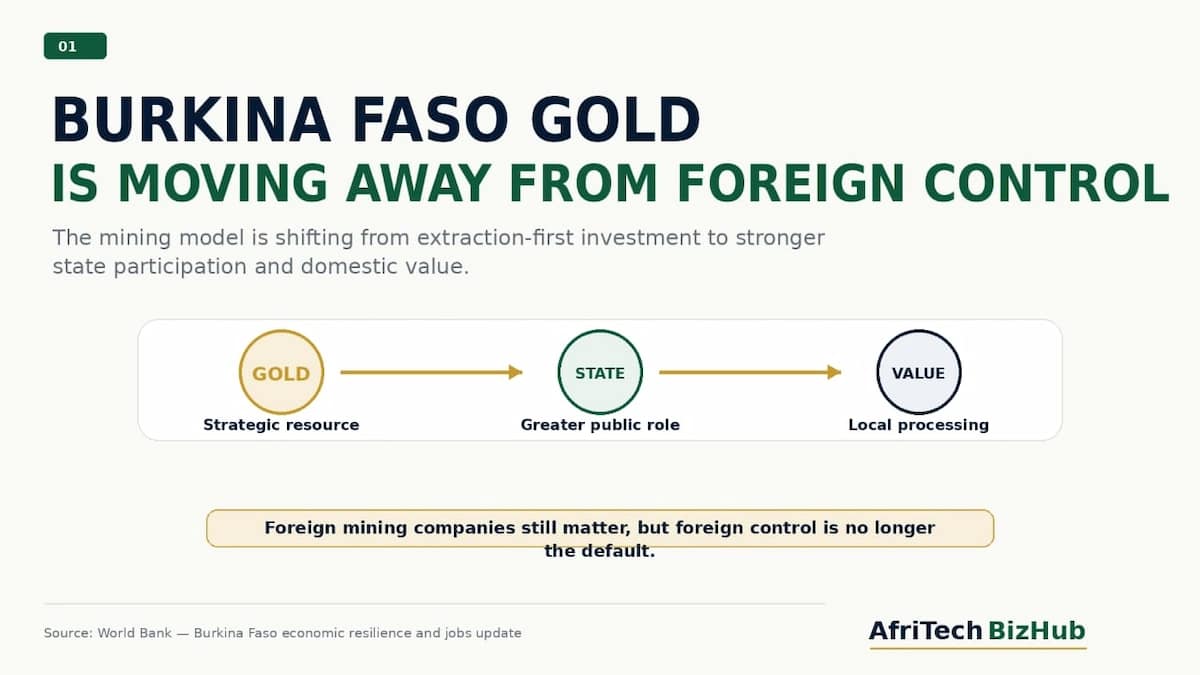
The country no longer expects foreign companies only to develop its gold resources; it demands a larger role in the ownership, management and value created from them.
New mining rules and the transfer of selected assets to a state-owned company have altered how investors approach ownership, production and long-term returns.
Burkina Faso Gold now forms part of a wider strategy covering domestic participation, refining, processing, public revenue and industrial development.
The government is testing whether stronger control over strategic resources can produce deeper economic benefits than a model centred mainly on foreign-financed extraction and mineral exports.
Why is Burkina Faso Gold Now Fully State-Controlled?
Burkina Faso Gold is not fully state-controlled, but the government has moved several strategic assets into public ownership.
Burkina Faso acquired the Boungou and Wahgnion gold mines in 2024 before transferring interests in five mining companies to the state-owned Société de Participation Minière du Burkina, known as SOPAMIB, in 2025.
The assets included companies connected to the Boungou and Wahgnion mines as well as exploration and mining-service operations, giving the state a more direct commercial position in the Gold Mining Sector.
The 2024 Mining Code reinforced this policy by raising the state’s free participation in newly permitted mining companies from 10% to 15% and creating room for further public or domestic investment.
Foreign Mining Companies still operate major Gold Mine projects across the country, but government ownership now extends beyond taxation and regulation.
Burkina Faso has introduced a model in which the state can participate as a shareholder and asset owner while retaining its authority over licences, production and mining policy.
How Does Economic Sovereignty Reshape Burkina Faso’s Mining Sector?
Economic Sovereignty changes the destination of mining income before it leaves Burkina Faso.
Greater state participation allows more dividends, procurement expenditure and commercial returns to pass through domestic institutions, while local-content requirements create additional opportunities for Burkinabè suppliers and workers.
The policy places refining, processing and mineral marketing inside the same economic strategy as extraction rather than allowing most value to accumulate after the gold has been exported.
Burkina Faso Gold can support industrial policy when mining operations purchase transport, energy, engineering, financial and technical services locally.
Domestic processing can also improve production oversight and create specialised skills, but a refinery alone cannot transform the economy.
More value remains inside Burkina Faso only when local companies can compete for mining contracts and public revenue is invested in infrastructure, electricity, education and productive industries.
Why Are Foreign Mining Companies Losing Burkina Faso Gold Projects?
Burkina Faso Gold is not fully state-controlled, but the government has moved several strategic assets into public ownership.
Burkina Faso acquired the Boungou and Wahgnion gold mines in 2024 before transferring interests in five mining companies to the state-owned Société de Participation Minière du Burkina, known as SOPAMIB, in 2025. y
The assets included companies connected to the Boungou and Wahgnion mines as well as exploration and mining-service operations, giving the state a more direct commercial position in the Gold Mining Sector.
The 2024 Mining Code reinforced this policy by raising the state’s free participation in newly permitted mining companies from 10% to 15% and creating room for further public or domestic investment.
Foreign Mining Companies still operate major Gold Mine projects across the country, but government ownership now extends beyond taxation and regulation.
Burkina Faso has introduced a model in which the state can participate as a shareholder and asset owner while retaining its authority over licences, production and mining policy.
How Does Economic Sovereignty Reshape Burkina Faso’s Mining Sector?
Economic Sovereignty changes the destination of mining income before it leaves Burkina Faso.
Greater state participation allows more dividends, procurement expenditure and commercial returns to pass through domestic institutions, while local-content requirements create additional opportunities for Burkinabè suppliers and workers.
The policy places refining, processing and mineral marketing inside the same economic strategy as extraction rather than allowing most value to accumulate after the gold has been exported.
Burkina Faso Gold can support industrial policy when mining operations purchase transport, energy, engineering, financial and technical services locally.
Domestic processing can also improve production oversight and create specialised skills, but a refinery alone cannot transform the economy.
More value remains inside Burkina Faso only when local companies can compete for mining contracts and public revenue is invested in infrastructure, electricity, education and productive industries.
Why Are Foreign Mining Companies Losing Burkina Faso Gold Projects?
Foreign Mining Companies are losing relative control because access to Burkina Faso Gold now comes with greater state participation and stronger domestic obligations.
The transfer of selected mining assets to SOPAMIB demonstrated that strategic mines can move into public ownership when their previous ownership arrangements no longer fit the government’s mining policy.
New investors must therefore evaluate projects within an operating environment where equity, procurement, processing and major commercial decisions can involve the state more directly.
These conditions alter capital allocation without removing the need for foreign investment.
Developing a Gold Mine requires substantial financing, specialised equipment, geological expertise and years of operational planning, making regulatory clarity central to expected returns.
Some companies may direct capital towards markets offering greater ownership freedom, while others may accept lower control in exchange for access to commercially valuable deposits.
Foreign participation remains important, but Foreign Control is no longer the default structure for every strategic asset.
How Will Ibrahim Traoré Boost the Burkina Faso Economy?
The economic case for Ibrahim Traoré’s mining reforms rests on whether higher production and stronger state participation produce wider domestic benefits.
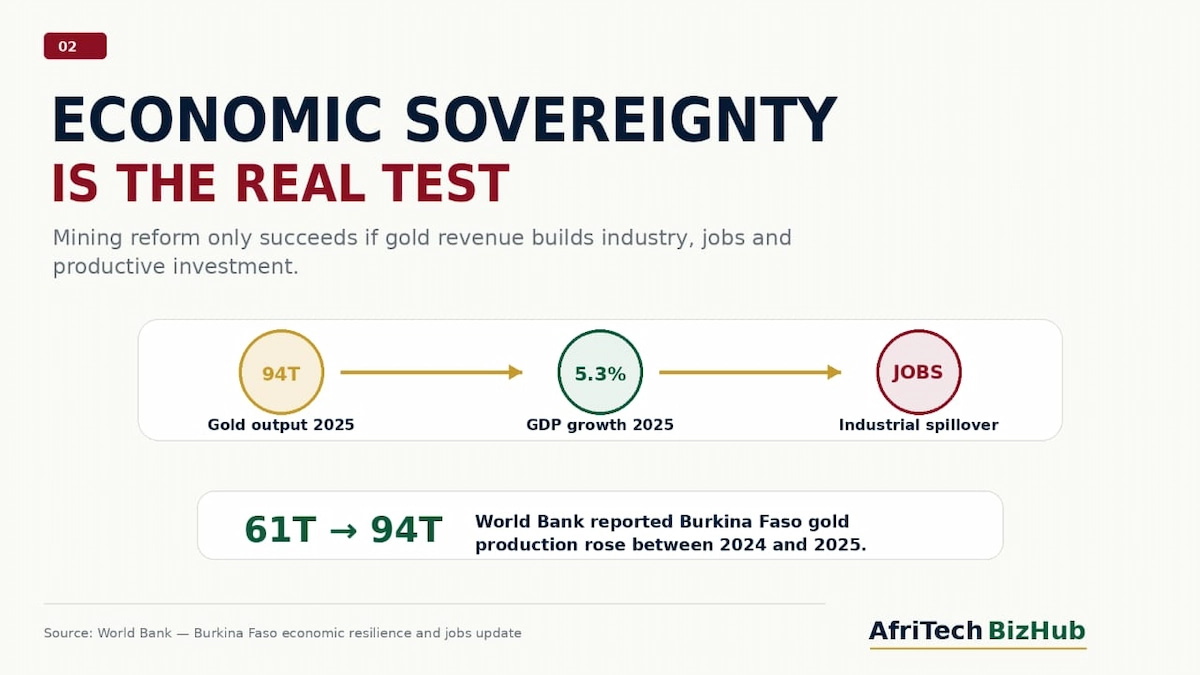
The World Bank reported that Burkina Faso’s gold production increased from 61 tonnes in 2024 to 94 tonnes in 2025, supported by the formalisation of artisanal mining and renewed production from industrial mines.
The institution also estimated that real gross domestic product growth rose from 4.8% in 2024 to 5.3% in 2025, with mining among the sectors supporting the improvement.
Higher production can strengthen public revenue, exports and domestic investment, but the Burkina Faso Economy gains more when mining income reaches sectors beyond gold.
Investment in electricity, roads, technical education, manufacturing and local supplier capacity would allow mining activity to support businesses that remain productive after individual deposits decline.
Mining reform becomes economic reform only when Burkina Faso Gold finances employment, infrastructure and industries that reduce the country’s dependence on exporting unprocessed resources.
Why Is Burkina Faso Reclaiming Its Mining Wealth?
Burkina Faso’s future gains will depend on the capabilities built around its mineral resources rather than the number of companies placed under government control.
A successful strategy would connect the Mining Sector to reliable power, transport infrastructure, domestic financing, engineering services and skilled employment.
It would also require transparent institutions capable of managing commercial assets, monitoring production and directing mining income towards long-term national investment.
Burkina Faso Gold can provide the capital needed to strengthen other areas of the economy, but resource revenue cannot replace productivity, investment discipline or effective public administration.
Economic transformation will occur when gold supports competitive agriculture, manufacturing and services instead of leaving national growth tied primarily to production volumes and international prices.
Reclaiming mining wealth will therefore be judged by whether Burkina Faso creates more economic value before its natural resources leave the country.


Recent Comments