

Featured Summary:
- Africa mining expansion is increasingly colliding with weak industrial power systems as electricity shortages, unstable grids, and rising energy costs threaten refining and long-term mineral processing
- Mining companies across Africa are increasingly financing private power systems as unreliable national grids raise operational risks and reduce industrial competitiveness
- The larger mining challenge is no longer mineral access alone. It is whether African economies can generate stable industrial-scale electricity fast enough to support processing, refining, and manufacturing
Africa’s mining challenge is increasingly becoming an industrial power-systems challenge rather than a resource-access problem.
The continent holds some of the world’s most commercially important reserves of cobalt, copper, lithium, manganese, graphite, and rare earth minerals, but refining and industrial production require stable electricity systems capable of supporting continuous industrial-scale operations.
Across several mining regions, weak grids, power shortages, unstable transmission systems, and rising industrial energy costs are beginning to collide directly with Africa’s ambitions around mineral processing, refining, and industrialization.
Why Mining Companies Across Africa Are Building Private Power Systems
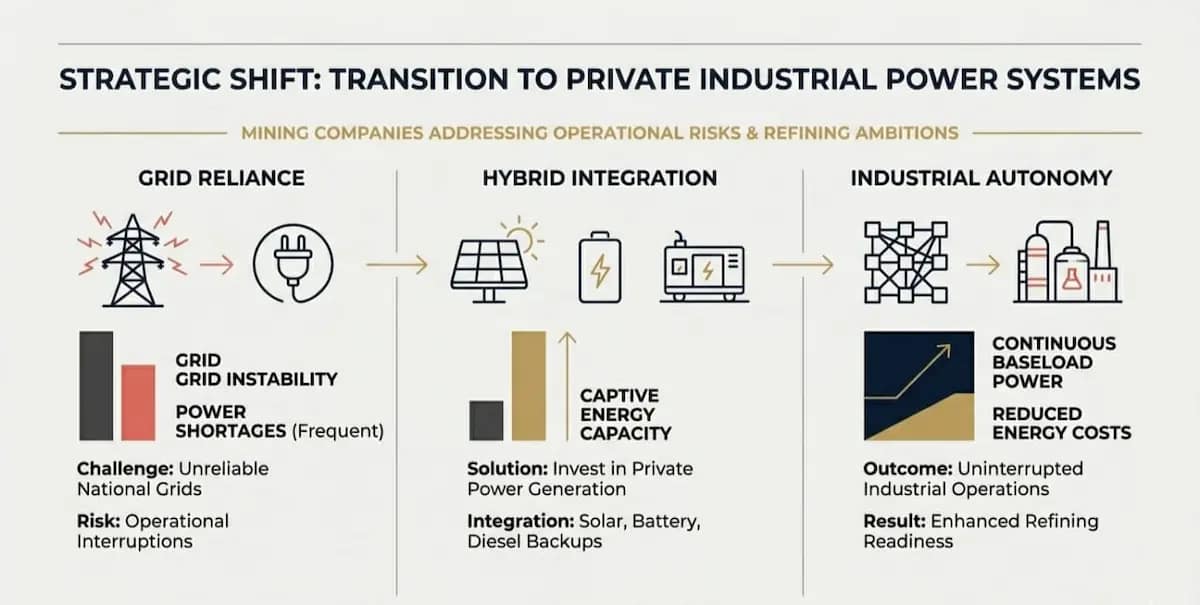
Power reliability is becoming commercially critical across Africa’s mining sector as operators attempt to protect production from unstable grids, electricity shortages, and rising industrial energy costs.
Captive-energy systems tied directly to mining operations are expanding across several mineral corridors, with companies increasingly investing in hybrid power projects combining solar generation, battery storage, diesel backup systems, and private transmission infrastructure.
The pressure is no longer centered only on electricity access.
Long-term cost stability and uninterrupted industrial operations are becoming equally important as mining companies compete globally against producers operating inside far more stable power markets such as Australia, Canada, and parts of Latin America.
Across several mining regions, operators are increasingly behaving less like traditional extraction firms and more like industrial utility developers as electricity reliability becomes directly tied to refining ambitions, operational competitiveness, and long-term mineral investment.
Why Africa’s Refining Ambitions Still Depend on Industrial Power Density
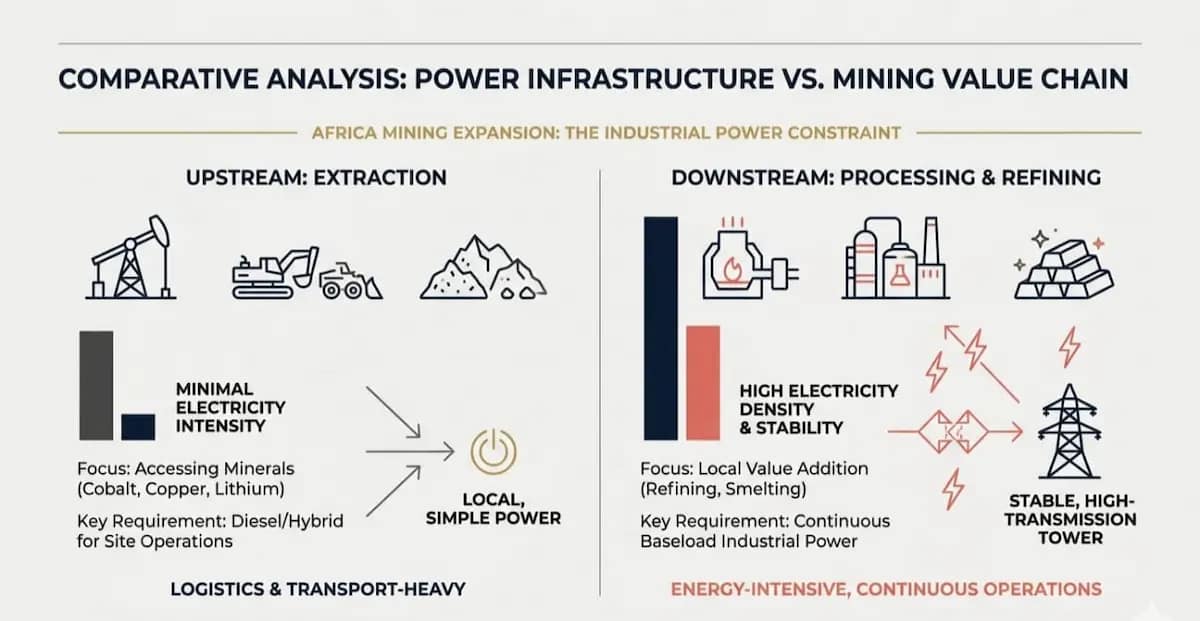
African governments increasingly want more minerals processed locally rather than exported abroad in raw form, but refining lithium, copper, cobalt, and other industrial minerals requires far larger and more stable electricity supply than extraction alone.
Smelters, refineries, and industrial processing plants operate on continuous baseload power that many national grids across Africa still struggle to provide consistently despite rising Africa mining expansion and growing pressure for local mineral processing.
This is creating growing friction between industrial policy and grid reality.
Governments continue inserting local-processing requirements into mining agreements, but industrial-scale power systems are not expanding at the same pace as refining ambitions.
Africa’s mineral-processing strategy may ultimately depend less on resource ownership and more on whether countries can generate enough electricity density to sustain uninterrupted industrial production at competitive cost.
Why Renewable Energy Corridors Are Becoming Part of Africa’s Mining Strategy
Mining corridors across Africa are increasingly being linked to renewable-energy systems, transmission infrastructure, and industrial power projects as governments and investors attempt to stabilize long-term electricity supply around mining zones.
Energy systems are becoming part of wider corridor planning tied directly to copper, cobalt, lithium, graphite, and rare-earth supply chains as Africa mining expansion places heavier pressure on industrial electricity demand.
The World Bank has repeatedly highlighted reliable electricity infrastructure as one of the biggest constraints to industrial growth and private-sector competitiveness across Sub-Saharan Africa despite the continent holding some of the world’s strongest renewable-energy potential.
Across several mining regions, renewable-energy projects are increasingly being integrated into wider industrial power systems alongside transmission expansion, hydroelectric supply, gas generation, battery storage, and backup infrastructure as operators attempt to reduce exposure to unstable public grids.
The broader shift reflects growing pressure to secure stable long-term electricity reliability around industrial mining corridors rather than depending entirely on weaker national power systems.
Why Africa Mining Expansion Is Reshaping Industrial Power Investment
Africa mining expansion is increasingly pushing mining investment beyond exploration spending alone into electricity generation, transmission systems, captive-energy infrastructure, and industrial power development.
Large mining operators now face growing pressure to finance both extraction projects and the electricity systems needed to keep operations commercially viable as mining electricity shortages and unstable grids continue affecting industrial reliability across several mineral-producing regions.
This is quietly raising the barrier to entry across parts of Africa’s mining sector.
Smaller and mid-sized operators often lack the balance-sheet strength required to build large-scale power infrastructure alongside extraction projects, while larger mining firms are becoming better positioned to control long-term industrial expansion through captive power systems and integrated energy investment.
Africa’s industrial mining future is increasingly favoring operators capable of financing reliable industrial-scale electricity systems at the same scale as mineral development itself.


Recent Comments