


Featured Summary:
- Africa mining infrastructure remains weaker than the scale of mineral demand now building around global EV and industrial supply chains
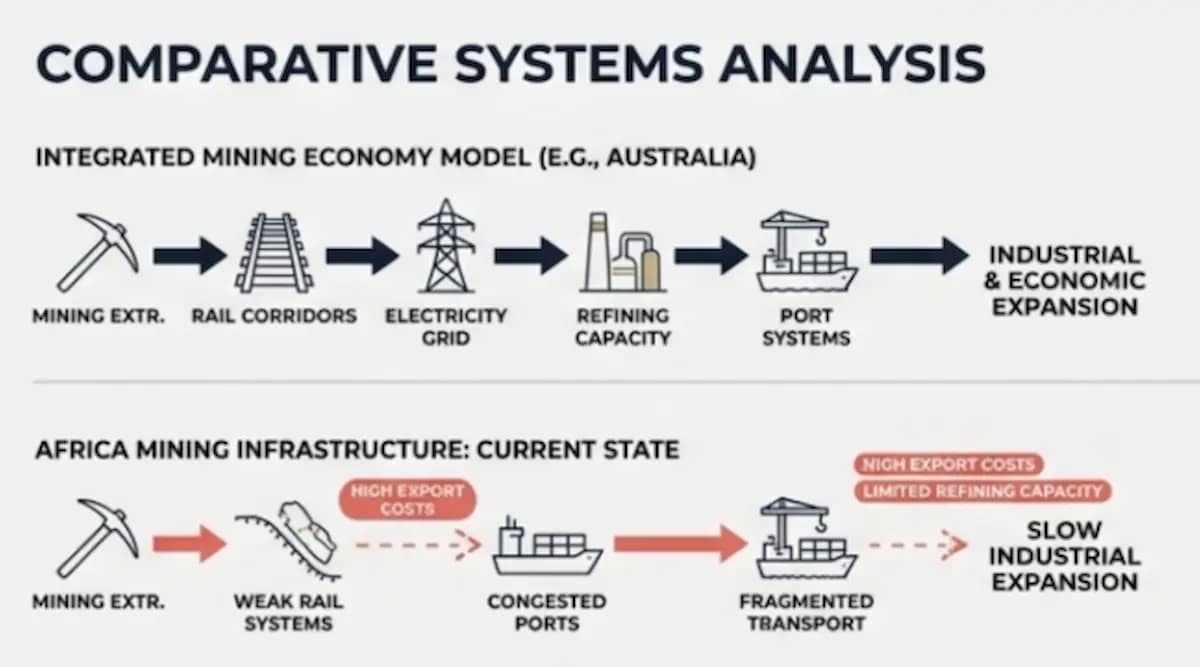
- Australia’s mining industry operates through more integrated rail, port, and export systems than many African mining economies
- Africa’s mineral wealth may deliver less long-term value without faster expansion of rail corridors, ports, electricity systems, and industrial infrastructure
Africa mining infrastructure is becoming one of the biggest constraints on the continent’s ability to convert critical mineral demand into long-term industrial power as global competition around cobalt, lithium, copper, and rare earth supply chains accelerates.
Rail bottlenecks, weak port systems, limited refining capacity, and underdeveloped logistics networks continue raising export costs and slowing industrial expansion across many African mining economies despite the scale of mineral reserves sitting beneath the continent.
Major mining economies such as Australia built integrated rail corridors, export terminals, electricity systems, and industrial infrastructure around mining decades before supply-chain competition intensified.
Across much of Africa, mineral extraction is still expanding faster than the infrastructure required to fully industrialize it.
Why Africa Mining Infrastructure Is Becoming Strategically Important
Critical minerals alone may not determine which African economies benefit most from the global EV and industrial transition as infrastructure increasingly becomes the system deciding refining capacity, export economics, and long-term industrial competitiveness.
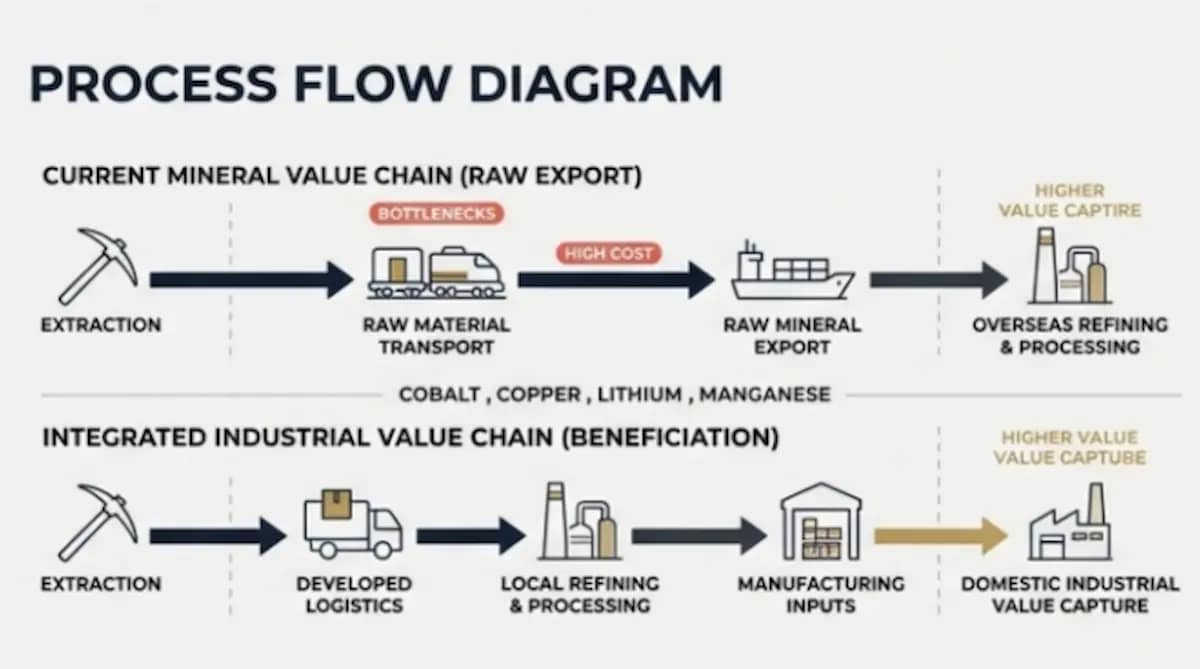
The pressure building around Africa’s mineral economy mirrors the structural imbalance that shaped parts of the continent’s crude oil era for decades, where countries exported raw resources while much of the refining and industrial value remained outside the continent.
Much of Africa’s cobalt, lithium, copper, manganese, and other strategic minerals still leave the continent for refining and industrial processing abroad rather than moving through integrated manufacturing systems closer to extraction zones.
As global competition around EV batteries, AI infrastructure, and energy-transition supply chains accelerates, the countries capable of combining mining activity with rail systems, ports, electricity infrastructure, refining capacity, and industrial coordination may ultimately capture far more long-term value from the minerals boom.
How Weak Rail and Port Systems Are Limiting Africa’s Mineral Expansion
Africa’s mineral expansion is increasingly being slowed by outdated rail systems, congested ports, delayed shipments, and high transport costs across several mining economies.
Many mining regions across Central and Southern Africa still struggle to move large mineral volumes efficiently despite rising global demand for cobalt, copper, lithium, and manganese linked to EV and industrial supply chains.
Across parts of Africa, rail modernization and port expansion still depend heavily on foreign-backed financing and externally driven corridor projects tied to mineral exports.
Mining corridors are expanding, but logistics systems across several African economies still operate below the scale and speed required to support globally competitive mineral industries.
The operational gap is becoming increasingly visible in shipment delays, export inefficiencies, and the continent’s continued dependence on external transport and refining systems.
Why Australia’s Mining Industry Operates Differently From Africa’s
Australia built modern rail corridors, export terminals, electricity systems, and mining logistics networks around its mineral industry decades before global demand for critical minerals accelerated.
That infrastructure allows mining companies to move large mineral volumes faster, lower export costs, and maintain stronger competitiveness across global supply chains while supporting wider industrial and economic expansion around the sector.
Across much of Africa, mining activity still operates through weaker rail systems, fragmented transport corridors, slower export networks, and underdeveloped logistics infrastructure despite the continent’s large mineral reserves.
Many mining corridors across Africa are still expanding mainly through foreign-backed infrastructure projects tied directly to extraction and export activity rather than broader industrial development across entire mining economies.
The difference is increasingly becoming visible in export efficiency, industrial scale, and how much long-term value mining sectors contribute to national economies.
How China, the U.S., and Gulf Investors Are Expanding Mining Corridors Across Africa
Africa mining infrastructure is increasingly becoming part of a wider geopolitical competition as China, the United States, European partners, and Gulf-backed investors expand financing around rail corridors, ports, and mineral export systems tied to cobalt, copper, lithium, and manganese supply chains.
The Lobito Corridor has emerged as one of Central Africa’s most strategically important infrastructure projects, linking mining regions in the DRC and Zambia to Angola’s Atlantic coast as global competition around EV batteries and industrial minerals accelerates.
The G7 stated in 2025 that the Partnership for Global Infrastructure and Investment would continue expanding infrastructure investment across Africa, including economic corridors such as the Lobito Corridor in Southern and Central Africa.
The corridor expansion shows how rail systems, logistics infrastructure, and export routes across Central Africa are increasingly becoming tied to geopolitical competition, trade influence, and long-term supply-chain positioning as global powers compete for faster access to strategic minerals.
Can Africa Mining Infrastructure Expand Fast Enough to Keep More Mineral Value?
Mineral wealth will not decide Africa’s position in the next industrial cycle. Execution will.
The continent can still build the rail systems, ports, electricity networks, refining plants, and logistics corridors needed to capture more value from critical minerals, but high financing costs and weak infrastructure delivery remain major constraints.
At the Africa Forward Summit, leaders pushed back against risk pricing that continues raising the cost of infrastructure capital across the continent, but financing alone may not solve the infrastructure gap without faster delivery and industrial coordination.
The deeper challenge is whether African governments can use foreign capital without allowing external systems to capture most of the long-term industrial value again.
Mining corridors are expanding, but industrial coordination across the continent still remains uneven.
Mineral ownership alone will not determine the winners of the next industrial cycle. Infrastructure will.


Recent Comments